Loading...

Starting a narrative essay in an American college classroom can feel like stepping into unfamiliar territory, especially with myths about writing swirling around. Many students worry their first draft must be perfect or that personal stories lack academic value, which can lead to frustration and writer’s block. Recognizing that narrative writing is a journey of discovery, not instant perfection, offers freedom to explore ideas openly while using AI for support in organization and authenticity.
| Point | Details |
|---|---|
| Understanding Narrative Writing | Narrative essays require strategic organization and reflection beyond merely recounting events. They transform personal experiences into intellectual insights. |
| Common Myths | Misconceptions about narrative writing, such as needing a perfect first draft, create unnecessary anxiety for students. Recognizing the iterative nature of writing is crucial. |
| Types of Academic Narratives | Different narrative essay types serve distinct academic purposes, emphasizing personal growth, reflection, and cultural perspectives. |
| Improving Writing Quality | Students should focus on mastering grammatical rules, developing a consistent style, and engaging in systematic proofreading to enhance clarity in their writing. |
Written narratives are more complex than most students initially understand. A narrative essay represents a personal storytelling approach that goes far beyond simple recounting of events, requiring strategic organization, reflection, and thoughtful communication of experiences.
Common myths about narrative writing often mislead students and create unnecessary anxiety. Here are some key misconceptions students frequently encounter:
In reality, writing myths often misrepresent the creative process. Writing is inherently recursive - a journey of discovery where ideas evolve through drafting and revision. Effective narrative writing involves embracing uncertainty and allowing your narrative to develop organically.
Successful narrative essays require strategic approaches that go beyond linear thinking. Writers must understand that drafting is an exploratory process where initial thoughts transform through careful reflection and editing. This means being open to restructuring your narrative, cutting unnecessary details, and refining your core message.
Key strategies for crafting compelling narratives include:
Narrative writing is not about perfection, but authentic communication. The most powerful stories emerge when writers are willing to be vulnerable, reflective, and genuine in sharing their experiences.
Pro tip: Keep a journal or draft document where you can freely explore your narrative ideas without judgment, allowing your story to develop naturally and authentically.
Academic narrative essays represent a unique genre of writing that goes beyond simple storytelling, requiring students to craft meaningful, structured experiences that communicate deeper insights. Academic essay genres include several narrative approaches designed to engage readers through personal and reflective storytelling.
The primary types of academic narrative essays include:
Each narrative type serves a distinct purpose in academic writing. Personal experience narratives, for instance, allow students to demonstrate critical thinking by connecting individual experiences to broader academic concepts. These essays require more than simply recounting events - they demand analytical depth and meaningful interpretation.
Here's a comparison of academic narrative essay types and their primary academic purpose:
| Narrative Type | Academic Purpose | Typical Audience |
|---|---|---|
| Personal Experience | Demonstrates personal growth | Instructors, peers |
| Reflective | Connects experience to broader topics | Scholars, educators |
| Descriptive | Engages through vivid detail | General readers |
| Biographical | Highlights notable individuals | Historians, researchers |
| Cultural | Explores societal perspectives | Sociologists, diverse groups |
Successful narrative essays typically incorporate several key structural elements:
Narrative writing is an art of transformation. It transforms personal experiences into scholarly insights, allowing writers to demonstrate academic skills while maintaining authentic storytelling.
Pro tip: Select narrative topics that genuinely resonate with your personal experiences and offer opportunities for meaningful academic analysis.
Narrative essays are sophisticated compositions that require careful attention to fundamental storytelling elements. Understanding the core characteristics of voice, plot, and structure transforms a simple story into a compelling academic narrative.
The key components of narrative writing include:
Narrative voice represents the writer's distinctive communication style. It goes beyond mere description, revealing personality, perspective, and emotional depth. A strong voice allows readers to connect intimately with the writer's experience, making the narrative more engaging and authentic.
Plot and structure work together to create meaningful narrative progression. Successful narrative essays typically follow a strategic framework:
Narrative writing transforms personal experiences into intellectual insights. The most powerful essays reveal deeper truths through carefully crafted storytelling.

Pro tip: Practice developing your narrative voice by writing regularly and exploring different perspectives in your personal reflections.
AI technologies are revolutionizing academic writing by offering sophisticated support for narrative development. Generative AI tools transform academic writing through intelligent assistance in idea generation, organization, and refinement.
The key ways AI enhances narrative originality include:
AI tools do more than simply correct grammar or suggest edits. They act as intelligent writing companions, helping students develop more nuanced, sophisticated narratives by providing real-time feedback and creative suggestions. These technologies analyze writing patterns, identify potential areas of improvement, and offer contextually relevant recommendations that preserve the writer's unique voice.
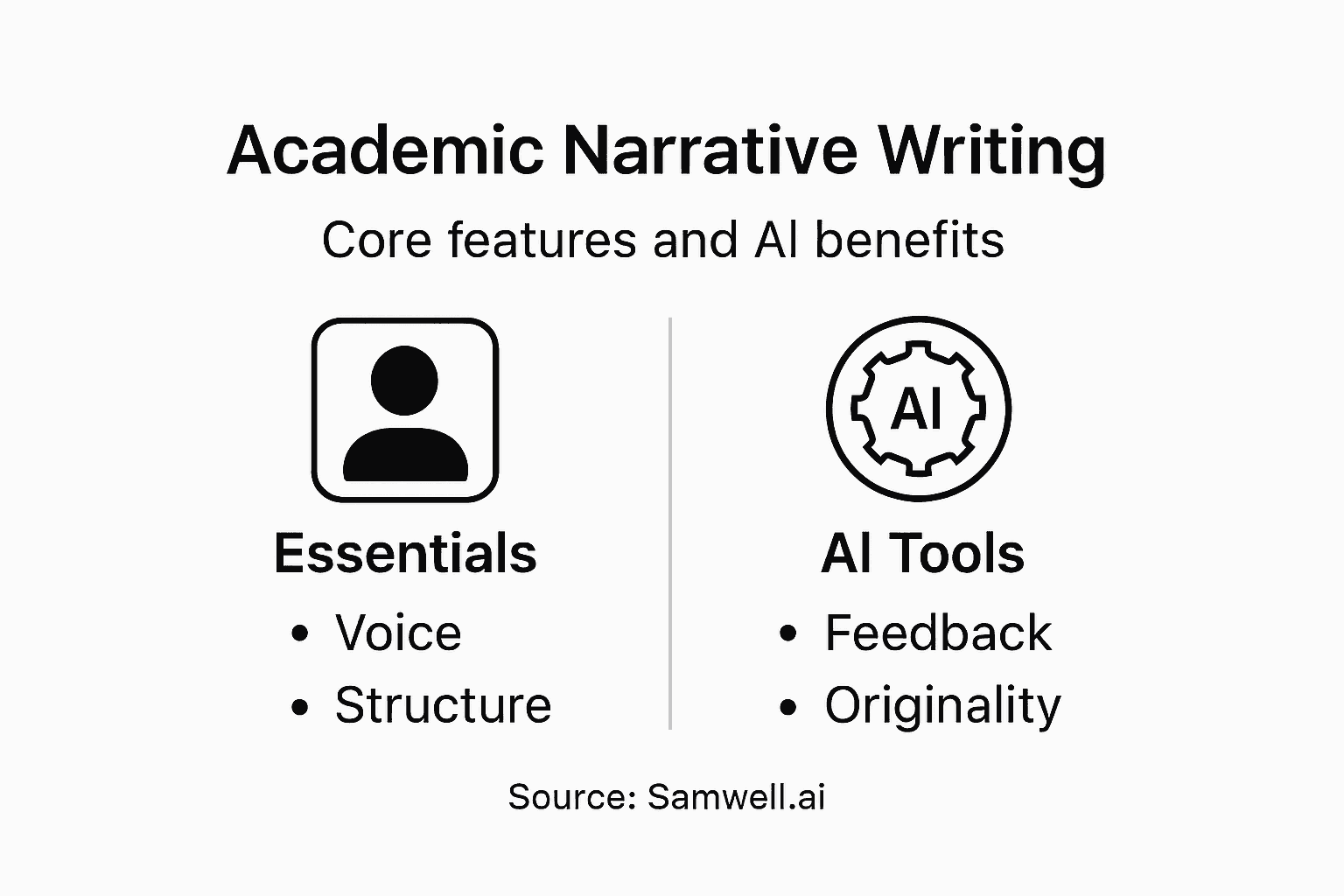
For quick reference, here's how AI tools contribute to narrative writing development:
| AI Capability | Benefit for Writers | Example Use |
|---|---|---|
| Idea Expansion | Stimulates creative thinking | Suggests new angles |
| Structure Optimization | Enhances organization | Reorders story sections |
| Language Enhancement | Improves clarity and style | Refines word choice |
| Plagiarism Prevention | Ensures originality | Flags copied phrases |
| Personalized Support | Adapts to writer’s process | Offers tailored suggestions |
The most effective AI writing tools follow a collaborative approach:
Narrative originality emerges from the dynamic interaction between human creativity and technological insight. AI serves as a catalyst, not a replacement, for authentic academic expression.
Pro tip: Use AI tools as collaborative partners, not substitutes for your own critical thinking and creative process.
Academic writing demands precision and clarity, yet students often struggle with common linguistic pitfalls that undermine their work. Common student writing errors can significantly impact communication and academic performance.
The most frequent mistakes in student writing include:
Grammatical errors can transform an otherwise thoughtful piece of writing into a confusing mess. Students frequently struggle with complex sentence structures, often creating long, meandering sentences that obscure their core message. Proper editing requires careful attention to sentence construction, ensuring each sentence communicates a clear and precise thought.
To improve writing quality, students should focus on these critical areas:
Writing is a skill that improves with intentional practice and self-reflection. The most successful students view their writing as a continuous process of refinement.
Pro tip: Read your work aloud to identify awkward phrasings and grammatical inconsistencies that might slip past silent review.
Struggling to craft authentic and impactful written narratives while avoiding common pitfalls like vague language or structural confusion Many students find it challenging to transform personal stories into polished academic essays with clear voice and purpose. This article highlights how embracing a strategic writing process and refining your narrative through reflection and editing can unlock academic success. Now imagine having a cutting-edge platform that guides you through this process by expanding ideas, optimizing structure, and ensuring originality.
Experience how Samwell.ai supports your writing journey by combining intelligent AI assistance with tools like our 'Power Editor' for focused revisions and 'Guided Essays' to build strong outlines reflecting your unique voice. Whether you need help overcoming writing myths or avoiding frequent grammar errors Samwell.ai empowers you to produce compelling narrative essays that resonate with instructors and peers alike. Don't wait to elevate your academic storytelling Visit Samwell.ai today and start transforming your personal experiences into scholarly insights that stand out.
A narrative essay is a personal storytelling approach that requires strategic organization, reflection, and thoughtful communication of experiences rather than just recounting events.
Common myths include the belief that narratives must be perfect on the first draft, that personal stories are unprofessional, and that there's only one correct way to structure a narrative.
Improving narrative writing skills involves understanding key elements like voice, plot, and structure, and practicing by writing regularly and reflecting on personal experiences.
Types of academic narrative essays include personal experience narratives, reflective narratives, descriptive narratives, biographical narratives, and cultural narratives, each serving a distinct purpose in showcasing deeper insights.