Loading...

Staring at a blank screen while drafting the why major essay is a familiar frustration for many students. This prompt pushes you to reveal your true academic motivation and connect personal stories to your chosen field. Colleges like Yale and Purdue expect concise, thoughtful responses that showcase your fit and passion. Discover how powerful storytelling and academic motivation and career alignment can strengthen your essay, plus see how AI tools make originality and clarity easier than ever.
| Point | Details |
|---|---|
| Importance of Authenticity | Craft essays that reflect genuine passion and personal narratives; avoid clichés and superficial content. |
| Connection to Academic Goals | Link personal experiences to academic ambitions to create a compelling narrative about your journey. |
| Research Requirements | Customize your essay by researching each college's specific programs and prompts to demonstrate thoughtful alignment. |
| Utilizing AI Tools | Use AI responsibly for initial drafts and grammar checks, but ensure your unique voice remains evident in the final essay. |
The why major essay is a critical supplemental application component that allows college admissions officers to understand your academic motivations and professional aspirations. This specialized essay prompt requires students to articulate their genuine interest in a specific academic discipline, demonstrating both intellectual passion and strategic planning for their future career path.
College admissions teams use this essay to evaluate several key aspects of your application:
Academic motivation and career alignment drive the core purpose of this essay. Colleges want to understand not just what major you plan to pursue, but why you are genuinely passionate about that specific field of study. This means going beyond surface-level statements and providing meaningful insights into your academic journey.
Typically, the why major essay prompt will ask you to explain your academic interests through three primary lenses:
The most compelling why major essays demonstrate a clear, authentic connection between personal passion and academic ambition.
Specific details matter. Admissions officers appreciate essays that showcase research into the college's specific programs, faculty, and resources. Your essay should reveal how the institution's unique offerings align perfectly with your academic and professional goals.
Pro tip: Avoid generic statements and instead focus on sharing specific, personal stories that illustrate your genuine commitment to your chosen field of study.
College why major essay requirements demonstrate significant variation across different institutions. Specific requirements differ dramatically based on individual college policies, academic departments, and institutional priorities.
The key variations include:
Some colleges design highly specialized prompts that require deep institutional research. For instance, engineering programs might request technical background information, while liberal arts colleges could emphasize intellectual curiosity and interdisciplinary thinking.

Here is a quick comparison of common why major essay prompt types across colleges:
| Essay Type | Word Count Range | Typical Focus | Level of Institutional Research Required |
|---|---|---|---|
| Motivational (Basic) | 200-250 words | General interest | Minimal |
| Academic Exploration (Detailed) | 350-500 words | Field depth, fit | Moderate |
| Discipline-Specific (Technical) | 300-500 words | Technical background | High |
| Integrated Personal-Academic | 400-500 words | Story + career goals | High |
Prompt complexity levels vary widely across institutions:
Not all colleges require a why major essay, but many view it as a critical component of understanding student motivation.
College essay requirements often include nuanced expectations that go beyond simple explanations. Top-tier universities typically want comprehensive narratives that demonstrate:
Pro tip: Research each college's specific essay requirements meticulously and customize your approach for each application to maximize your chances of success.
College admissions teams seek far more than a simple explanation of academic interests in the why major essay. Demonstrating academic passion requires a nuanced and strategic approach that goes beyond surface-level statements.
The critical elements colleges evaluate include:
Admissions officers are searching for essays that reveal a student's unique academic narrative. They want to understand not just why you want to pursue a specific major, but how your personal experiences, intellectual discoveries, and future aspirations intersect with that academic path.
Compelling essays typically showcase:
A truly exceptional why major essay transforms a simple application document into a powerful personal narrative.
Top institutions want more than generic statements. They seek evidence of intellectual engagement that demonstrates:
Pro tip: Craft your essay as a narrative journey that reveals your intellectual growth, showing not just what you want to study, but why you are uniquely positioned to excel in your chosen field.
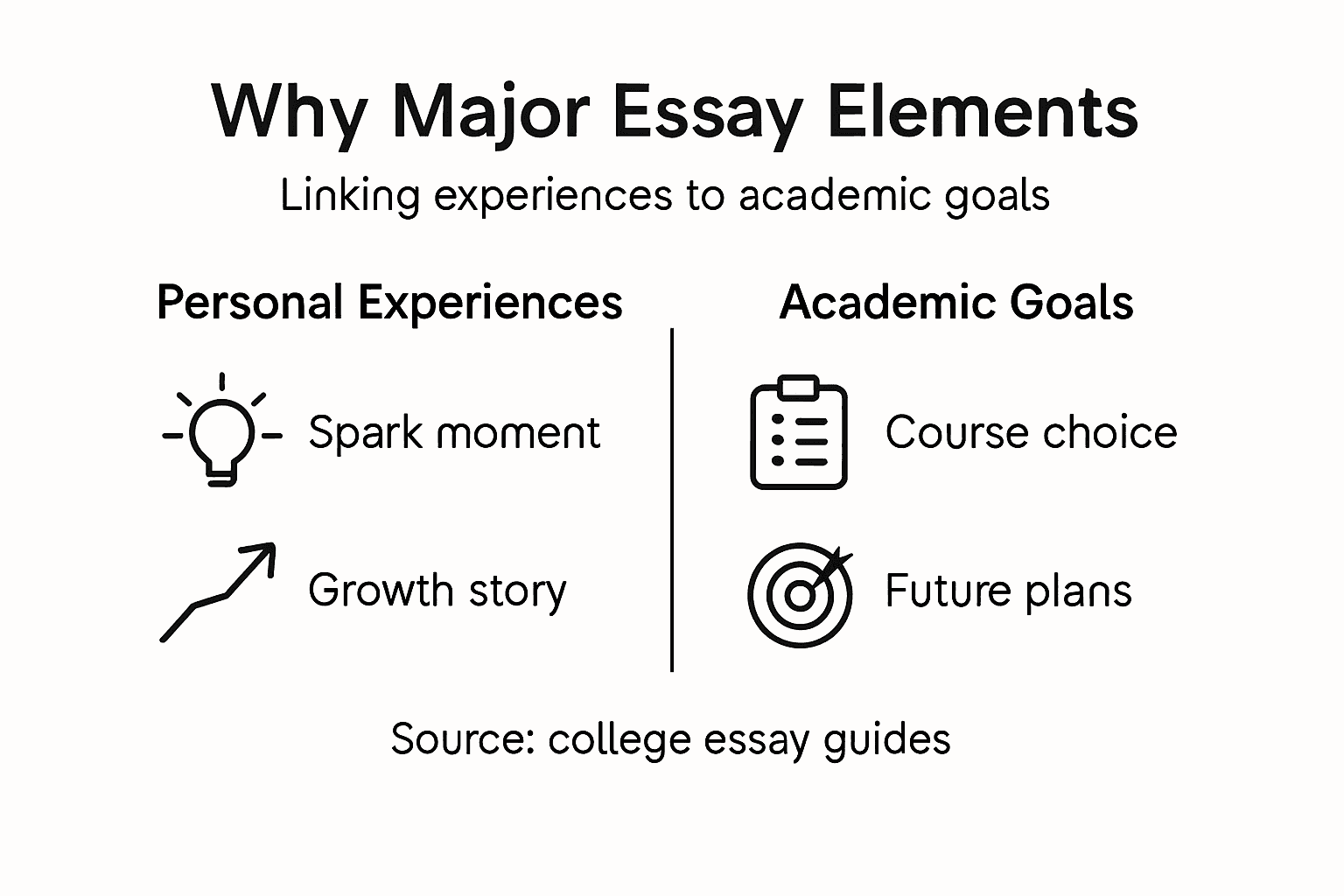
Successful why major essays transform personal narratives into powerful academic statements. Academic writing requires authentic storytelling that reveals genuine intellectual passion and strategic career thinking.
The most compelling personal experiences connect to academic goals through:
Strategic narrative development involves crafting a coherent story that demonstrates how past experiences directly inform future academic ambitions. Admissions officers want to see a logical progression from personal discovery to academic commitment.
Effective connection strategies include:
Personal experiences are the bridge between curiosity and academic commitment.
Admissions teams seek essays that reveal deeper insights about the student's intellectual journey. Specific academic goals should demonstrate:
The following table summarizes strategies for connecting personal experience to academic ambitions:
| Connection Strategy | Purpose | Example of Implementation |
|---|---|---|
| Reflect on Key Experiences | Reveal authentic motivation | Discuss a formative research trip |
| Link to Academic Goals | Show future orientation | Explain a research project impact |
| Mention Institutional Fit | Demonstrate specific alignment | Reference unique college program |
| Describe Skill Progression | Highlight growth and potential | Chronicle project milestones |
Pro tip: Treat your essay as a narrative documentary of your intellectual evolution, showing how personal experiences have systematically guided you toward your academic destination.
Crafting a compelling why major essay requires avoiding critical pitfalls that can undermine your application. College essay mistakes often stem from a lack of authenticity and strategic storytelling.
The most prevalent errors students make include:
Writing inauthentically represents the most significant mistake in why major essays. Admissions officers can quickly detect when students are not being genuine about their academic passions and motivations.
Major red flags in essay writing:
An exceptional essay reveals the student's unique voice and intellectual journey.
Some students fall into the trap of writing off-topic or superficial content. The most effective essays demonstrate:
Pro tip: Draft multiple versions of your essay and seek honest feedback from teachers or mentors who can help you identify and eliminate potential weaknesses.
AI technology offers sophisticated strategies for improving academic writing while maintaining strict originality standards. AI writing assistance transforms academic approaches by providing targeted support for multilingual and emerging academic writers.
Key benefits of responsible AI tool usage include:
Ethical AI implementation requires understanding the delicate balance between technological assistance and personal creativity. Students must view AI tools as collaborative partners rather than replacement writers.
Effective AI writing strategies:
AI tools should augment human creativity, not replace independent thinking.
Academic writing technologies provide nuanced support that goes beyond simple editing. Successful implementation requires:
Pro tip: Always review and personalize AI-generated content, ensuring your unique voice remains the primary narrative driver.
Writing a compelling why major essay demands more than just passion. You need a clear narrative that connects your personal experiences to your academic goals while demonstrating genuine intellectual curiosity and alignment with your chosen institution. The challenge lies in articulating these complex ideas authentically and strategically without falling into clichés or generic statements. This is where AI-powered tools can be a game changer.
Unlock your essay’s full potential with Samwell.ai, an advanced AI-driven platform designed to help students create high-quality, original academic essays tailored to their unique stories. Utilize features like the 'Power Editor' for content refinement, 'Guided Essays' for structured outlines, and plagiarism reduction powered by Semihuman.ai technology. Start crafting a personalized why major essay that stands out to admissions officers today. Don’t miss the chance to blend intellectual passion with AI-enhanced precision. Visit Samwell.ai now and take the next step toward your academic future.
A why major essay is a supplemental application component where students explain their interest in a specific academic discipline. It is important because it allows admissions officers to assess the student's motivations and fit for the college's programs.
You can connect personal experiences to academic goals by identifying transformative moments that sparked your interest, discussing challenges you've overcome, and demonstrating how these experiences shape your future career aspirations.
Common mistakes include writing generic narratives, failing to provide personal insights, ignoring the specific essay prompt, and using inappropriate tones. It's crucial to be authentic and reflective in your writing.
AI tools can assist by providing grammar corrections, vocabulary suggestions, and structural recommendations. However, it's essential to maintain your unique voice and ensure that the content remains original and authentic.