Loading...

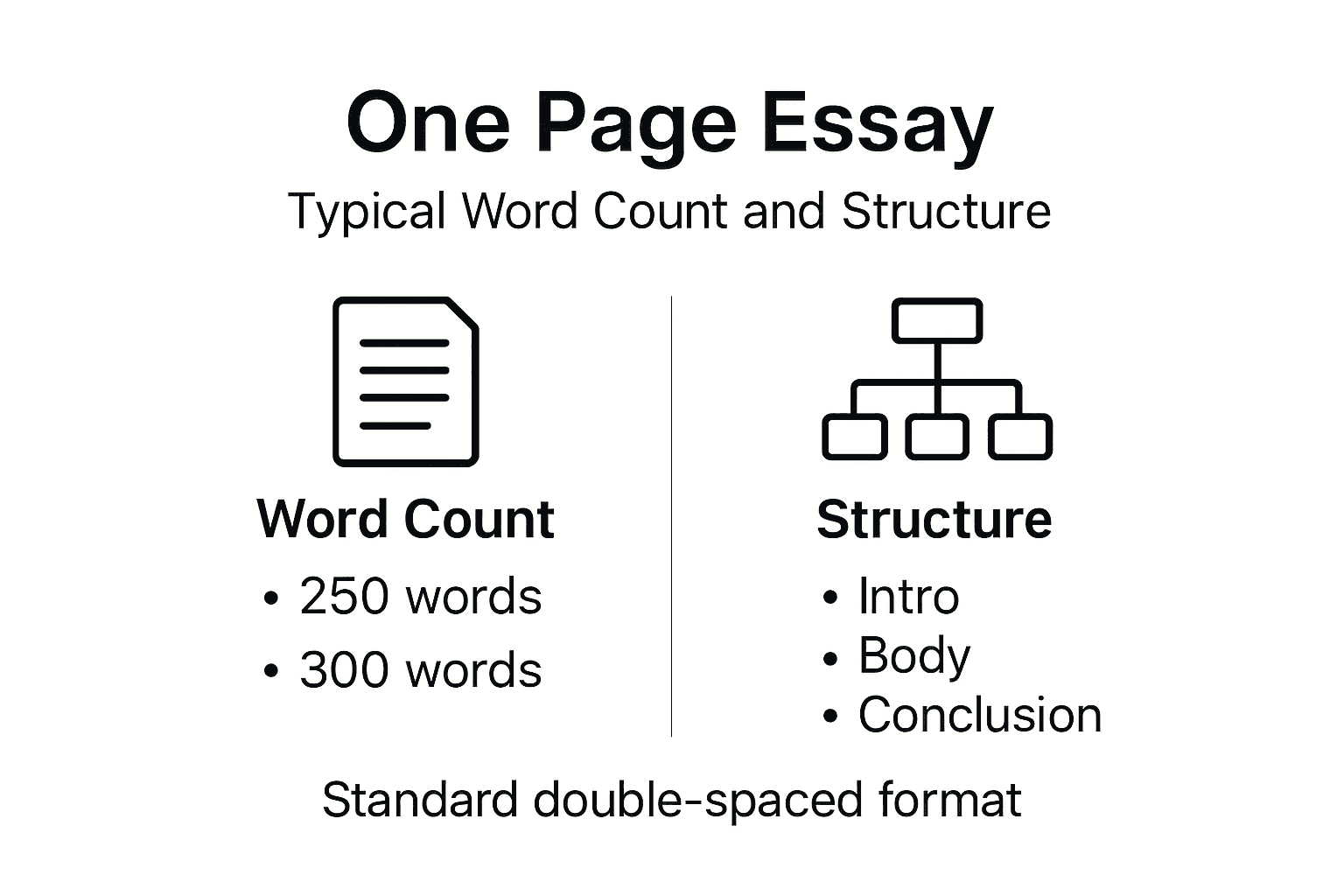
Staring at a blank page and worrying about how many words fit into a one page essay is a common struggle for college students everywhere. When strict assignment guidelines and word limits loom, finding the right balance between quality and requirements can feel stressful. By understanding that a standard academic page with 12-point Times New Roman font, double-spacing, and one-inch margins fits about 250 to 300 words per page, you gain clear direction for your next assignment.
| Point | Details |
|---|---|
| One Page Essay Structure | A one page essay should consist of an Introduction, Body Paragraphs, and a Conclusion. Effective organization is crucial for conciseness and clarity. |
| Formatting Requirements | Standard specifications include 12-point Times New Roman font, one-inch margins, and double-spacing, yielding approximately 250-300 words per page. |
| Quality Over Quantity | Focus on developing strong arguments rather than merely increasing page length; concise writing that addresses the topic is valued more highly. |
| Strategies for Meeting Word Counts | Utilize specific examples and analytical commentary to enhance arguments while maintaining clarity, avoiding unnecessary verbiage. |
A one page essay represents a concise academic writing format that demands precise organization and strategic content development. Unlike lengthier academic papers, this compact format requires writers to communicate their ideas efficiently within limited space. Standard academic formatting guidelines establish critical parameters for creating an effective one page essay.
The fundamental structure of a one page essay typically includes three core components:
To maximize the limited word count, students must prioritize clarity and concision. The standard essay format recommends using specific technical specifications that impact overall word count and readability:
These formatting requirements generally translate to approximately 250-300 words per page, making strategic word choice paramount. Writers must craft each sentence to carry maximum informational weight without unnecessary elaboration.
Pro Tip: Practice condensing complex ideas into fewer, more impactful sentences by eliminating redundant language and focusing on precise academic communication.
Formatting choices play a critical role in determining the actual number of words that fit on a single page of an academic essay. Specific formatting guidelines directly influence the page's word density and overall document appearance.
The key formatting elements that impact word count include:
Understanding these technical specifications helps students strategically manage their essay's word distribution. Document formatting techniques not only impact word count but also improve overall readability.
A standard academic page using 12-point Times New Roman font with double-spacing and one-inch margins typically accommodates approximately 250 words. This means students must be extremely precise in their language, choosing each word carefully to maximize the limited space available.

Additionally, formatting influences visual perception. By using strategic techniques like headings, bullet points, and consistent spacing, writers can make their essays appear more organized and potentially reduce the perceived density of text.
Here's how common formatting choices affect essay length and readability:
| Formatting Choice | Impact on Word Count | Impact on Readability | Typical Use |
|---|---|---|---|
| Font Size (12 pt) | Moderate word count | Easy to read, professional | Academic essays |
| Margin Width (1") | Limits text space | Balanced, visually appealing | Most assignments |
| Double-Spacing | Reduces word count | Improves clarity and spacing | Standard in school |
| Font (Times NR) | Average density | Universally accepted style | College submissions |
Pro Tip: Experiment with different font sizes and styles during drafting to understand how formatting directly affects your essay's word count and visual presentation.
Understanding academic standards is crucial for successfully completing essay assignments across various educational institutions. Specific formatting guidelines establish critical parameters that students must follow to ensure their work meets institutional expectations.
Typical academic assignment requirements often include:
Most institutions have rigorous academic submission standards that go beyond simple formatting. These guidelines ensure fairness in evaluation, maintain academic integrity, and provide a consistent framework for assessing student work.
Professors typically enforce these requirements strictly. Failing to meet formatting or submission guidelines can result in grade penalties, ranging from point deductions to potential assignment rejection. This means students must pay meticulous attention to every detail, from margin width to citation style.
Pro Tip: Create a personal checklist of formatting requirements for each assignment, reviewing it carefully before submission to avoid unnecessary grade reductions.
Many students harbor misunderstandings about essay length and quality that can significantly impact their academic writing. Academic writing myths often lead to counterproductive writing strategies that compromise the fundamental purpose of academic assignments.
Common misconceptions about page length include:
Effective academic writing demands substance over arbitrary length. Professors and academic evaluators prioritize clear argumentation, critical thinking, and coherent development of ideas over mere word count or page length.
Students often mistakenly believe that padding their essays with verbose language or redundant information will improve their grades. In reality, concise, well-structured writing that directly addresses the assignment's requirements is far more impressive and demonstrates genuine understanding.
Compare the effects of focusing on quality versus quantity in academic writing:
| Focus Area | Outcome | Academic Impression | Risk |
|---|---|---|---|
| Quality (Clarity) | Strong argument | Demonstrates critical thinking | May seem brief |
| Quantity (Length) | Excessive padding | Shows lack of focus | Lowers credibility |
Pro Tip: Focus on developing a clear, focused argument rather than obsessing over page length, and remember that quality always trumps quantity in academic writing.
Meeting word count requirements demands strategic writing that balances substantive content with concise communication. Paragraph structure techniques enable students to develop comprehensive essays without resorting to unnecessary padding.
Effective strategies for meeting word counts include:
Revision strategies play a crucial role in meeting word count requirements without sacrificing quality. Students should focus on thoughtful expansion of ideas, ensuring each sentence contributes meaningfully to the overall argument.
Successful academic writing requires precision. Rather than adding unnecessary words, students should aim to develop their arguments more thoroughly, providing nuanced explanations and substantive analysis that naturally extend the essay's length.
Pro Tip: Track your word count during drafting, but prioritize developing a strong, coherent argument over simply reaching a numerical target.
Writing a one page essay can feel overwhelming when every word counts and formatting rules limit your space. You need to deliver a clear and powerful argument while meeting strict academic standards like font size, spacing, and citation style. The pressure to balance quality with word count often leads to stress and uncertainty about hitting the right length without losing focus.
Take control of your essay writing with Samwell.ai. Our advanced AI-driven platform understands the challenges of concise academic writing. Whether you need help expanding your ideas thoughtfully or crafting precise sentences that fit page requirements, Samwell.ai offers tools like the Power Editor for targeted editing and Guided Essays for structured outlines to keep your content focused and impactful. Don’t risk grade penalties or lose time worrying about formatting mistakes. Start now to write confidently and efficiently while ensuring your work meets institutional guidelines and shines in clarity and quality.
A one page essay typically contains about 250-300 words.
You should use 12-point Times New Roman font, one-inch margins, and double-spacing throughout the essay.
Formatting choices such as font size, type, line spacing, and margin width can significantly affect the total word count and readability of your essay.
To meet word count requirements, focus on expanding your arguments with examples, developing robust introductory and concluding paragraphs, and incorporating detailed analyses and insights.