Loading...

Staring at a blank page while you try to write an informative essay can feel overwhelming. Whether you need to present a historical event, explain a scientific process, or tackle a complex social issue, it is easy to lose direction without the right structure and research habits. Creating original content and citing sources properly can also add more pressure to your writing process.
This list gives you practical steps that make academic writing clearer, more organized, and free from plagiarism. You will learn how to structure your essays, present information objectively, and use technology to enhance your writing.
Get ready to discover actionable techniques and smart tools that will turn confusing assignments into manageable, rewarding tasks.
| Key Insight | Explanation |
|---|---|
| 1. Structure your informative essay clearly | A five-paragraph structure enhances clarity: introduction, three body paragraphs, and a conclusion. Each section has a distinct purpose. |
| 2. Conduct meticulous research | Base your informative essays on credible, verifiable sources to present accurate information and maintain objectivity. |
| 3. Use technology for plagiarism prevention | Utilize digital tools like citation generators and plagiarism checkers to ensure originality and proper attribution in your writing. |
| 4. Craft objective social issue essays | Discuss social dynamics neutrally by presenting multiple perspectives and verified data, avoiding personal bias. |
| 5. Leverage AI tools for writing support | Use AI tools to assist in drafting and editing, but always ensure you add your unique insights and verify sources. |
An informative essay is your academic roadmap for presenting clear, objective information about a specific topic. Unlike persuasive essays that argue a point, informative essays aim to educate readers by breaking down complex subjects into digestible, structured content.
The classic informative essay follows a strategic five-paragraph structure designed to maximize clarity and comprehension:
The structure helps writers organize information systematically and guides readers through a logical exploration of the subject. Each paragraph serves a distinct purpose:
A well-structured informative essay transforms complex topics into clear, accessible knowledge.
Successful informative essays require meticulous research, objective presentation, and a commitment to educational clarity. Your goal is not to persuade but to illuminate.
Pro tip: Always outline your essay before writing to ensure logical flow and comprehensive coverage of your chosen topic.
Writing an informative essay about a historical event requires transforming complex historical narratives into clear and engaging prose. The goal is to educate readers by presenting facts systematically while maintaining an objective perspective.
A powerful historical informative essay typically includes several key elements:
Effective historical writing demands precision and neutrality. When crafting your essay, focus on presenting verifiable information rather than personal interpretations or speculative arguments.
A compelling historical informative essay typically follows this strategic structure:
Historical events are complex tapestries of human experience that require careful and objective examination.
When writing about historical topics, researchers must prioritize credible sources and maintain a balanced perspective that allows readers to understand complex historical narratives.
Pro tip: Always cross-reference multiple scholarly sources to ensure accuracy and comprehensive understanding of historical events.
Informative essays about scientific processes transform complex technical information into accessible knowledge. Your goal is to explain intricate scientific mechanisms in a way that engages readers without overwhelming them with technical jargon.
Key Elements of a Scientific Process Essay:
Successful scientific explanations require a strategic approach to breaking down complex topics. When exploring scientific concepts, focus on creating a narrative that guides readers through the process logically.
A robust scientific informative essay typically follows this structure:
Scientific writing transforms intricate knowledge into a comprehensible journey of discovery.
Effective Communication Strategies:
Pro tip: Imagine explaining the scientific process to a curious teenager and use language that sparks their imagination while maintaining technical integrity.
Informative essays about social issues demand a delicate balance between factual presentation and nuanced understanding. Your primary goal is to illuminate complex social dynamics without introducing personal bias or inflammatory rhetoric.
Critical Components of Objective Social Issue Writing:
Successful social issue essays require rigorous analytical approaches that prioritize understanding over judgment. The most effective essays transform complicated social challenges into clear educational narratives.
A comprehensive social issue informative essay typically follows this structural framework:
Objective writing transforms complex social narratives into opportunities for genuine understanding.
Strategies for Maintaining Objectivity:
Key Research Considerations:
Pro tip: Always approach social issues with intellectual humility and a genuine commitment to understanding diverse human experiences.
AI essay generation tools have transformed academic writing by offering unprecedented support in research and composition. These advanced platforms help students develop structured essays while maintaining academic integrity and originality.
Key Strategies for AI Essay Generation:
Understanding how to leverage AI writing technologies effectively requires a strategic approach that balances technological assistance with personal academic standards.
Essential AI Essay Generation Steps:
Effective AI essay tools are collaborative partners in academic writing not replacement for critical thinking.
Critical Considerations:
Ethical AI Writing Practices:
Pro tip: Approach AI essay generation as a collaborative process where technology supports your intellectual development rather than replacing your unique academic voice.
AI Power Editors represent a revolutionary approach to academic writing refinement combining technological precision with academic integrity. These sophisticated tools transform raw essay drafts into polished academic submissions by providing comprehensive editing and citation support.
Key Editing Capabilities:
Learning to strategically cite academic sources transforms your writing from basic drafts to professional academic submissions.
Essential AI Editing Workflow:
AI editing tools are precision instruments designed to refine academic writing without compromising individual voice.
Advanced Citation Management:
Citation Best Practices:
Pro tip: Treat AI editing tools as collaborative partners that enhance your writing skills rather than replace your critical thinking and personal academic development.
Technology offers powerful tools for maintaining academic integrity and preventing unintentional plagiarism in informative essays. Modern digital solutions provide sophisticated methods for ensuring originality and proper attribution of sources.
Technological Plagiarism Prevention Strategies:
Students can now prevent academic misconduct through intelligent technological interventions that support ethical writing practices.
Key Technological Plagiarism Prevention Tools:
Technology transforms plagiarism prevention from a challenge into an achievable academic standard.
Effective Plagiarism Mitigation Techniques:
Academic Integrity Best Practices:
Pro tip: Treat plagiarism prevention technologies as learning tools that help you develop stronger academic writing skills rather than mere compliance mechanisms.
Below is a comprehensive table summarizing the informative essay writing strategies and examples discussed throughout the article.
| Category | Details | Key Strategies |
|---|---|---|
| Informative Essay Purpose | Educates readers by presenting factual, objective information on specified topics | Maintain a structured approach to convey content systematically. |
| Essay Structure | Introduction: Presents thesis Body: Detailed explanations Conclusion: Synthesize points | Outline essay content to secure logical flow and clarity. |
| Historical Analysis | Context, Chronology, Key Actors, and Significance | Use credible sources and maintain an objective tone. |
| Scientific Explanation | Background, Step-by-Step Process, Applications, Implications | Break down complex concepts into understandable language with analogies. |
| Social Issue Discussion | Context, Perspectives, Data Presentation, Systemic Implications | Incorporate diverse viewpoints and maintain a balanced, non-inflammatory tone. |
| AI Essay Tools Utility | Draft Generation, Content Customization, Originality Validation | Guide AI outputs by inputting clear instructions; refine drafts critically for personalization. |
| Editing with AI | Grammar Checks, Citation Assistance, Tone Optimization | Use AI as a supportive role to enhance submission quality while preserving your voice. |
| Plagiarism Prevention | Citation Generators, Originality Checkers, Verification Systems | Develop robust research practices and utilize technology to ensure academic integrity. |
This table encapsulates the article's insights into effective essay writing strategies for various contexts, emphasizing structural clarity and ethical considerations.
Struggling to craft clear and well-structured informative essays? This article highlights common challenges like organizing complex information, maintaining objectivity, and adhering to citation standards. If you need help transforming intricate topics into engaging, plagiarism-free content while following formats such as MLA or APA, you are not alone. Many students face hurdles in outlining, researching, and polishing essays to reach academic success.
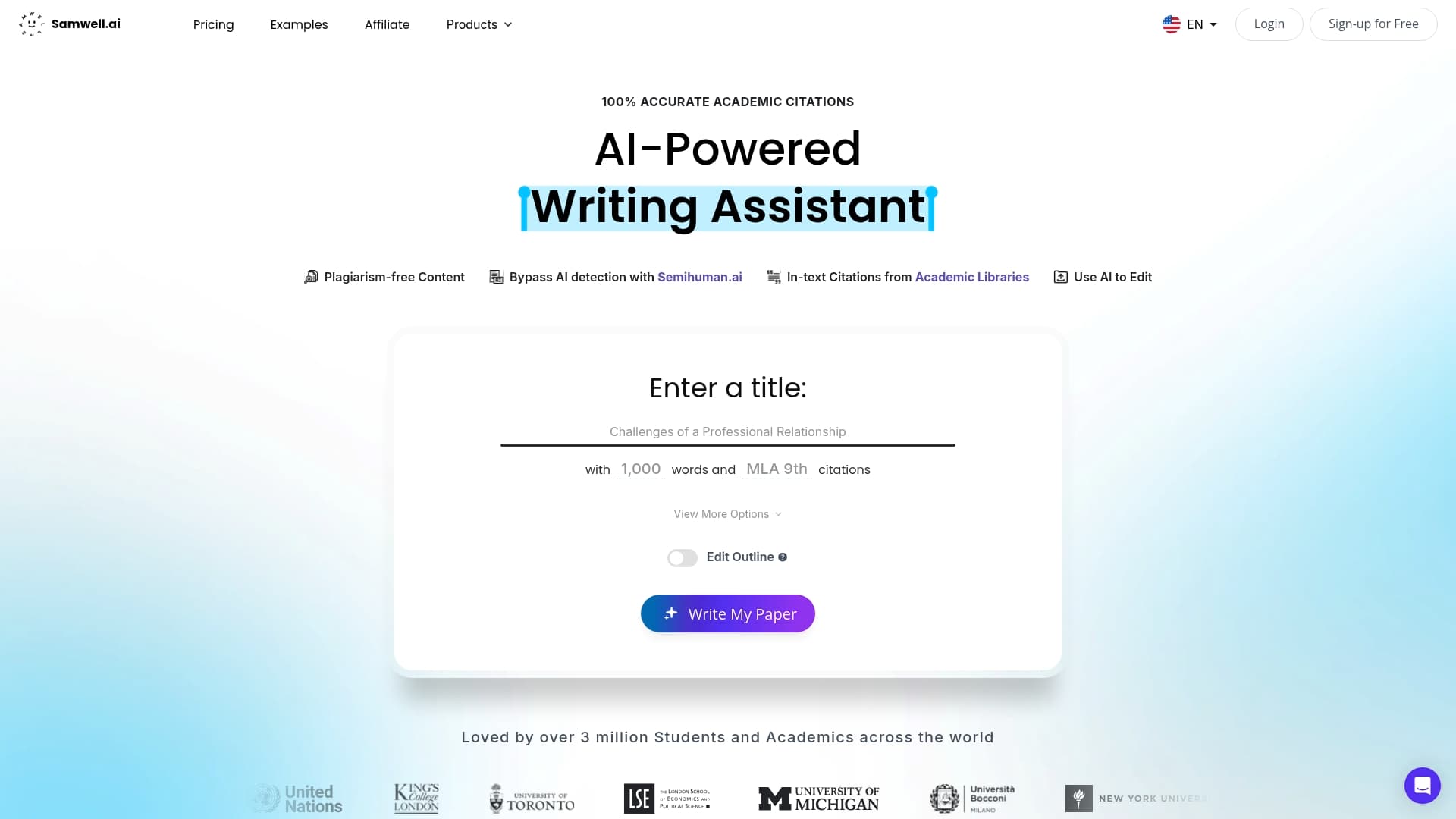
Experience how Samwell.ai can simplify your writing process with advanced tools like the Power Editor for precise editing, Guided Essays that help you create effective outlines, and real-time AI detection to ensure originality. Join over 1,000,000 users who trust our platform to create customized academic content designed around your unique instructions. Don’t wait to elevate your writing skills and meet your academic goals. Start your journey now at Samwell.ai and discover tailored essay generation that works for you.
An informative essay typically follows a five-paragraph structure: an introduction, three body paragraphs, and a conclusion. Start by drafting an outline to organize your main points and ensure each paragraph serves a specific purpose.
Select a topic that interests you and allows for in-depth exploration. Consider brainstorming a list of potential topics and conducting preliminary research to ensure sufficient information is available.
Maintain an objective tone by focusing on factual information rather than personal opinions. Use credible sources to present data and statistics, and avoid emotional language that may sway the reader's perspective.
Each body paragraph should cover a distinct aspect of your topic, providing clear explanations and evidence. Start with a topic sentence, followed by supporting details, and conclude with a sentence that ties back to your thesis.
Reinforce your main points and central thesis in your conclusion without introducing new information. Summarize key insights concisely and consider ending with a thought-provoking statement or question that encourages further reflection.
Research is crucial for providing accurate and reliable information in your essay. Dedicate time to gather data from reputable sources, and take detailed notes to support your arguments and ensure factual integrity.