Loading...

Over ninety percent of American college students report that research projects feel overwhelming at some point in their academic journey. Organizing information, evaluating sources, and clarifying research goals can quickly become confusing without a clear strategy. Whether you are a first year student or deep into graduate work, practical steps can turn a stressful process into a manageable system. Learn how to sharpen your research skills and set your projects up for lasting success.
| Key Message | Explanation |
|---|---|
| 1. Define Clear Research Goals | Start with specific objectives to structure your study effectively. This clarity enhances focus and motivation throughout the project. |
| 2. Use Reliable Sources | Collect credible academic materials and evaluate them using methods like the CRAAP test to ensure robustness in your research foundation. |
| 3. Organize Your Research | Create a logical file structure with clear categories and a consistent naming convention to streamline access to your materials. |
| 4. Capture Key Insights | Implement a note-taking system that organizes information meaningfully and fosters active engagement with your research. |
| 5. Conduct a Thorough Review | Critically evaluate your research structure for coherence and rigor, making adjustments to strengthen your overall arguments. |
Successful academic projects start with laser-sharp research goals. Your ability to define precise objectives will transform scattered thoughts into a focused research strategy.
Begin by asking yourself fundamental questions: What specific problem are you investigating? What knowledge gap will your research address? Research demonstrates that goal clarity significantly enhances learning effectiveness and helps maintain your motivation throughout the project. Think of your research goals as a roadmap guiding your academic journey.
Break down your overarching research objective into specific, measurable components. Instead of a vague goal like "study mental health," narrow it to something concrete such as "examine the impact of peer support programs on adolescent mental health retention rates." Studies confirm that well-defined objectives improve engagement and outcome achievement. This precision helps you stay focused and select appropriate research methods.
Pro tip: Create a one-page research goal summary that clearly articulates your objective, potential methodology, and expected outcomes. Revisit this document regularly to ensure you remain aligned with your original research vision.
Research is only as strong as its foundation of credible sources. In this step, youll learn how to collect and evaluate academic materials that will provide robust support for your project.
Understanding the CRAAP test provides a systematic approach to evaluating source reliability across academic disciplines. This method helps you assess sources through five critical lenses: Currency (how recent the information is), Relevance (how directly the source relates to your research), Authority (the credentials of the author or publication), Accuracy (the verifiability of information), and Purpose (the intent behind the source). Start by prioritizing peer-reviewed journal articles, academic books, and publications from recognized institutional research centers.
Strategies for locating trusted academic articles can significantly enhance your research quality. Utilize academic databases like Google Scholar, JSTOR, or your university library resources. Create a systematic approach by developing a spreadsheet to track potential sources, including key details like publication date, author credentials, and relevance to your specific research question. Cross reference sources and look for consensus among multiple credible publications to strengthen your research foundation.
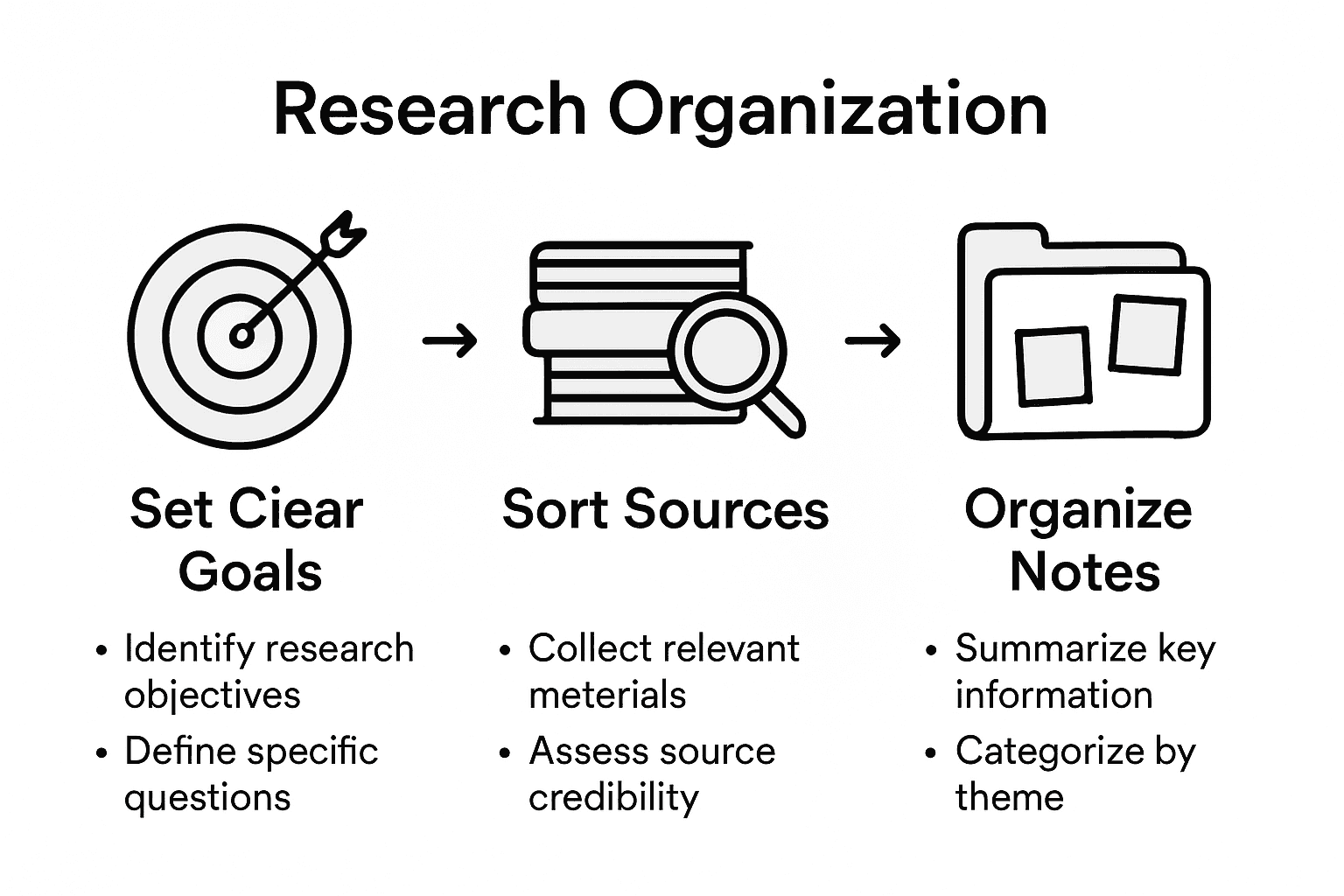
Here's a comparison of popular academic source evaluation methods and their unique strengths:
| Evaluation Method | Key Focus Area | Strengths |
|---|---|---|
| CRAAP Test | Reliability & Purpose | Systematic, multi-dimensional review |
| Peer Review | Scholarly Rigor | Ensures methodology and findings |
| Source Triangulation | Consensus Building | Confirms facts across publications |
Pro tip: Create digital folders or use reference management software like Zotero to organize your sources systematically. Categorize materials by theme, relevance, and potential use in your research to streamline your writing process.
A well-structured research approach transforms scattered information into a coherent academic masterpiece. In this step, youll learn how to create an organizational framework that brings clarity and precision to your research process.

Research methodology frameworks emphasize the critical importance of structural coherence and writing precision in academic work. Start by creating a master document with clear sections that mirror your research goals. Divide your project into logical components: introduction, literature review, methodology, results, discussion, and conclusion. Within each section, develop subsections that break down complex ideas into digestible parts. Think of your research document like an architectural blueprint each component should connect seamlessly and support the overall structure.
Implement a consistent naming convention for your digital and physical research files. Create main folders for broad categories like sources, drafts, and data analysis. Within these, develop subfolders that track different stages of your research. Use a chronological and thematic approach when filing documents digital or physical. Number your drafts sequentially and include date stamps to track your research evolution. This systematic approach prevents document chaos and ensures you can quickly retrieve specific materials when needed.
Pro tip: Use color coding or tagging systems in your digital file management to visually distinguish between different types of sources research papers, reference materials, personal notes to enhance quick visual navigation.
This table summarizes best practices for efficient research file organization:
| Practice | Description | Benefit |
|---|---|---|
| Naming Conventions | Use consistent, descriptive file names | Easier document identification |
| Thematic Subfolders | Sort files by topic or research stage | Quick retrieval of materials |
| Chronological Filing | Date-stamp drafts and files | Tracks project development |
Effective research is more than collecting information its about transforming raw data into meaningful insights. In this step, youll master the art of capturing and organizing your research discoveries in a way that propels your academic work forward.
Understanding how to formulate and structure research objectives provides the foundation for effective note management. Start by creating a comprehensive note taking system that aligns with your research goals. Use a digital notebook or specialized research software that allows for easy tagging, categorization, and cross referencing. For each source you review, develop a consistent template that captures key information source details, main arguments, direct quotes, and your personal reflections. This approach transforms passive reading into active research engagement.
Research objectives play a crucial role in structuring and managing academic research effectively. Develop a color coded or numbered annotation system to highlight different types of information critical quotes, potential controversies, methodological insights, and personal observations. Create a master document that synthesizes these notes linking ideas across different sources. This approach helps you identify patterns, develop original arguments, and maintain a clear connection between your sources and your research narrative.
Pro tip: Schedule weekly review sessions to consolidate your notes. During these sessions, summarize key insights, identify emerging themes, and update your research map to ensure youre maintaining a clear and dynamic research trajectory.
The final stage of your research journey involves critically examining your work to ensure academic rigor and intellectual integrity. This step transforms your raw research into a polished scholarly document that can withstand academic scrutiny.
Research methodology frameworks emphasize the critical importance of structural coherence and writing precision in academic work. Begin by conducting a comprehensive self review of your research structure. Assess each section for logical flow, ensuring that your introduction clearly states research objectives, your methodology explains your approach transparently, and your discussion connects findings back to your original research questions. Look for potential gaps in reasoning, unsupported claims, or areas where additional explanation could strengthen your argument.
Develop a systematic validation checklist that covers multiple dimensions of research quality. Examine your work for consistency in citation style, alignment with research objectives, and adherence to academic writing conventions. By understanding the practical steps for reviewing research, you can identify potential weaknesses and refine your work. Pay special attention to how your arguments progress from one section to another, checking that each paragraph builds upon the previous one and contributes meaningfully to your overall research narrative.
Pro tip: Recruit a critical peer or mentor to review your research structure. An external perspective can reveal blind spots in your reasoning and provide invaluable insights that you might have overlooked during your own review process.
Struggling to transform your scattered ideas into a focused academic project? The article highlights the importance of setting sharp research goals, managing reliable sources, and maintaining a logical organization system. These steps can feel overwhelming but are essential for academic success. Samwell.ai understands these challenges and offers powerful tools designed to simplify your research and writing journey while ensuring academic integrity.
Take control of your research process today by using Samwell.ai's advanced features like the Power Editor to refine your drafts, Guided Essays for structured outlines that mirror your research goals, and real-time AI detection to maintain originality. Don’t let disorganized notes or unclear objectives hold you back. Visit Samwell.ai now and experience a smarter way to produce high-quality, credible academic work. Start transforming your research chaos into clarity with tools tailored for your success.
Setting clear research goals involves defining specific objectives that guide your study. Break down your overarching goal into measurable components, such as focusing on a specific impact of a program, to maintain clarity and motivation throughout your project.
The CRAAP test is a method for assessing the reliability of sources based on Currency, Relevance, Authority, Accuracy, and Purpose. Use this framework to prioritize peer-reviewed articles and reputable publications, ensuring a solid foundation for your research.
To organize your research notes, create a structured system that allows for easy categorization and cross-referencing. Use a digital notebook to capture key information from each source, utilizing templates for consistency and enabling you to link ideas across different materials.
Start by conducting a self-review of your research sections to ensure logical flow and coherence. Develop a systematic checklist for consistency in citation and alignment with your objectives, checking that each paragraph contributes meaningfully to your overall narrative.
Create a spreadsheet or use reference management software to track your sources, including key details like publication date and author credentials. This organized approach will streamline your writing process and help you retrieve materials quickly as needed.