Loading...

Over 80 percent of American college students say that mastering citation styles is one of their biggest academic challenges. Getting citations right is not just a matter of following rules. Proper citation protects your credibility and helps your work stand out in academic communities. This practical guide offers clear, step by step strategies to help you nail every detail, avoid costly citation mistakes, and meet the strict expectations of professors and publishers.
| Key Point | Explanation |
|---|---|
| 1. Choose the right citation style | Align your citation style with your academic discipline to enhance credibility and professionalism. |
| 2. Gather reliable source information | Use the CRAAP test to evaluate sources by assessing their currency, relevance, authority, accuracy, and purpose. |
| 3. Format in-text citations accurately | Follow specific style guidelines to ensure citations are correctly placed, punctuated, and consistent throughout your paper. |
| 4. Create a comprehensive reference list | Organize references alphabetically or numerically, and include all necessary publication details to demonstrate scholarly rigor. |
| 5. Double-check for accuracy and consistency | Review citations systematically to ensure accuracy, matching in-text entries with the reference list to maintain academic integrity. |
Selecting the right citation style is critical for academic writing credibility. Different academic disciplines require specific citation formats that signal scholarly professionalism and help readers track your research sources.
Your citation style should align with your academic field. Understanding types of in text citation helps you navigate this crucial decision. Social science papers typically use APA style, while humanities frequently prefer MLA. Business and fine arts often utilize Chicago style, and natural sciences gravitate toward CSE formatting.
To choose correctly, consider three key factors: your academic discipline, assignment requirements, and publication guidelines. Your department or professor might specify a preferred style. When in doubt, consult your institutional style guide or ask your academic advisor. Some academic journals also have specific citation preferences, so research their submission requirements carefully.
Warning: Inconsistent citation formatting can result in grade penalties or manuscript rejections. Take time to understand the nuanced rules of your chosen style before beginning your research paper.
Gathering accurate source information is the foundation of credible academic writing. In this step, you will learn how to identify and collect reliable research materials that will strengthen your academic paper.
One powerful approach for evaluating source reliability is the CRAAP test methodology, which helps researchers assess sources through five critical dimensions: Currency, Relevance, Authority, Accuracy, and Purpose. This systematic evaluation method ensures you select high quality academic references. When reviewing potential sources, examine publication dates, author credentials, supporting evidence, and the overall context of the research.
Start by conducting thorough searches in academic databases, scholarly journals, and reputable online research repositories. University library resources often provide access to peer reviewed materials that meet rigorous academic standards. Pay special attention to scholarly publications from established academic institutions and recognized experts in your field. Cross reference sources, check bibliographies, and look for consistent information across multiple credible publications.
Warning: Not all online sources are equal. Avoid relying exclusively on general websites or unverified sources. Academic research demands precision and credibility. Always prioritize peer reviewed journals, academic publications, and sources with clear methodological foundations.
Formatting in-text citations correctly is crucial for maintaining academic integrity and giving proper credit to original researchers. This step will help you navigate the nuanced world of citation formatting across different academic styles.
Citation styles vary significantly depending on your academic discipline. APA style typically uses author-date format (Smith, 2023), while MLA employs author-page notation (Smith 20-22). Technical fields like computer science often use numbered citations in square brackets, which correspond to a numbered reference list at the end of your document.

To format citations accurately, start by identifying the specific style required for your paper. Review the guidelines carefully, paying attention to punctuation, capitalization, and placement of citations within your text. Some general rules apply across most styles: always place the citation close to the referenced information, ensure consistency throughout your document, and include all necessary publication details.
Warning: Inconsistent or incorrect citations can lead to accusations of plagiarism. Double-check each citation against your style guide, and when in doubt, consult your instructor or a writing center professional for guidance. Precision matters more than perfection, but attention to detail will strengthen your academic writing.
Creating a comprehensive reference list is the final crucial step in academic writing that demonstrates your research rigor and scholarly integrity. This process transforms your scattered citations into a structured, professional compilation of sources.

The Chicago Manual of Style provides comprehensive guidelines for constructing reference lists that are both accurate and consistent. Begin by organizing your sources alphabetically or numerically, depending on your chosen citation style. Ensure each entry includes essential publication details such as author names, publication dates, titles, journal names, volume numbers, and page ranges.
Pay meticulous attention to formatting requirements specific to each source type. Academic publications like journal articles, books, websites, and conference proceedings each have unique citation protocols. Medical and scientific writing styles often require additional precision in reference documentation. Use consistent indentation, punctuation, and capitalization throughout your reference list.

Warning: Incomplete or incorrectly formatted references can undermine your academic credibility. Always double-check each entry against your style guide, and consider using citation management software to help maintain accuracy and consistency. A well-crafted reference list not only supports your arguments but also demonstrates your commitment to scholarly excellence.
Double-checking your citations is the final quality control step that separates good academic writing from exceptional scholarly work. This meticulous review ensures your research meets the highest standards of academic integrity and precision.
Advanced AI-powered citation verification systems are transforming how researchers ensure source accuracy. Systematically review each citation by cross referencing the original source, verifying page numbers, checking publication dates, and confirming that quoted or paraphrased content truly reflects the original material. Pay special attention to direct quotes, ensuring they are transcribed exactly as they appear in the original text.
Academic writing frameworks emphasize the importance of consistent formatting throughout your document. Create a comprehensive checklist that includes verifying citation style consistency, matching in-text citations with reference list entries, and confirming that all sources are properly attributed. Read through your entire document backward to interrupt your usual reading pattern and catch errors you might otherwise miss.
Warning: Even minor citation errors can compromise your academic credibility. If you are uncertain about a citation, consult your instructor, a writing center professional, or the original source. Remember that accuracy is more important than perfection. A few carefully corrected citations are better than a document filled with unchecked references.
Accurately citing sources is essential to avoid plagiarism and enhance your academic credibility. If you find yourself struggling with different citation styles like APA, MLA, or Chicago, or spending too much time formatting in-text citations and compiling reference lists, you are not alone. The challenges of gathering reliable sources, ensuring consistency, and double-checking every detail can be overwhelming. Samwell.ai understands these frustrations and offers a powerful solution to streamline your academic writing process while maintaining strict compliance with citation standards.
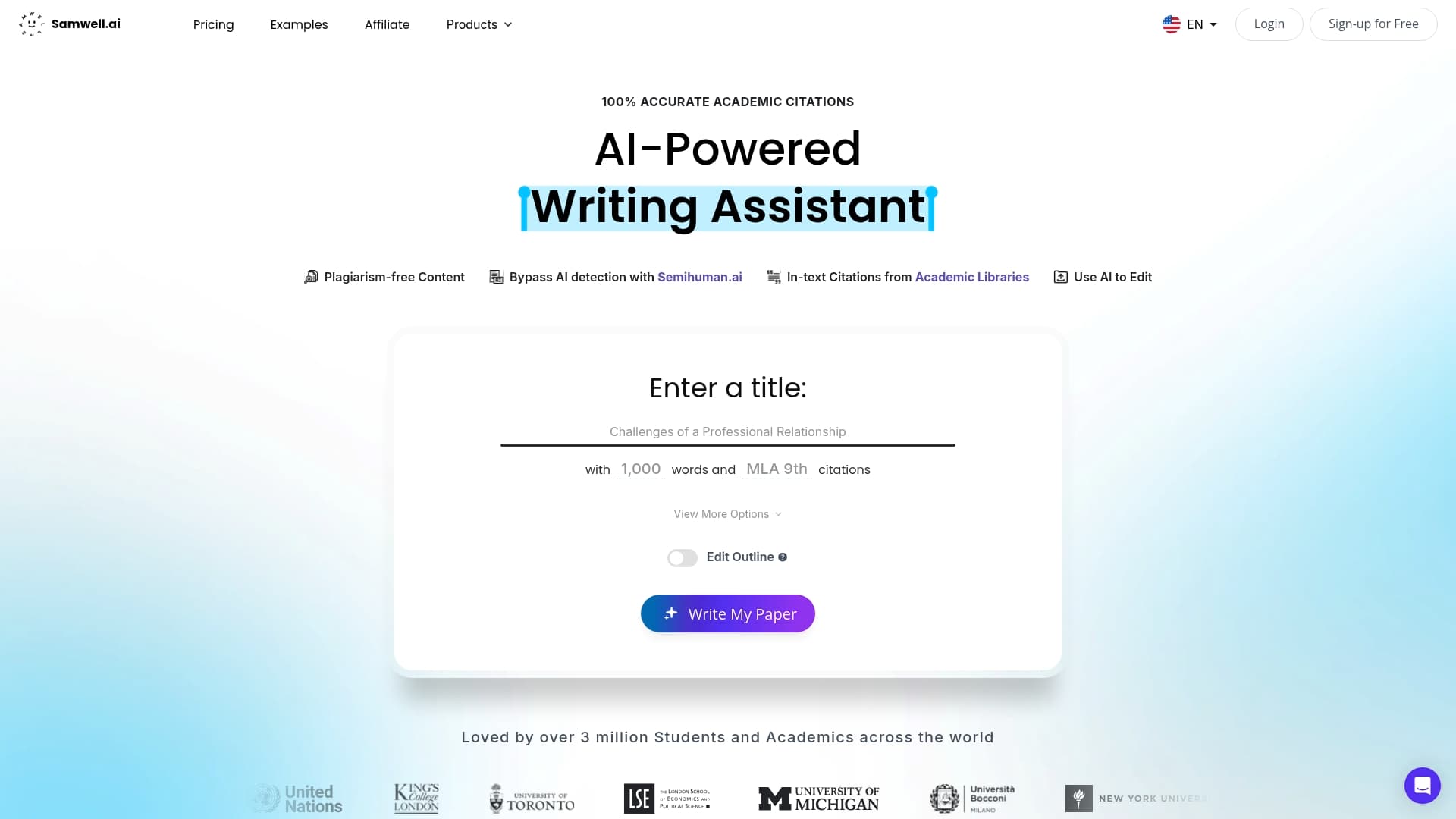
Unlock the full potential of your research papers with Samwell.ai, an advanced AI-driven platform tailored for students and academics who want to produce high-quality, plagiarism-free work effortlessly. With features like the 'Power Editor' to refine your content, 'Guided Essays' for structured outlines, and real-time AI detection to safeguard originality, you can focus more on your ideas and less on formatting headaches. Don't let citation errors put your academic reputation at risk. Visit Samwell.ai today and experience a smarter way to write, cite, and succeed.
Selecting the appropriate citation style depends on your academic discipline, assignment requirements, and publication guidelines. Review your department's specified style or consult your instructor. If you're unsure, familiarize yourself with common styles used in your field, such as APA for social sciences or MLA for humanities.
The CRAAP test is a method for evaluating sources based on Currency, Relevance, Authority, Accuracy, and Purpose. Use this test when gathering research materials to ensure that your sources meet high academic standards. For example, check whether the publication date and author credentials enhance the source's credibility.
To format in-text citations, identify the specific style required for your paper, such as APA or MLA. Follow the specific guidelines closely regarding punctuation and placement within your text, ensuring that citations are consistent and accurate throughout your document. For instance, in APA format, you would cite as (Author, Year).
Your reference list should include essential details like author names, publication dates, titles, and journal names. Organize the entries alphabetically or numerically depending on your citation style, and carefully follow formatting rules for different source types. For example, ensure journal articles include volume numbers and page ranges.
Double-check your citations by cross-referencing them with the original sources and verifying all details such as page numbers and publication dates. Create a checklist that includes confirming consistency between in-text citations and the reference list. This can help prevent minor errors that might compromise your academic credibility.
Common mistakes include inconsistent formatting, missing information in citations, and incorrect placement of in-text citations. Avoid these errors by carefully following your chosen style guide and reviewing your work for consistency. Aim to correct any citation issues before submitting your paper to maintain your scholarly integrity.