Loading...

Staring at a blank page and a 500 word limit can leave you wondering just how many paragraphs you need and how long each should be. College assignments rarely spell out these details, yet getting them right is crucial for strong writing and higher grades. By focusing on the idea that a paragraph develops a single point and spans 100 to 250 words in most academic essays, you set yourself up for clear structure and logical flow.
| Point | Details |
|---|---|
| Paragraph Structure Matters | Clear structure aids comprehension and grading. Organize your ideas logically to enhance readability. |
| Aim for Appropriate Lengths | Maintain a paragraph length of 100-250 words for effective development, avoiding extremely short or long paragraphs. |
| Focus on Topic Sentences | Every paragraph should start with a strong topic sentence to clarify the main idea for your reader. |
| Transitions Enhance Flow | Use transitional phrases to connect ideas between paragraphs and create a cohesive argument throughout your essay. |
When you sit down to write a 500 word paper, one of the first questions that pops into your head is probably: how many paragraphs should this actually be? The answer depends on understanding what a paragraph actually is, not just counting sentences or eyeballing length. A paragraph is fundamentally a unit of thought. It develops a single idea and gives your reader a clear reason to pause and absorb what you've written before moving to the next concept.
Academically speaking, college paragraphs typically span 100 to 250 words, which means a standard 500 word essay usually breaks down into roughly two to five substantive paragraphs. But here's where students often get stuck: that range isn't arbitrary. It exists because effective paragraphs need room to breathe. Your opening sentence introduces the main idea (the topic sentence). Your body sentences provide evidence, examples, or reasoning that supports that idea. Your final sentence or two might transition to the next paragraph or reinforce your argument. That structure takes space to execute well.
The specific number of paragraphs in your 500 word assignment depends on your argument's complexity. A straightforward persuasive essay might have an introduction paragraph, two body paragraphs, and a conclusion, landing you at four paragraphs total. A more nuanced analysis might require an introduction, three body paragraphs, and a conclusion, giving you five. The thing is, shorter paragraphs (under 100 words) often leave ideas underdeveloped, leaving readers wanting more evidence or explanation. Conversely, paragraphs that exceed 250 words become dense and hard to follow, especially for instructors reading dozens of papers. When you're working within a 500 word limit, every paragraph needs to pull its weight.
One practical approach: outline your main points first. If you have three distinct arguments to make, you'll likely need three body paragraphs plus an introduction and conclusion. That structure naturally fits a 500 word frame. If you're following standard academic paragraph development practices/1%3A_Introduction_to_Writing/1.6%3A_Writing_Paragraphs_(Part_2)), your paragraphs will maintain consistent depth and clarity. Remember, instructors aren't counting sentences or words per paragraph obsessively. They're looking for whether you've fully developed each idea and organized your thoughts logically. A well constructed four paragraph essay beats a padded five paragraph essay every time.
Pro tip: Draft your essay without worrying about paragraph length, then read through and check whether each paragraph focuses on one main idea and includes sufficient evidence. If a paragraph feels thin or scattered, it probably needs more development or should be combined with an adjacent paragraph.
Not all paragraphs are created equal, and that's exactly how academic writing should work. Your introduction paragraph might be shorter and more direct, setting up your argument in three or four sentences. Your body paragraphs might be longer, requiring more space to develop evidence and analysis. Your conclusion might be brief again, wrapping up your main points without introducing new ideas. This variation isn't random. It's driven by what each paragraph needs to accomplish in your essay.

When you're working with a 500 word constraint, understanding how paragraphs serve different functions becomes crucial to your overall structure. An introductory paragraph typically establishes context and presents your thesis, often requiring just enough space to hook your reader and state your position clearly. Transition paragraphs, if you use them, might be even shorter—sometimes just one or two sentences bridging two larger ideas. Body paragraphs do the heavy lifting, presenting evidence, examples, and analysis that support your main argument. These naturally run longer because they need room to develop your points thoroughly. Closing paragraphs return to brevity, summarizing your argument without padding. The length variation reflects purpose, not careless writing.
Effective paragraphs maintain unity and coherence regardless of their length. Each paragraph should focus on a single controlling idea, whether that's explained in 75 words or 200 words. Your topic sentence introduces that controlling idea, then your supporting sentences build on it with evidence, examples, or reasoning. The paragraph ends before you're ready to shift to a new idea. This structure prevents the rambling, unfocused paragraphs that confuse readers and waste your precious word count. When you're drafting a 500 word essay, every word should advance your argument or support your main point. Fluff has no place here.
One practical reality many students miss: short paragraphs don't always mean weak writing. Sometimes a single sentence paragraph, placed deliberately for emphasis, hits harder than three longer paragraphs saying the same thing. Conversely, a dense, poorly organized two hundred word paragraph exhausts readers faster than a clear, well structured one that runs longer. What matters is whether your paragraphs maintain proper development with coherence and sufficient detail. When you outline your 500 word essay, think about what each paragraph needs to accomplish. Count your main supporting points—if you have three distinct arguments, you'll need three body paragraphs, each giving that argument the space it deserves. If an idea can be explained thoroughly in 120 words, don't force it to 180. If it needs 200 words to be convincing, don't chop it down artificially. The goal is clarity and persuasion, not hitting some arbitrary length target.
Pro tip: After drafting each paragraph, ask yourself what purpose it serves in your overall argument. If you can't articulate that purpose clearly, the paragraph probably needs rethinking or combining with another paragraph.
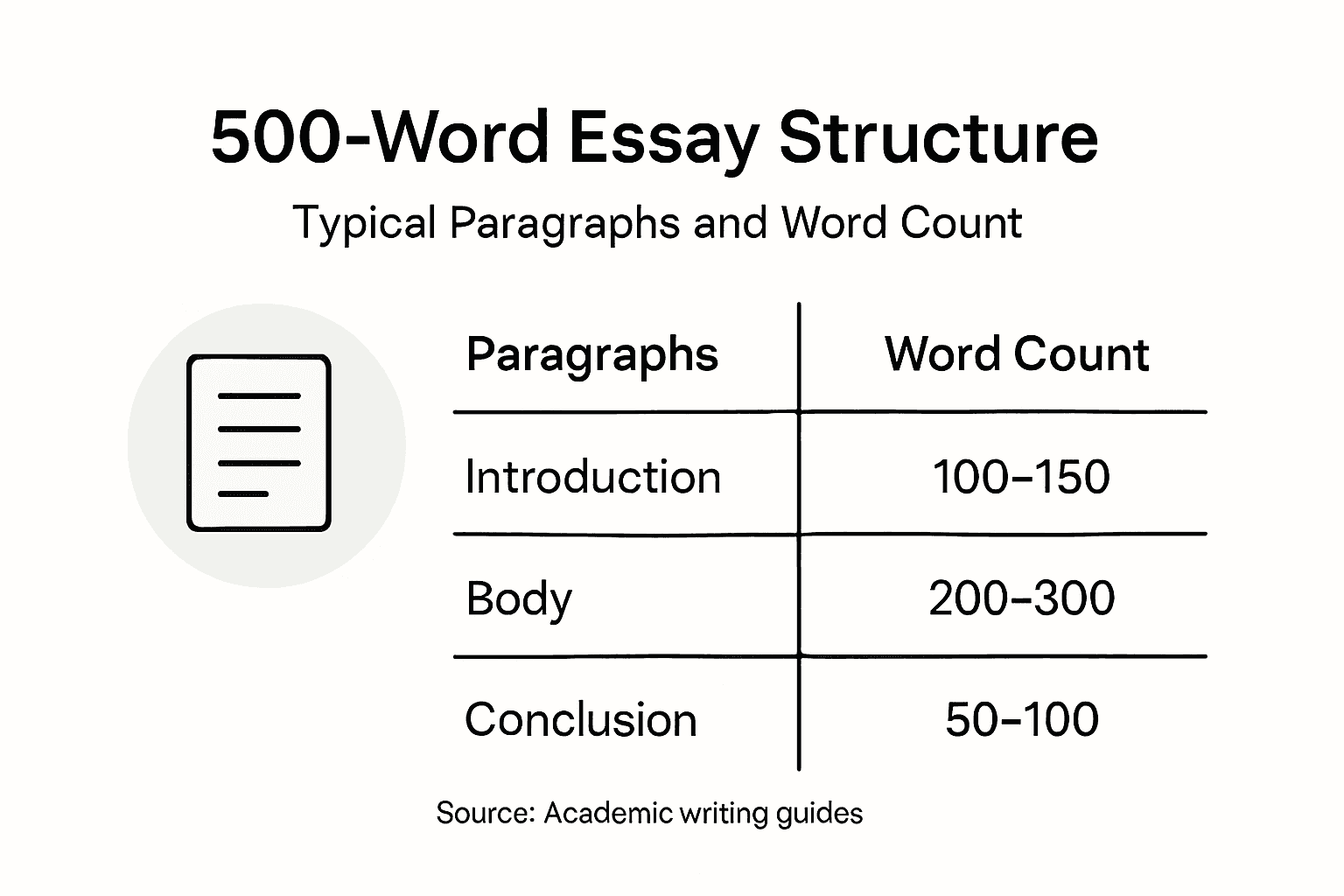
Here's how common paragraph types typically vary in a 500-word academic essay:
| Paragraph Type | Usual Length | Primary Purpose | Key Features |
|---|---|---|---|
| Introduction | 50–100 words | Present thesis and context | Engaging, concise, direct |
| Body Paragraph | 100–200 words | Develop main arguments | Evidence, analysis, logic |
| Transition | 20–50 words | Bridge major ideas | Short, connects sections |
| Conclusion | 40–80 words | Summarize and restate argument | Clear, no new ideas |
Formatting matters more than most students realize. Your instructor doesn't just care about what you say; they also care about how your paper looks on the page. When you're working with a tight 500 word limit, proper formatting becomes even more critical because visual clarity helps readers absorb your ideas quickly. The good news is that formatting standards are consistent and predictable. Once you understand the basics, you can apply them to any assignment.
APA style formatting guidelines specify clear requirements that most academic papers follow. Set your margins to 1 inch on all sides, which gives your text breathing room and matches instructor expectations. Use a readable font like 12 point Times New Roman or Calibri, which ensures your work looks professional and remains easy to read on screen or in print. Apply double spacing throughout your entire paper, including between paragraphs and before and after headings. This spacing makes your paper easier to grade and allows instructors room for feedback. Indent the first line of each paragraph by 0.5 inches, a simple formatting choice that clearly marks where each new paragraph begins.
When you're structuring a 500 word paper with these formatting requirements in mind, you're typically looking at approximately 4 to 5 substantive paragraphs. Your first paragraph introduces your topic and thesis. Your body paragraphs develop your main arguments with evidence and analysis. Your final paragraph wraps up your ideas and restates your main point. With double spacing and 1 inch margins, 500 words fills roughly one and a half to two pages, depending on your font choice and paragraph length variation. This means each paragraph has room to develop without being cramped, but not so much space that you can afford to include filler or weak arguments. Every sentence needs purpose.
Beyond the basics, consider your paper's structure. Use a clear title centered at the top, written in title case (capitalize the first and last words and all major words). If your assignment requires a header with your name, date, and course information, place that in the upper left corner of the first page. Don't add decorative elements or fancy fonts. Your goal is clarity and professionalism, not creativity in design. Tables, charts, or graphs count toward your word limit, so use them strategically if your topic requires them. Most 500 word essays don't need visual elements; strong writing does the work instead. Headings within your paper should be clear and descriptive, helping readers follow your argument's structure. When you combine proper academic paper formatting with a well organized paragraph structure, your 500 word assignment transforms from a constraint into an opportunity to demonstrate precision and clarity in your writing.
Pro tip: Format your paper before you finish writing, not after. Working within properly formatted margins and spacing from the start helps you visualize how much space you actually have, preventing last minute scrambling to cut or add content.
Here's something that might surprise you: your paragraph structure directly affects your grade. It's not just about content quality or argument strength, though those matter too. Instructors grade based on how well they can follow your thinking, and that's entirely determined by structure. When your paragraphs are organized clearly with distinct claims, supporting evidence, and analysis, professors can navigate your argument effortlessly. When they're scattered or poorly organized, even brilliant ideas get lost in the confusion. You're essentially making your instructor's job easier or harder through structure alone.
Well organized paragraphs function like a roadmap for your reader. Clear paragraph structures improve readability by guiding readers through your argument step by step. Each paragraph should open with a topic sentence that states your main claim. Then you provide evidence, whether that's research findings, quotations, or specific examples. Finally, you analyze that evidence, explaining how it supports your larger argument. This rhythm—claim, evidence, analysis—creates predictability. Your instructor knows what to expect in each paragraph, making your ideas accessible and your reasoning transparent. Paragraphs that jump between unrelated ideas or bury their main point confuse readers and trigger lower grades. The structure does half the work for you; clarity and persuasiveness handle the rest.
The relationship between organization and grading is undeniable at the college level. Clarity, coherence, and adherence to academic conventions significantly influence grades, with essays featuring strong paragraph organization and smooth transitions earning higher marks. Think about it from an instructor's perspective: they're reading dozens of papers. A 500 word essay with clear paragraph breaks, logical transitions between ideas, and integrated evidence is refreshing and straightforward to evaluate. A 500 word essay that reads like one continuous block of rambling paragraphs exhausts them. Beyond grading speed, structure actually demonstrates your critical thinking. When you organize ideas logically, you're showing that you understand how your arguments connect and build on each other. Disorganized paragraphs suggest you haven't fully processed your own ideas, which naturally results in lower marks.
Your paragraph structure also affects how well evidence lands. A piece of evidence buried in a poorly organized paragraph might go unnoticed. The same evidence, properly introduced and analyzed within a well structured paragraph, becomes powerful. Consider your 500 word essay as five carefully constructed paragraphs rather than an amorphous block of text. Your introduction establishes context and your thesis. Three body paragraphs each develop a distinct argument with supporting evidence. Your conclusion restates your position and reinforces your main points. This structure isn't rigid dogma; it's a proven formula for clarity. Instructors reward it because it works. When you submit an essay with strong paragraph organization, you're demonstrating professionalism, critical thinking, and respect for your reader's time. Those qualities consistently translate to better grades.
Pro tip: Before submitting your essay, read it aloud paragraph by paragraph, and ask yourself whether each paragraph has one clear main idea and sufficient evidence supporting it. If you stumble over a paragraph or lose the main point, your instructor will too.
Most students repeat the same paragraph mistakes over and over without realizing it. These aren't complicated errors or obscure writing problems. They're predictable, fixable issues that crop up because nobody ever explicitly taught you what to avoid. The good news is that once you recognize these mistakes, you can eliminate them from your writing. Your 500 word essay will transform from mediocre to solid just by sidestepping these common pitfalls.
The first and most damaging mistake is writing a paragraph without a clear topic sentence. Your paragraph might contain good ideas, but if readers can't immediately identify what the paragraph is about, you've already lost them. A strong topic sentence appears at or near the beginning of your paragraph and tells your reader exactly what main idea you're developing. Without it, paragraphs feel aimless and rambling. The second major error is cramming multiple ideas into a single paragraph. You might write a paragraph about the causes of climate change, then shift to discussing solutions, then mention historical environmental policy all in one block. That's paragraph chaos. One paragraph equals one main idea. Mixing ideas confuses readers and weakens your argument's strength. Additionally, common paragraph organization mistakes include insufficient evidence supporting your claims and weak transitions between paragraphs. If you make a claim but provide only thin supporting evidence, readers won't be convinced. If your paragraphs feel disconnected from each other, readers lose your argument's thread.
Another frequent problem is creating paragraphs that are either too short or too long for your content. A paragraph that's 50 words probably doesn't develop its idea adequately. A paragraph that's 400 words in a 500 word essay doesn't give you room to develop your full argument. Finding the right length requires balance. More importantly, you need to ensure that paragraphs have clear controlling ideas, supporting details, logical order, and smooth transitions. Many students write paragraphs where ideas jump around randomly. They'll start with evidence, skip to analysis, then circle back to more evidence. Your reader's brain has to work overtime to follow your thinking. Structure your paragraph logically: introduce your main idea, provide evidence, then analyze it. That's the rhythm that works. Missing or unclear topic sentences represent another widespread mistake. Your topic sentence is your contract with the reader. You're saying, "Here's what this paragraph is about." When that sentence is missing or buried halfway down the paragraph, readers waste mental energy trying to figure out your point. Place your topic sentence where it belongs: at the start of your paragraph, clearly and concisely stated.
Poor transitions between paragraphs is a mistake that weakens coherence across your entire essay. When you finish one paragraph and jump to the next without connecting them, your essay feels choppy and disorganized. Use transitional words and phrases like "however," "additionally," "in contrast," or "furthermore" to guide readers from one paragraph to the next. These small words do enormous work in creating flow. Finally, many students fail to maintain unity within their paragraphs. Every sentence should support your paragraph's controlling idea. Stray sentences that explore tangential topics create confusion and dilute your argument. When you write your 500 word essay, discipline yourself to keep every sentence in every paragraph focused on that paragraph's main idea.
Pro tip: After writing your draft, read each paragraph in isolation and write down its main idea in a single sentence. If you struggle to articulate the main idea or find yourself writing multiple sentences, that paragraph needs reorganization or splitting into two separate paragraphs.
Below is a summary of frequent paragraph organization mistakes and their impact:
| Mistake | Effect on Essay | Solution |
|---|---|---|
| Missing topic sentence | Ideas appear unfocused | Begin with a clear main claim |
| Multiple topics in one paragraph | Confuses reader, weakens argument | Separate into single-idea paragraphs |
| Insufficient supporting evidence | Claims lack credibility | Provide relevant examples or sources |
| Poor transitions | Essay feels choppy, disjointed | Use linking words or phrases |
| Overly long or short paragraphs | Main ideas lost or underdeveloped | Adjust length to fit idea development |
| Lack of unity within paragraphs | Reader loses track of argument | Keep all sentences on one main idea |
Struggling to balance paragraph length and structure in your academic writing can be frustrating and stressful. This article highlights the challenges of maintaining coherent and well-developed paragraphs within a strict 500 word limit. From crafting clear topic sentences to ensuring smooth transitions, every detail counts toward creating a compelling paper that earns better grades. If organizing ideas and managing academic formatting feel overwhelming, you are not alone.

Unlock the full potential of your writing with Samwell.ai, a cutting-edge AI-powered platform designed to help students master essay structure effortlessly. With innovative tools such as Guided Essays for outlining your arguments clearly and the Power Editor to develop paragraphs with strong evidence and coherence, Samwell.ai ensures your 500 word paper is organized and impactful. Start improving your academic writing today by visiting Samwell.ai and experience how precision meets clarity on every page.
Typically, a 500-word essay should contain around 4 to 5 paragraphs, depending on the complexity of your argument.
Each paragraph in a 500-word essay should ideally range from 100 to 200 words to ensure clarity and sufficient development of ideas.
Clear paragraph structures enhance readability and help instructors follow your argument, which can positively influence your grade.
Avoid missing topic sentences, mixing multiple ideas within a paragraph, and providing insufficient evidence. These mistakes can weaken your overall argument.