Loading...

Staring at a blank page with a looming essay assignment, many undergraduate students in the United States and Canada wonder how many words are enough to get their point across without losing their professor’s interest. Essay length is more than just a guideline, shaping how thoroughly you explain your ideas while keeping your writing organized and focused. Understanding these length requirements helps students use AI writing tools to develop stronger essays that fully meet academic expectations.
| Point | Details |
|---|---|
| Purpose of Essay Length | Essay length establishes a framework for clear communication, balancing comprehensive analysis and concise presentation. |
| Types and Word Counts | Different essay types have varying word count requirements, influencing depth and structure of writing. |
| Common Mistakes | Students often misunderstand length requirements, potentially harming their grades by failing to adhere to guidelines. |
| Influencing Factors | Factors such as academic level, subject complexity, and instructor guidelines shape essay length expectations. |
In academic writing, an essay length is more than just a number—it's a strategic framework for effectively communicating complex ideas. Academic expectations for essay length typically revolve around balancing comprehensive analysis with concise presentation.
Essay length serves multiple critical purposes in academic communication:
At its core, an essay is a formal piece of writing designed to present a coherent argument or perspective. The length requirement ensures that students can develop their thoughts systematically, moving from introduction through substantive body paragraphs to a clear conclusion.
The primary goal of defining essay length is not to constrain creativity, but to establish a framework for clear, disciplined academic communication.
Word count ranges typically vary based on academic level and specific assignment requirements. For undergraduate work, essays often range between 400-1500 words, with most standard assignments falling around 1000 words. This range allows students to demonstrate comprehensive understanding without becoming overly verbose.
Pro tip: Always confirm specific length requirements directly with your instructor, as individual guidelines can vary significantly between courses and institutions.
Essay types significantly influence word count requirements, with college admission essay lengths varying dramatically across different academic contexts. Understanding these variations helps students craft precisely targeted written work.
The most common essay types include:
Each essay type demands a unique approach to length and depth. Narrative essays focus on storytelling and personal experiences, allowing more flexibility in word count. Argumentative essays require more extensive research and detailed evidence, naturally extending their length.

Here's a quick reference comparing common essay types by purpose and depth:
| Essay Type | Primary Purpose | Depth Required | Example Topics |
|---|---|---|---|
| Narrative | Share personal experiences | Moderate | Study abroad reflection |
| Descriptive | Create vivid imagery | Limited | Describe a childhood home |
| Argumentative | Defend a specific viewpoint | Extensive | Climate policy analysis |
| Expository | Explain concepts or ideas | Moderate | How photosynthesis works |
| Persuasive | Convince the reader to act | Substantial | Health benefits of exercise |
Academic writing demands precision: your word count should reflect the complexity of your argument, not arbitrary page requirements.
Undergraduate assignments typically range from 1000-1500 words, while graduate-level essays might extend to 2000-2500 words. Advanced research papers and dissertations can span several thousand words, depending on specific academic requirements and research depth.
The following summary showcases how academic level typically influences essay length and expectations:
| Academic Level | Typical Word Count | Depth of Analysis | Citation Requirement |
|---|---|---|---|
| High School | 300-800 words | Basic understanding | Usually not required |
| Undergraduate | 1000-1500 words | Analytical depth | Required |
| Graduate | 2000-2500 words | Specialized analysis | Extensive referencing |
Pro tip: Always review your specific assignment guidelines, as individual instructors may have unique expectations that deviate from general recommendations.
Essay length is not a one-size-fits-all concept, with college essay standards shaped by multiple nuanced factors. Academic writing demands a strategic approach to determining appropriate word count based on several key considerations.
The primary factors influencing essay length include:
Different academic disciplines approach essay length with unique perspectives. Science and engineering essays tend to prioritize conciseness and technical precision, while humanities disciplines often value more elaborate narrative and analytical approaches.
The most effective essays balance depth of content with clarity of communication, regardless of strict word count requirements.
Contextual nuances play a crucial role in determining appropriate essay length. A complex philosophical argument might require more extensive exploration, while a straightforward laboratory report demands precision and brevity. Graduate-level work typically allows for more in-depth analysis, expanding potential word count compared to undergraduate assignments.

Pro tip: Always confirm specific length requirements directly with your instructor, as individual expectations can vary significantly between courses and academic departments.
Essay structure is fundamentally influenced by length, with college essay formatting presenting a dynamic approach to organizing content across different word count ranges. The strategic allocation of paragraphs and sections becomes increasingly nuanced as essay length expands.
Typical structural breakdown by essay length includes:
The number and depth of paragraphs directly correlate with total word count. Shorter essays demand precision and focus, while longer essays allow for more elaborate exploration of complex topics.
Effective essay structure is not about filling space, but creating a logical progression of ideas that maintains reader engagement.
Each section should maintain a clear purpose and contribute meaningfully to the overall argument. Longer essays provide opportunities for more sophisticated arguments, additional supporting evidence, and nuanced analytical perspectives.
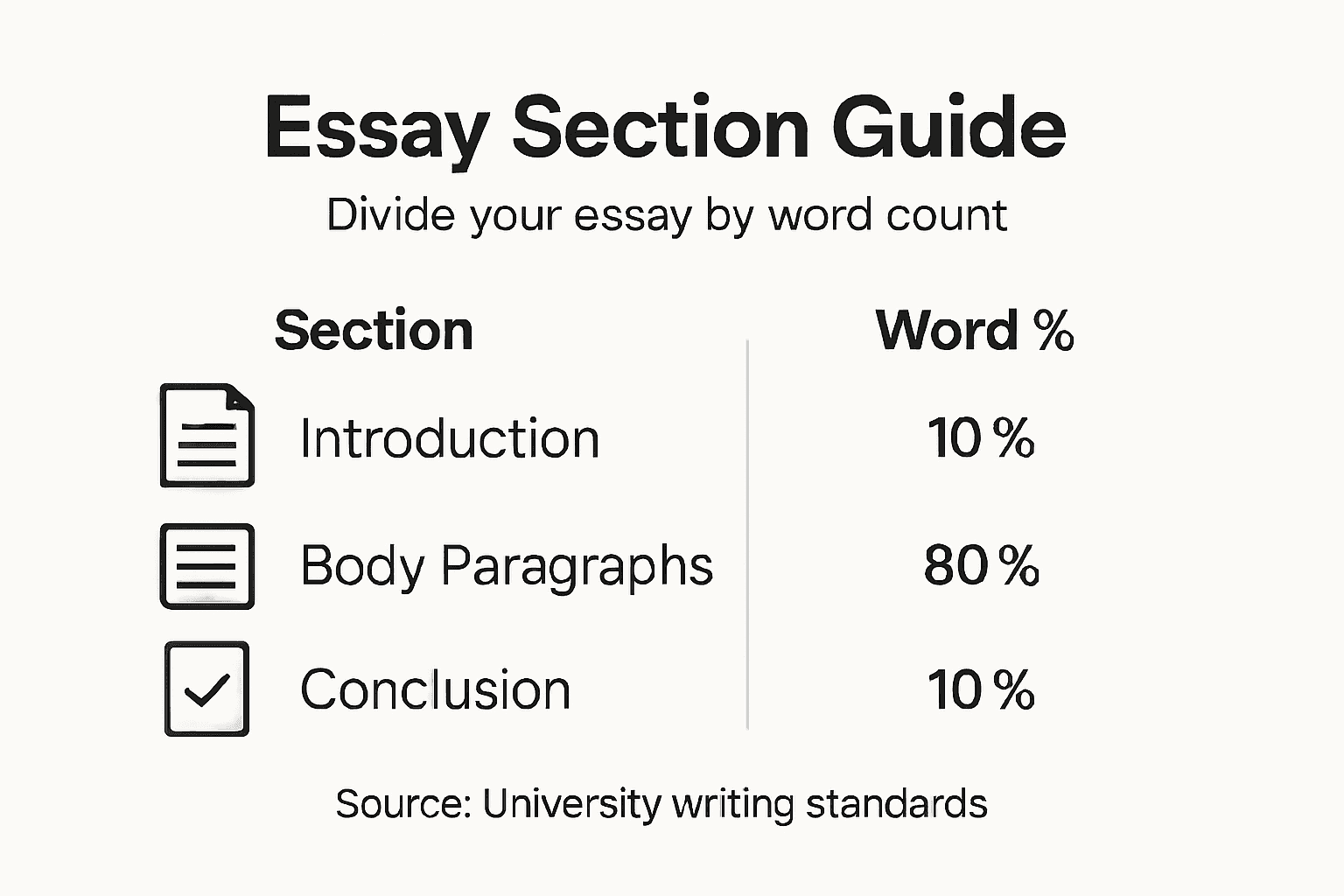
Pro tip: Allocate approximately 10% of your total word count to the introduction, 80% to the body paragraphs, and 10% to the conclusion for balanced essay structure.
Students frequently misunderstand essay length requirements, with college essay writing challenges creating significant academic obstacles. Understanding these common pitfalls can help writers avoid grade-reducing errors and improve their overall academic performance.
Common mistakes in essay length include:
Many students mistakenly believe that simply reaching a specific word count guarantees academic success. However, instructors prioritize clarity, coherence, and substantive content over arbitrary length requirements. Quality always trumps quantity in academic writing.
The goal is not to fill pages, but to communicate ideas effectively and concisely.
Some writers overcompensate by including verbose language or irrelevant information, which actually diminishes the essay's overall quality. Others may underwrite, providing insufficient evidence or analysis to support their arguments.
Pro tip: Always review your essay against the original assignment guidelines, focusing on meeting both the minimum and maximum word count requirements while maintaining strong analytical content.
Struggling to meet exact essay length requirements without sacrificing quality is a common challenge for students. Whether you need to balance depth and clarity or fine-tune your word count to fit specific standards, understanding the nuances of essay length can feel overwhelming. Key concepts like structured outlines, precise word counts, and strategic paragraph allocation highlight the complexity of crafting well-balanced essays that meet academic expectations.
Unlock the power of AI-driven assistance tailored to your academic writing needs at Samwell.ai. Use advanced tools like the Power Editor for targeted content expansion or condensation and Guided Essays for building structured, concise outlines that respect word count limits. Achieve clarity, depth, and originality seamlessly while avoiding common pitfalls such as unnecessary padding or incomplete arguments. Start refining your essay length strategy today by visiting Samwell.ai. Get the academic edge you deserve now.
Undergraduate essay lengths typically range from 1000 to 1500 words, with 1000 words being a common target for many assignments.
Several factors influence essay length, including academic level, subject complexity, assignment type, disciplinary expectations, and specific instructor guidelines.
Common essay types include narrative essays (500-700 words), descriptive essays (300-500 words), argumentative essays (800-1500 words), expository essays (500-800 words), and persuasive essays (500-1000 words).
Common mistakes include ignoring word count limits, padding content to meet lengths, misunderstanding that longer essays guarantee higher grades, neglecting specific instructions, and inconsistent formatting to inflate word count.