Loading...

Most American universities expect undergraduate essays to hit a specific word count, yet nearly 60 percent of international students report confusion about what length truly means for their grade. Getting essay length right is not just an american tradition but a core skill in global academia. As writing standards shift between disciplines and professors, mastering these expectations—while using AI tools to stay efficient—can mean the difference between clarity and frustration.
| Point | Details |
|---|---|
| Understanding Essay Length | Essay length varies by academic level and type, impacting writing quality and clarity. Confirm specific requirements with instructors for precise expectations. |
| Essay Types Differ in Length | Different essay types, such as personal statements and research papers, have unique word count expectations suitable for their academic purposes. |
| Common Mistakes in Length | Students often misinterpret length as a measure of quality, focusing on word count instead of clarity and argument substance. |
| Leveraging AI Tools | AI tools can assist in maintaining essay length compliance but should be used as writing aids rather than replacements to ensure original voice and thought. |
In academic writing, understanding essay length requirements is crucial for students navigating higher education. Essay length standards vary significantly across different educational levels, disciplines, and assignment types. Typically, college essays range from 400 to 600 words, though this can fluctuate based on specific course requirements.
The purpose of defining essay length extends beyond mere word counting. Academic institutions use word count restrictions to help students develop concise writing skills, demonstrate their ability to communicate complex ideas efficiently, and maintain standardized evaluation criteria. Different academic levels impose distinct expectations: high school essays might require shorter compositions, while graduate-level papers often demand more extensive, research-intensive writing.
Understanding essay length involves recognizing multiple dimensions beyond raw word count. Factors like discipline, assignment type, and academic level significantly influence expected essay length. A scientific research paper will differ substantially from a humanities reflection essay, with STEM disciplines often requiring more technical, data-driven approaches and humanities courses emphasizing narrative and analytical depth.
Pro tip: Always confirm specific essay length requirements directly with your instructor, as individual course guidelines can vary dramatically from general academic standards.
Academic writing encompasses diverse essay types, each with unique word count expectations. Personal statements and college admission essays typically range between 400 and 600 words, serving as concise yet comprehensive self-representation tools. These shorter formats require students to communicate their experiences, aspirations, and personalities within tight word constraints.
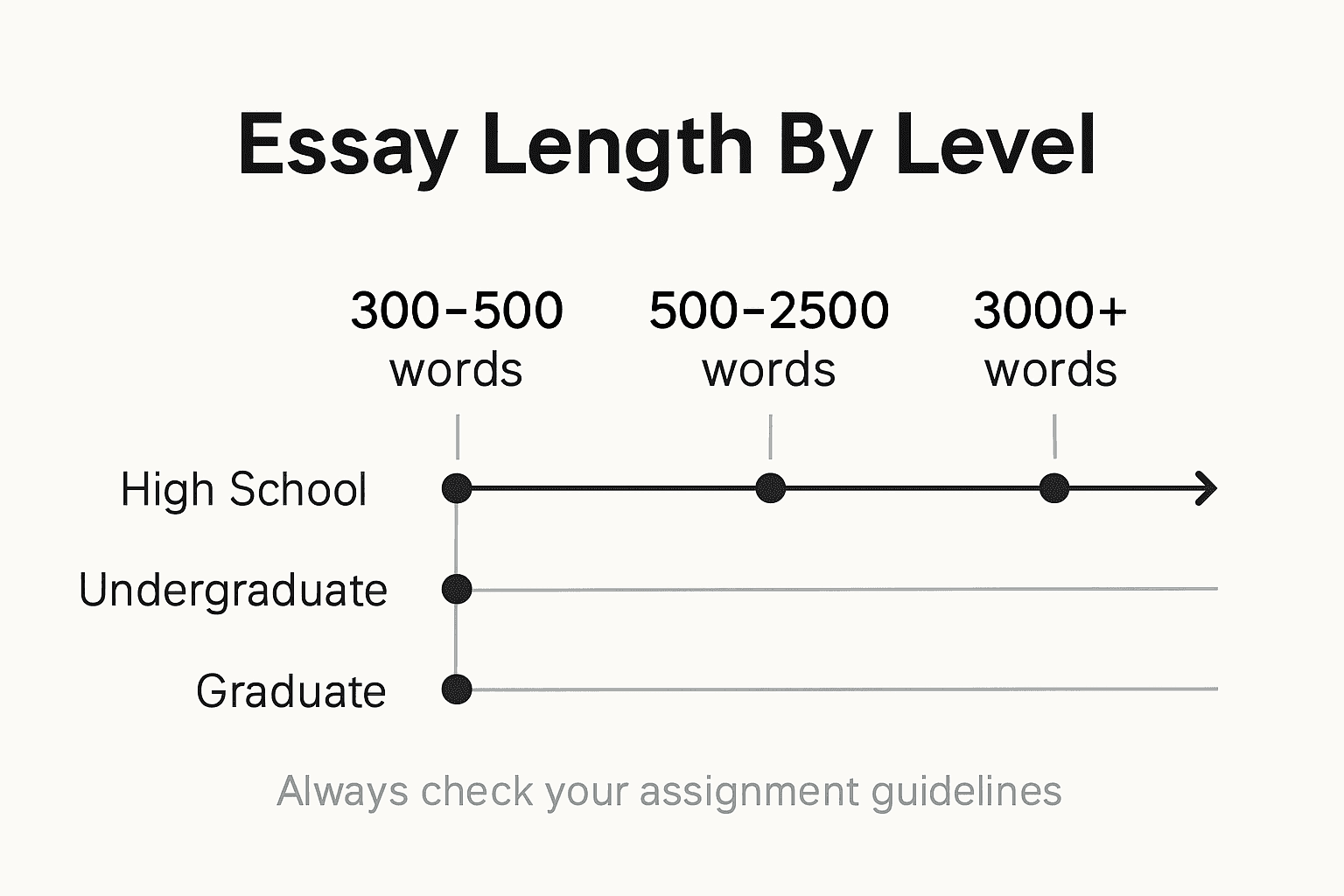
Different academic levels and disciplines demand varied essay lengths. Undergraduate essays often span 500 to 2,500 words, depending on complexity and subject matter. Argumentative essays might require robust research and extensive analysis, pushing word counts toward the higher end of the spectrum. Comparative essays, narrative compositions, and research papers each have distinct structural requirements that influence their recommended length.
Advanced academic writing, such as graduate-level research papers and doctoral dissertations, can extend well beyond standard undergraduate expectations. These comprehensive documents might range from 5,000 to 20,000 words, reflecting the depth of scholarly investigation and critical analysis required at higher academic levels. A 1500 word essay guide can provide valuable insights into structuring longer academic compositions effectively.
Pro tip: Always check specific assignment guidelines, as individual instructors might have unique requirements that deviate from general academic word count recommendations.
Here's a quick comparison of typical academic essay lengths by educational level and essay type:
| Academic Level | Common Essay Types | Typical Word Count Range |
|---|---|---|
| High School | Basic argument, summary | 300–500 words |
| Undergraduate | Argumentative, narrative | 500–2,500 words |
| Graduate/Master's | Research paper, analysis | 3,000–20,000 words |
| Doctoral/PhD | Dissertation, thesis | 5,000–20,000+ words |
Academic writing evolves dramatically across different educational stages, with essay length directly reflecting increasing intellectual complexity. Assignment complexity fundamentally shapes essay expectations/04%3A_Writing_in_College/4.03%3A_Writing_Assignments), creating distinct length requirements that challenge students as they progress through academic levels.
High school essays typically represent the most concise writing form, usually spanning 300 to 500 words. These assignments focus on fundamental skills like basic argument construction, summary, and rudimentary analysis. Undergraduate work introduces more sophisticated requirements, with essays ranging from 500 to 2,500 words. Students must demonstrate deeper critical thinking, engage with scholarly sources, and develop more nuanced arguments that require substantial textual exploration.

Graduate-level academic writing represents the pinnacle of scholarly composition, where length becomes a vehicle for demonstrating profound intellectual engagement. Doctoral and master's level essays often extend from 3,000 to 20,000 words, demanding comprehensive research, theoretical integration, original analysis, and meticulously documented arguments. These extensive compositions reflect the advanced scholarly expectations of terminal degree programs, where depth and precision supersede simplistic word count metrics.
Pro tip: Always review your specific department's style guide, as individual academic programs may have unique length requirements that differ from general academic standards.
Academic essays follow a precise structural framework that ensures clarity and professional presentation. Standardized formatting guidelines dictate critical elements like 1-inch margins, double spacing, and consistent font usage, typically Times New Roman at 12-point size. These technical specifications create a uniform appearance that allows readers to focus on the content rather than visual distractions.
College essay structures traditionally comprise four essential components: a compelling title, an engaging introduction, substantive body paragraphs, and a comprehensive conclusion. The introduction serves as a roadmap, presenting the central thesis and establishing the essay's intellectual context. Body paragraphs develop nuanced arguments through logical progression, with each paragraph representing a distinct yet interconnected idea supported by credible evidence and analytical insights.
Different academic disciplines and citation styles such as APA, MLA, and Chicago impose unique formatting requirements that extend beyond basic structural elements. These guidelines govern everything from in-text citations and reference lists to heading styles and page numbering. Mastering these technical nuances demonstrates a student's academic sophistication and commitment to scholarly communication standards. Precise adherence to these formatting protocols signals intellectual rigor and professional competence.
Pro tip: Always consult your specific institutional style guide, as individual departments may have unique formatting requirements that supersede general academic conventions.
This table summarizes key formatting requirements across popular academic citation styles:
| Aspect | APA Style | MLA Style | Chicago Style |
|---|---|---|---|
| Margin Size | 1 inch | 1 inch | 1 inch |
| Font | Times New Roman, 12 pt | Times New Roman, 12 pt | Times New Roman, 12 pt |
| Line Spacing | Double | Double | Double |
| Reference Format | Author-Date | Works Cited | Bibliography |
Students frequently misunderstand the fundamental relationship between essay length and academic quality. Essay length misconceptions often lead to counterproductive writing strategies that prioritize word count over substantive content. Many mistakenly believe that longer essays automatically translate to higher grades, when in reality, clarity and precision matter far more than sheer volume.
Another prevalent mistake is rigidly interpreting word count requirements without considering the underlying academic objectives. Students might mechanically pad their essays with unnecessary language or, conversely, submit essays that are frustratingly brief. These approaches demonstrate a fundamental misunderstanding of academic writing, which demands thoughtful argumentation, critical analysis, and concise communication. Understanding that word count is a guideline, not a strict mathematical formula, is crucial for developing effective academic writing skills.
Misconceptions about page length versus word count further complicate students' understanding of essay requirements. Different formatting standards can dramatically alter page length, making it essential to focus on the actual word count rather than visual page space. Some students incorrectly assume that adjusting font size, margins, or line spacing can manipulate their essay's perceived length, a strategy that typically backfires and signals academic inexperience to instructors.
Pro tip: Always focus on the quality of your arguments and clarity of expression, treating word count as a structural guideline rather than a primary measure of academic excellence.
Artificial intelligence has revolutionized academic writing support, offering sophisticated solutions for managing essay length and structural requirements. AI-powered writing tools now provide unprecedented assistance in navigating complex word count constraints, helping students maintain precise academic standards while improving overall writing quality.
Modern AI technologies excel at helping students meet specific length requirements through intelligent content generation and editing capabilities. These advanced tools can analyze existing text, suggest expansions or contractions, and provide real-time feedback on essay structure and word count compliance. Academic writing instruction research highlights the nuanced role of AI in supporting students' writing processes, emphasizing that these tools are most effective when used as collaborative assistants rather than replacement writers.
While AI tools offer remarkable precision in length management, students must approach their use with critical awareness. Potential risks include over-reliance, potential loss of personal writing voice, and unintentional plagiarism. Successful AI tool integration requires a balanced approach that leverages technological support while maintaining individual critical thinking and authentic academic expression. Responsible use means viewing AI as a sophisticated writing companion that enhances, rather than replaces, a student's fundamental writing skills.
Pro tip: Always review and personally edit AI-generated content to ensure it accurately reflects your unique voice and academic intentions.
Struggling to meet essay length requirements without sacrificing clarity or academic rigor is a common challenge that every student faces. This article highlights how understanding precise word counts, proper formatting, and assignment level expectations play a critical role in academic success. At the same time, students often feel overwhelmed by balancing these demands while maintaining originality and a strong personal voice.
Samwell.ai offers a cutting-edge solution tailored to these exact pain points. Using our innovative Power Editor, you can effortlessly expand or condense your essays while preserving quality and coherence. Our platform’s AI-driven guidance on formatting standards like APA and MLA also helps ensure every paper meets institutional requirements. With the unique Semihuman.ai technology, you can confidently avoid plagiarism risks and produce authentic, personalized content aligned with academic integrity.
Ready to transform how you handle essay length and structure challenges? Explore how Samwell.ai can streamline your writing process, provide customized content generation, and enhance your academic performance today. Get started now to write smarter and meet every assignment’s demands with ease.
College essays generally range from 400 to 600 words, but this can vary based on specific course requirements and assignment types.
Essay length expectations increase with academic levels; high school essays typically span 300 to 500 words, while undergraduate papers can range from 500 to 2,500 words, and graduate papers often extend from 3,000 to 20,000 words.
Yes, different essay types have unique word count expectations. For example, personal statements are usually 400 to 600 words, while argumentative essays may require more extensive research and analysis, leading to higher word counts.
Understanding essay length is essential for developing concise writing skills, effectively communicating complex ideas, and meeting standardized evaluation criteria in academic settings.