Loading...

Many nursing students encounter confusion when academic writing expectations differ sharply from what they are used to. Understanding the unique demands of nursing essays is vital because clear focus and logical argument reflect not only your academic skills but also your readiness for clinical responsibilities. In this guide, you will discover how a strong purpose statement, thoughtful essay types, and academic integrity are central to standing out, while AI tools can support your growth when used ethically and effectively.
| Point | Details |
|---|---|
| Understanding Purpose Statement | A well-crafted purpose statement anchors your nursing essay, ensuring clarity and focus while revealing your specific argument. |
| Types of Nursing Essays | Familiarize yourself with different types of nursing essays (reflective, argumentative, analytical, descriptive) to match your writing approach with assignment requirements. |
| Emphasis on Structure | Organize your nursing papers with a clear outline to enhance clarity and logical flow in your arguments, preventing aimless writing. |
| Academic Integrity Awareness | Be vigilant about academic integrity: avoid plagiarism and ensure proper citation practices to uphold your credibility in the nursing profession. |
Nursing essays serve a distinctly different purpose than casual writing or even general academic papers. At their core, nursing essays exist to introduce a clear focus and communicate your main argument through what's known as a purpose statement. This isn't about filling pages with information—it's about engaging your reader by outlining your key arguments upfront while maintaining enough intrigue to keep them reading. Think of it like triage in a clinical setting. Just as you prioritize patient care based on urgency and severity, your nursing essay prioritizes the most critical ideas and presents them in a way that sets expectations for everything that follows. Your purpose statement anchors the entire essay, preventing rambling and ensuring every paragraph serves a function within your argument.
Here's where misconceptions often trip up nursing students. Many confuse a strong purpose statement with overly casual phrasing like "This paper will describe" or "This essay discusses." That's impersonal and weak. Instead, your purpose statement should demonstrate scholarly thinking and clear academic phrasing. Rather than saying "This paper will look at patient compliance," you might write "Medication non-compliance in geriatric populations stems from cognitive decline, complex dosing schedules, and inadequate patient education." Notice the difference? The second version reveals your position, not just your topic. It shows you've already analyzed the problem and have something substantive to argue. This clarity establishes your credibility before your reader finishes the introduction.
When you understand the true purpose of nursing essays, you avoid several common pitfalls. Students sometimes treat essays as mere summaries of information they've gathered, when really they should be analytical arguments grounded in evidence. Others hesitate to take clear positions, hedging their statements with vague language. Effective nursing essays combine your voice with scholarly rigor, presenting arguments that matter in clinical practice and healthcare policy. Whether you're writing about evidence-based interventions, ethical dilemmas in patient care, or best practices in nursing education, your purpose statement and overall essay structure should reflect the gravity and complexity of your topic. This distinction separates a competent essay from one that truly demonstrates nursing expertise.
Pro tip: Before you write a single body paragraph, spend 10 minutes crafting your purpose statement as a standalone sentence. Test it by asking: "Does this sentence reveal my specific argument, or just my general topic?" If it passes that test, you have a powerful anchor for your entire essay.
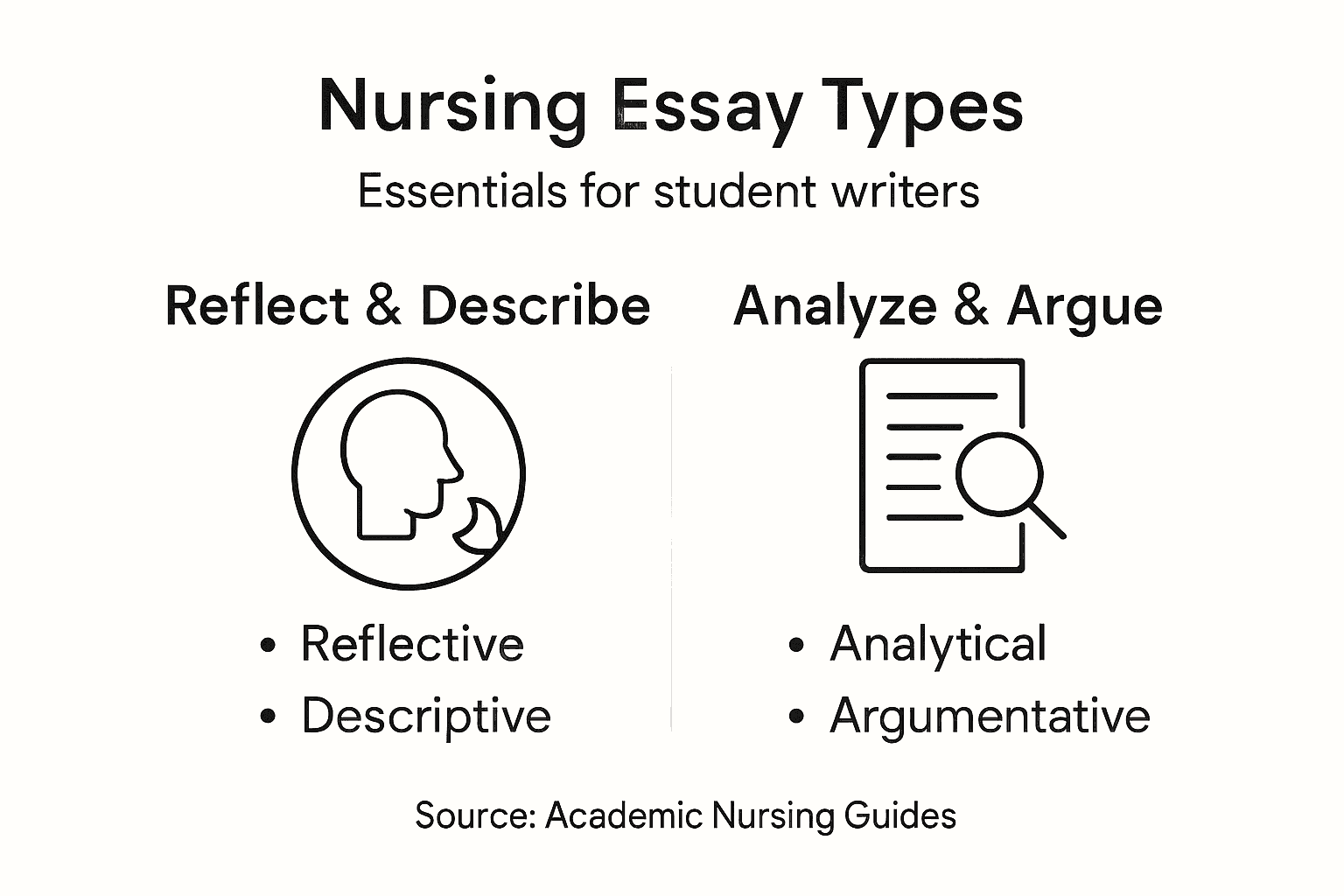
Nursing essays are not one-size-fits-all. Each type serves a distinct purpose and requires different approaches to demonstrate your competencies. The main categories include reflective essays, argumentative essays, analytical essays, and descriptive essays, each demanding specific skills and perspectives. Understanding which type you're writing helps you choose the right structure, tone, and evidence to support your work.
Reflective essays ask you to examine your own clinical experiences and how they've shaped your professional growth. These are personal yet academic. You're not just telling a story about a patient interaction or difficult shift; you're analyzing what you learned, how it challenged your assumptions, and what you'd do differently next time. Reflective writing connects theory to practice in a way that shows deep thinking. Argumentative essays take the opposite approach. Here you make a clear claim about a nursing issue and defend it with evidence. Maybe you're arguing that nurse-led clinics improve patient outcomes, or that mandatory shift limits reduce medication errors. Your job is to present compelling evidence and counter opposing viewpoints. Analytical essays break down nursing theories and concepts to explain how they work and why they matter in practice. You might analyze a specific care model, examine the effectiveness of a particular intervention, or evaluate research findings. Descriptive essays explain procedures, patient conditions, or healthcare settings in clear, detailed ways. These essays help readers understand complex clinical processes or scenarios without necessarily making arguments or reflecting personally.
Here's a quick comparison of the four major nursing essay types and what sets each apart:
| Essay Type | Main Purpose | Example Focus | Skills Demonstrated |
|---|---|---|---|
| Reflective | Analyze personal clinical experiences | Lessons from a challenging patient case | Critical self-reflection |
| Argumentative | Defend a clear position with evidence | Debating nurse-led clinics' impact | Persuasive reasoning |
| Analytical | Break down theories or research findings | Examining a pain management model | Evaluation and explanation |
| Descriptive | Explain clinical processes or scenarios | Detailing IV insertion steps | Clarity and observation skills |
The challenge is matching the essay type to your assignment requirements and learning objectives. If your instructor asks you to "reflect on your clinical practice," a descriptive essay won't work. If they want you to "evaluate the evidence," a reflective essay falls short. Pay close attention to assignment language. Words like "analyze" or "evaluate" signal analytical writing. "Argue" or "defend" signal argumentative writing. "Describe" or "explain" suggest descriptive work. "Reflect" or "critically examine" point toward reflective essays. Many nursing students struggle because they write in the wrong style for their assignment, even if the writing itself is technically sound. Knowing the distinction between these types means you can match your effort to what's actually being asked of you, saving time and earning stronger grades.
Pro tip: Before you start writing, reread your assignment prompt and highlight the action verbs (analyze, argue, reflect, describe). Match those verbs to the essay type, then outline using that type's structure. This single step prevents wasted effort and mismatched approaches.
The writing process for nursing papers differs from general academic writing because your audience expects both evidence and clinical relevance. Start by understanding your assignment requirements, then move through planning, researching, drafting, and revising. Unlike other disciplines that may tolerate exploratory or meandering writing, nursing papers demand clarity and precision from the first draft onward. Your structure should guide readers through your argument logically, with each section building on the previous one.
The foundation of any nursing paper is a strong outline. Before you write a single paragraph, map out your main argument, key supporting points, and evidence you'll use. An essay outline format that works well for nursing papers includes your introduction with a clear thesis, body sections organized by theme or argument, and a conclusion that reinforces your position without simply repeating it. Within each section, identify which sources support which claims. This prevents you from writing without direction or discovering halfway through that you lack evidence for a critical point. Your introduction should answer three questions: What is the topic? Why does it matter in nursing? What is your specific argument? Your body sections should each address one main idea with evidence from research, clinical guidelines, or case examples. Your conclusion should not introduce new information but instead synthesize what you've presented and discuss implications for practice.

The revision stage separates good nursing papers from great ones. After drafting, step away for at least a day, then return with fresh eyes. Read for clarity first, not perfection. Does each paragraph support your thesis? Do transitions between ideas flow naturally? Are your claims backed by evidence, or are you making unsupported assertions? Many nursing students rush through revision, but this is where you catch weak arguments, unclear explanations, and places where readers might lose track of your logic. Check that your citations follow the required format consistently. Verify that clinical terminology is used accurately and that you haven't oversimplified complex concepts. Pay attention to how you present opposing viewpoints. Do you dismiss them unfairly, or do you acknowledge legitimate counterarguments before explaining why your position is stronger? This level of critical thinking distinguishes papers that earn recognition from those that simply meet requirements.
Pro tip: Outline your entire paper before writing a single body paragraph, then share that outline with a classmate or tutor for feedback. Catching structural problems at the outline stage saves you hours of revision later.
Academic integrity matters more in nursing than in many other fields because your credibility as a future healthcare professional depends on it. Admissions committees, employers, and colleagues will evaluate your character based on how you handle academic work. The most common mistakes nursing students make fall into predictable categories, and understanding them helps you avoid serious consequences. Academic integrity in nursing education remains a critical issue because these breaches directly reflect on professional ethics and patient safety mindsets. When students cut corners academically, it signals a willingness to cut corners clinically, which is unacceptable in healthcare.
The most frequent error is misunderstanding what constitutes plagiarism. Students often think plagiarism means copying word-for-word without quotation marks, but that's only one form. Paraphrasing without citing the original source is plagiarism. Using someone else's ideas, structure, or even clinical examples without attribution is plagiarism. Submitting work you've already submitted in another class is self-plagiarism, and many institutions treat it as seriously as stealing from another student. Some students also don't realize that having AI generate entire essays or substantial sections violates academic integrity policies, even if they edit the output. The boundary between using AI as a tool and letting AI do your thinking for you is critical. Another common mistake is inadequate citation. You might cite correctly sometimes but inconsistently, or you might cite sources but fail to cite others. Inconsistency raises red flags with instructors who use plagiarism detection software. Proper citation formatting also matters. If your instructor requires APA format, mixing in MLA citations signals carelessness at best and dishonesty at worst.
Below is a summary of common academic integrity risks in nursing education and their potential consequences:
| Integrity Risk | Example Situation | Potential Consequence |
|---|---|---|
| Plagiarism | Paraphrasing without citing | Academic probation or failure |
| Self-Plagiarism | Reusing your previous paper | Failing assignment or warning |
| Data Fabrication | Inventing patient care results | Dismissal or loss of trust |
| Improper Collaboration | Sharing answers on individual assignments | Disciplinary investigation |
| Citation Inconsistency | Mixing APA and MLA formatting | Grade reduction or redo required |
Beyond plagiarism, nursing students sometimes struggle with other integrity issues. Fabricating data or case examples violates honesty principles and damages the credibility of your argument. Cheating on exams or having someone else complete assignments seems obviously wrong, but stress and time pressure push some students toward these choices. Collaborating inappropriately also happens frequently. Group projects sometimes blur the line between legitimate collaboration and having one person do all the work while others claim credit. If your assignment is supposed to represent individual learning, group completion violates that expectation. The consequences for academic integrity breaches extend far beyond a failing grade. Many nursing programs require students to report integrity violations to licensing boards during credentialing. Some violations can result in program dismissal, which means years of work and investment disappear. Even if you survive the academic consequence, the professional consequence lingers. Building a reputation for honesty now protects your career for decades.
Pro tip: When you paraphrase, write without looking at the original source, then cite it anyway. This prevents accidental plagiarism and forces you to truly understand material instead of just rewording what's written.
AI tools are no longer distant future technology in nursing education. They're becoming practical assets that help you write better essays, think more critically, and prepare for technology-driven healthcare environments. The key is understanding how to use them responsibly as thinking partners rather than shortcuts that bypass your own learning. Implementation of standardized AI curriculum substantially improves nursing students' AI knowledge and acceptance, fostering readiness for technology-integrated clinical practice. When you learn AI alongside your nursing education, you develop both technical competence and the judgment to apply these tools ethically in real patient care situations.
For essay writing specifically, AI empowers you in several concrete ways. These tools help you brainstorm ideas, organize complex arguments, and identify gaps in your reasoning before you commit words to paper. If you're struggling to find the right phrasing for a clinical concept, AI can generate multiple options that you evaluate and adapt. If your essay lacks transitions between ideas, AI can suggest connections you then refine based on your actual argument. The critical distinction is that you remain the author. You decide what stays, what goes, what needs reworking. You verify that AI-generated suggestions are clinically accurate and aligned with evidence-based practice. You ensure the final essay reflects your analysis and professional judgment, not a machine's probabilistic output. Some students use AI to accelerate research by asking it to summarize multiple sources, then they verify those summaries against the originals. This saves hours compared to reading passively, but requires active critical thinking on your part.
Beyond essay writing, understanding how AI enhances clinical decision-making prepares you for actual nursing practice. Healthcare settings increasingly use AI for diagnostics, patient monitoring, and care planning. Nurses who understand both the capabilities and limitations of these tools make better decisions about when to trust AI recommendations and when to escalate concerns. Education on AI empowers nurses with skills to ethically utilize these technologies while maintaining human clinical judgment. This dual competence is what healthcare employers seek. They don't want nurses who blindly follow AI outputs, nor do they want nurses who reject AI entirely out of resistance to change. They want critical thinkers who can integrate technology responsibly into patient care. Starting this perspective now, in your academic work, builds habits that transfer directly to clinical practice.
Pro tip: Use AI to generate essay outlines and alternative arguments, then evaluate those outputs with the same critical eye you'd apply to published research. Ask yourself: Is this accurate? Does this align with my evidence? What would I change? This approach maximizes AI's power while keeping your brain in control.
Nursing essays demand clear purpose statements, precise structure, and rigorous academic integrity as highlighted in the article "Essays in Nursing: Elevating Skills with AI Tools." Many students face challenges like crafting strong arguments, avoiding plagiarism, and matching their writing style to assignment requirements. Samwell.ai understands these pain points and offers an advanced AI-driven platform tailored to help nursing students create high-quality essays. With features such as the 'Power Editor' for refining arguments and 'Guided Essays' for structured outlines, you can develop purpose statements that demonstrate critical thinking and scholarly rigor. Samwell.ai’s unique Semihuman.ai technology safeguards originality, helping you stay confident in academic integrity while navigating complex nursing topics.
Take control of your nursing writing journey today. Explore the benefits of AI-enhanced academic writing with Samwell.ai and transform your drafts into compelling essays that stand out for clarity, accuracy, and professionalism. Whether you need to generate outlines, polish clinical arguments, or verify citation styles like APA and MLA, Samwell.ai offers real-time support to help you meet deadlines and exceed expectations. Don’t let common essay pitfalls hold you back. Visit Samwell.ai now and elevate your nursing papers with smart AI tools designed for your success.
AI tools assist nursing students by helping them brainstorm ideas, organize arguments, and identify gaps in their reasoning, ultimately leading to stronger essays.
The main types of nursing essays include reflective, argumentative, analytical, and descriptive essays, each serving distinct purposes and requiring different approaches.
A purpose statement clearly defines the main argument of your nursing essay, guiding readers through your analysis and establishing your credibility as a writer.
Students can avoid plagiarism by properly citing all sources, paraphrasing correctly, and ensuring they don’t submit previously submitted work, thus maintaining academic integrity.