Loading...

Writing an academic essay about dogs often feels overwhelming when you want your work to stand out and meet university standards. For many students, organizing ideas while capturing the true complexity of the human-canine bond can be a struggle, especially with originality at stake. This introduction highlights the need to go beyond basic description and embrace canine essays as multidimensional scholarly explorations, helping you approach your assignment with confidence and creativity.
| Point | Details |
|---|---|
| Purpose of Dog Essays | Dog essays explore the complex relationship between dogs and humans, analyzing their social, emotional, and biological significance. |
| Types of Dog Essays | Different essay formats, such as persuasive, narrative, and analytical, require unique writing styles and methodologies. |
| Academic Rigor | A successful dog essay demands adherence to scholarly standards, including proper structure, thorough research, and rigorous citation practices. |
| Avoiding Plagiarism | Understanding various forms of plagiarism and employing effective research strategies is crucial for maintaining academic integrity. |
An essay on dogs represents a scholarly exploration of canine existence, relationship dynamics, and cultural significance. These academic papers go far beyond simple descriptions, diving into complex narratives about how dogs interact with human societies, emotions, and evolutionary pathways. The core purpose is to analyze dogs not just as animals, but as significant social and biological entities that profoundly impact human experiences.
Research reveals that dog-focused essays typically examine multiple interconnected dimensions:
The academic landscape for dog essays is rich and multifaceted. Canine domestication mechanisms demonstrate how these animals have been intricately linked with human development. Scholars approach these essays from scientific, anthropological, psychological, and historical viewpoints, creating nuanced narratives that transcend simple animal descriptions.

Understanding dogs requires recognizing their complex role beyond mere companionship. Human well-being research highlights how dogs contribute to emotional health, social bonding, and psychological resilience. An effective dog essay will critically analyze these intricate relationships, presenting evidence-based insights into the profound connections between humans and canines.
Pro tip: When writing your dog essay, focus on presenting original perspectives that go beyond surface-level descriptions and integrate interdisciplinary research for a comprehensive analysis.
Dog essays represent a diverse academic genre with multiple approaches to exploring canine experiences, relationships, and cultural significance. Essay variations capture different analytical perspectives that allow students to showcase their understanding of dogs through unique narrative and research strategies.
The primary types of dog essays include:
Each essay type requires a distinct approach and research methodology. Persuasive essays demand strong argumentative skills, while narrative essays rely on personal storytelling and emotional resonance. Comparative essays challenge writers to develop critical thinking and draw nuanced connections between different subjects.
Successful dog essays transcend simple description, requiring deep research, personal insight, and academic rigor. Writers must balance emotional engagement with scholarly analysis, presenting dogs as complex beings with significant cultural and biological importance.
Pro tip: Select an essay type that aligns with your strengths and interests, ensuring you can provide original insights and maintain academic credibility.
Here's how different types of dog essays differ in writing style and academic benefit:
| Essay Type | Primary Focus | Required Skills | Academic Value |
|---|---|---|---|
| Persuasive | Advocacy and argument | Critical thinking | Influences public perceptions |
| Narrative | Personal experience | Storytelling | Connects reader emotionally |
| Comparative | Contrasting topics | Analytical reasoning | Highlights important distinctions |
| Descriptive | Detailed observation | Descriptive accuracy | Provides vivid context and clarity |
| Analytical | In-depth exploration | Research and synthesis | Generates new academic insights |
Crafting an academic essay on dogs requires adhering to rigorous scholarly standards that demonstrate intellectual depth and research proficiency. Academic essay structure demands precise formatting to effectively communicate complex ideas about canine studies.
The fundamental components of a scholarly dog essay include:
Formal academic requirements extend beyond structural considerations. University writing guidelines emphasize several crucial elements:
Successful dog essays blend scholarly rigor with intellectual curiosity, transforming personal observations into sophisticated academic discourse. Writers must demonstrate deep understanding, critical thinking, and the ability to synthesize complex information about canine experiences, behaviors, and cultural significance.
Pro tip: Always review your draft against academic writing checklists to ensure you meet institutional standards for scholarly excellence.
Maintaining academic integrity requires a comprehensive understanding of plagiarism and strategic approaches to creating original scholarly work. Different types of plagiarism exist that can unintentionally compromise an essay's academic credibility.
Key plagiarism types to understand include:
Effective strategies for ensuring originality involve multiple approaches. Academic integrity policies recommend developing robust research and writing practices:
Writing an original dog essay requires deep engagement with source materials, critical thinking, and a commitment to intellectual honesty. Students must transform research into a unique narrative that reflects personal insights while respecting scholarly conventions and giving proper credit to original sources.
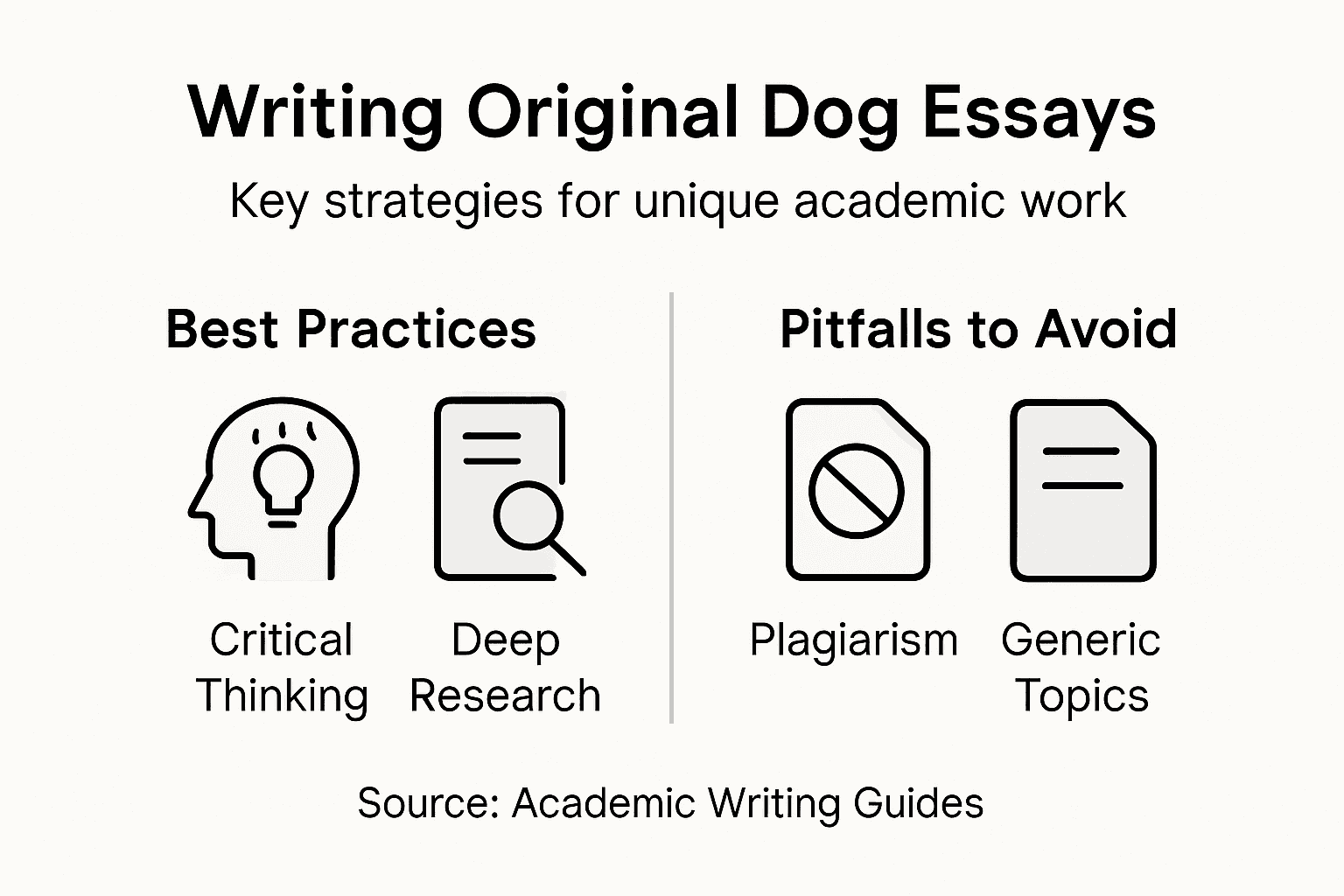
Pro tip: Always cross-reference your draft with multiple plagiarism detection tools and maintain meticulous citation records to ensure complete academic originality.
Successful dog essays require careful navigation of academic writing challenges. Research paper mistakes can significantly undermine the quality and credibility of scholarly work.
Common pitfalls students encounter include:
Most critical mistakes in dog-related academic writing stem from several key areas:
Dog essays demand a sophisticated approach that goes beyond surface-level observations. Students must develop a nuanced understanding of canine studies, combine rigorous research with original insights, and maintain strict academic standards throughout their writing process.
Pro tip: Always create a comprehensive research plan and double-check your draft against assignment guidelines to minimize common academic writing errors.
To help guide your academic process, here is a quick reference to common student mistakes and how to avoid them:
| Common Mistake | Effect on Essay Quality | Recommended Solution |
|---|---|---|
| Insufficient Research | Weak arguments, bias | Use diverse, current sources |
| Poor Note-Taking | Citation errors | Keep organized, detailed notes |
| Weak Thesis | Lack of focus | Refine main argument early |
| Misunderstanding Guidelines | Assignment penalties | Review rubric and ask for clarity |
| Inadequate Citation | Risk of plagiarism | Follow a consistent citation style |
Academic essays on dogs transcend traditional scholarly boundaries, offering profound insights into human-animal relationships and societal dynamics. Research exploring dog ownership impacts reveals critical connections between canine interactions and human well-being.
Key domains of academic dog research include:
These scholarly investigations produce tangible real-world impacts through multiple channels:
Public discourse is significantly shaped by academic dog research, demonstrating broad societal influence through policy recommendations, media representations, and institutional practices. Scholarly work transforms dogs from mere companions to subjects of serious academic inquiry.
Pro tip: Select research topics that bridge academic rigor with practical societal implications to maximize your essay's potential impact.
Writing an original and impactful essay on dogs requires balancing deep research, critical analysis, and flawless academic integrity. If you struggle with creating clear thesis statements, managing citations properly, or avoiding plagiarism pitfalls highlighted in the article, Samwell.ai offers the perfect solution. Our advanced AI-driven platform applies Semihuman.ai technology to help you generate unique content, organize complex ideas, and ensure compliance with MLA or APA standards effortlessly.

Ready to transform your dog essay into a sophisticated academic paper that stands out? Visit Samwell.ai now to access tools like the Power Editor for targeted content refinement and Guided Essays that structure your research with ease. Don’t let common pitfalls hold you back—take advantage of real-time AI checks and produce original, high-quality work with confidence today.
An essay on dogs aims to explore the complex relationships between humans and canines, examining their cultural significance, historical evolution, and emotional impacts. It goes beyond surface-level descriptions to analyze dogs as significant social and biological entities.
There are several types of essays that can be crafted about dogs, including persuasive essays, narrative essays, comparative essays, descriptive essays, and analytical essays, each serving a different analytical focus and requiring unique writing approaches.
A well-structured dog essay should include an introduction with a clear thesis statement, background context, body paragraphs with developed arguments, critical analysis of multiple perspectives, and a concluding section that synthesizes key insights and implications of the research.
Common mistakes include insufficient research, weak thesis statements, poor note-taking, misunderstanding assignment guidelines, and inadequate citation. To avoid these pitfalls, ensure thorough engagement with diverse sources, maintain organized notes, and strictly follow academic writing conventions.