Loading...

Struggling to decide how to cite sources in your American history or literature essay? Understanding the differences between the two major Chicago citation systems is crucial for humanities majors. The Notes-Bibliography system, with its superscript numbers and detailed footnotes, offers flexibility for essays needing commentary and context, while the Author-Date system prioritizes concise source identification. This guide helps clarify the key concepts of Chicago style in-text citation, so you can confidently document your research and avoid common mistakes.
| Point | Details |
|---|---|
| Chicago Style Offers Two Systems | Researchers can choose between the Notes-Bibliography system and the Author-Date system based on their academic discipline. |
| Disciplinary Preferences Matter | Humanities typically favor the Notes-Bibliography system, while social and natural sciences prefer the Author-Date system for quick source identification. |
| Citations must be Accurate | Common errors, such as mixing citation styles or omitting details, can compromise academic integrity. |
| Consult Department Guidelines | Always verify specific formatting requirements with your department, as preferences may vary even within the Chicago style. |
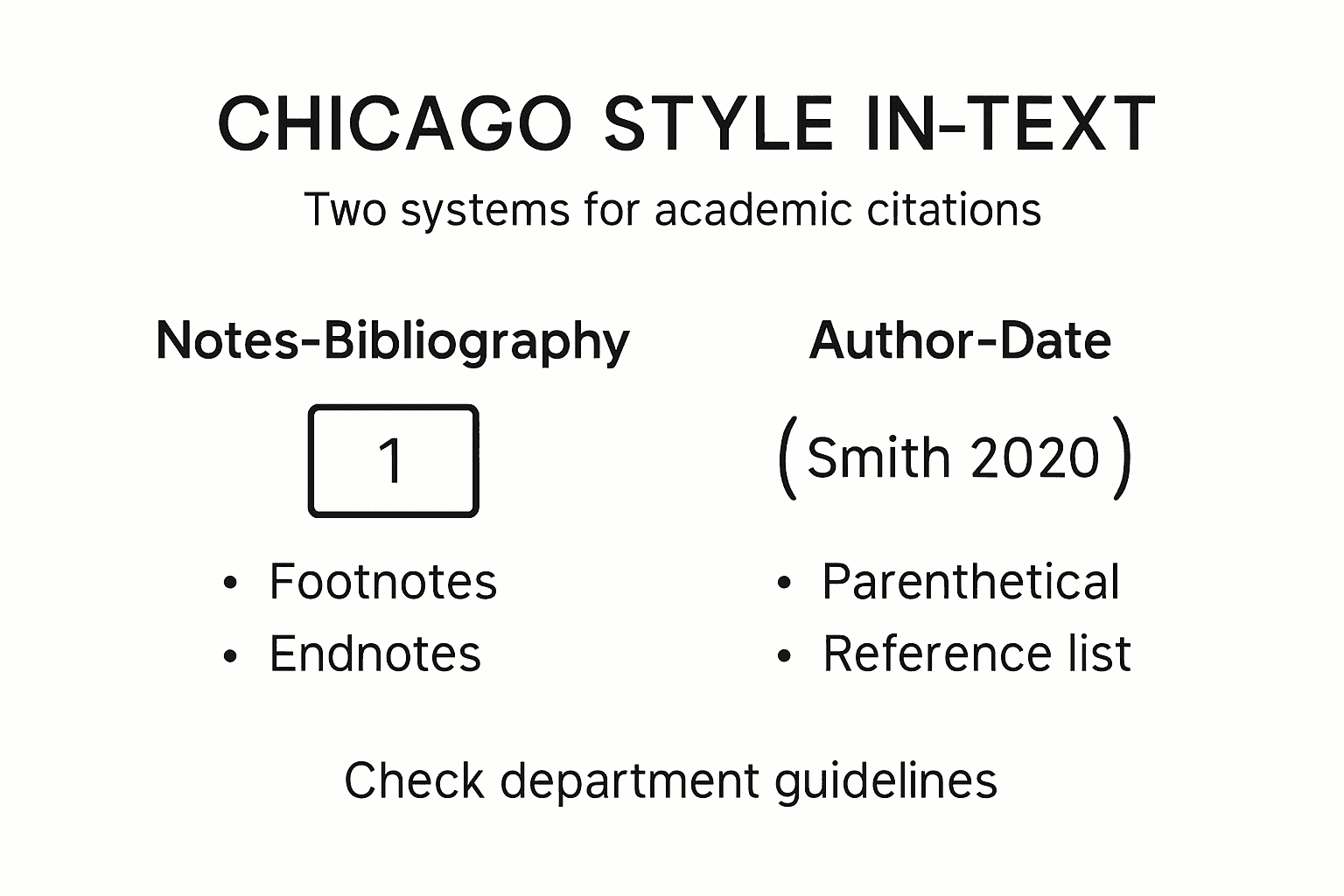
Chicago style in-text citation is a comprehensive academic referencing method used primarily in humanities and social sciences to credit sources and provide readers with clear attribution information. This citation system offers researchers two primary approaches: the Notes-Bibliography system and the Author-Date system, each designed to help scholars document their research comprehensively.
The Chicago Manual of Style citation guide outlines two distinct documentation methods that scholars can employ:
Notes-Bibliography System: Commonly used in literature, history, and arts disciplines
Uses superscript numbers in text
Corresponding footnotes or endnotes provide full citation details
Includes a comprehensive bibliography at document's end
Author-Date System: Preferred in social sciences and natural sciences
Utilizes parenthetical citations with author's last name and publication year
Connects directly to a reference list at document's conclusion
Emphasizes publication dates and quick source identification
Both systems share fundamental principles of academic integrity, ensuring that researchers properly acknowledge intellectual contributions while providing readers with clear pathways to verify and explore source materials. The choice between these two approaches depends primarily on your academic discipline and specific institutional requirements.

Pro tip: Always consult your department's specific guidelines, as some disciplines or individual professors might have unique preferences within the Chicago style framework.
The Chicago Manual of Style presents two distinct citation systems, each designed to meet the specific documentation needs of different academic disciplines. Chicago citation systems differ fundamentally in their approach to crediting sources, reflecting the unique communication requirements of various academic fields.
The key differences between the Notes-Bibliography (NB) and Author-Date systems can be understood through several critical dimensions:
Citation Placement
Notes-Bibliography: Uses superscript numbers linking to footnotes or endnotes
Author-Date: Uses parenthetical citations with author name and publication year
Disciplinary Preference
Notes-Bibliography: Preferred in humanities (literature, history, arts)
Author-Date: Favored in social sciences and natural sciences
Additional Information
Notes-Bibliography: Allows for extensive commentary and supplemental notes
Author-Date: Focuses on concise, date-specific source identification
The choice between these systems is not arbitrary but strategically aligned with the communication norms of different academic domains. Humanities scholars often require more contextual explanation, making the Notes-Bibliography system ideal. In contrast, scientific disciplines prioritize recent research and quick source verification, making the Author-Date system more suitable.
The primary goal of both systems remains consistent: to provide clear, traceable attribution of intellectual sources while maintaining academic integrity.
While the systems differ in format, they share fundamental principles of scholarly communication. Researchers must select the appropriate system based on their discipline's conventions, institutional requirements, and the specific demands of their research project.
Use this summary to quickly select the appropriate Chicago citation system based on your discipline:
| Academic Discipline | Recommended System | Key Reason for Preference |
|---|---|---|
| Literature, History, Arts | Notes-Bibliography | Detailed context & commentary |
| Social Sciences | Author-Date | Rapid source identification |
| Natural Sciences | Author-Date | Emphasis on publication date |
Pro tip: Always verify your department's specific citation guidelines, as some academic units may have unique preferences within the Chicago style framework.
Navigating the intricacies of Chicago style citations requires understanding how to format different types of sources across both the Notes-Bibliography and Author-Date systems. Chicago citation guidelines provide detailed instructions for documenting various source types with precision and clarity.
The formatting for common sources varies significantly between the two citation systems:
Book Citations
Notes-Bibliography: Full footnote with author's name, book title (italicized), publication details
Author-Date: Parenthetical citation with (Author Last Name Year) in text
Journal Article Citations
Notes-Bibliography: Include journal title, volume, issue number, and page range
Author-Date: Emphasize publication year in parenthetical references
Website Citations
Notes-Bibliography: Include website name, article title, publication or access date
Author-Date: Prioritize author (if available) and publication year
The fundamental goal remains consistent: provide enough information to enable readers to locate the original source quickly and accurately. Humanities disciplines typically prefer the more detailed Notes-Bibliography system, while scientific fields gravitate toward the concise Author-Date approach.
Accurate citations are not just about following rules, but about maintaining academic integrity and giving proper credit to original sources.
Researchers must pay close attention to specific formatting nuances, including punctuation, capitalization, and the order of information. Each source type demands careful consideration to ensure proper documentation.
Pro tip: Maintain a consistent style guide or citation template for each source type to streamline your citation process and minimize errors.
Research often presents unique citation challenges that require careful navigation. Chicago citation guidelines offer comprehensive strategies for handling nontraditional sources and complex bibliographic scenarios that fall outside standard documentation protocols.
Academic researchers must be prepared to address several special citation situations:
Multiple Authors
Up to three authors: List all names
Four or more authors: First author followed by "et al."
Corporate or institutional authorship: Use organization name
Digital and Electronic Sources
Include DOI or permanent URL when available
Add access date for web content with potentially changing information
Provide as much publication information as possible
Unpublished or Nontraditional Sources
Interviews: Cite in text or notes, typically not in bibliography
Personal communications: Mention directly in text
Archival materials: Include collection name, archive location
The complexity of citation requires researchers to be both precise and flexible. Different source types demand unique approaches, but the underlying principle remains consistent: provide enough information to help readers locate and verify the original source.
When standard citation information is incomplete, transparency and thorough documentation become paramount.
Both the Notes-Bibliography and Author-Date systems provide frameworks for handling exceptional sources, emphasizing the importance of clarity and academic honesty in research documentation.
Pro tip: Maintain a digital or physical reference guide for unusual sources to ensure consistent and accurate citation across your research project.
Citation errors can significantly undermine academic credibility, making it crucial to understand and prevent common pitfalls in Chicago style documentation. Chicago citation guidelines highlight several recurring mistakes that researchers must carefully navigate.
Academics frequently encounter the following citation challenges:
Inconsistent Citation System
Mixing Notes-Bibliography and Author-Date styles within same document
Not adhering to a single citation approach
Failing to match in-text citations with bibliography format
Punctuation and Formatting Errors
Incorrect placement of superscript numbers
Mishandling punctuation relative to citation marks
Improper italicization of titles
Source Documentation Problems
Omitting critical bibliographic details
Neglecting page numbers for direct quotations
Improper use of "ibid." in citations
The consequences of these errors extend beyond mere technical mistakes. Inconsistent or incorrect citations can raise questions about research integrity, potentially undermining the scholarly value of an entire academic work.
Precision in citation is not about perfection, but about maintaining clear and honest academic communication.
Researchers must develop a systematic approach to citation, carefully reviewing their documentation for consistency, completeness, and adherence to the chosen Chicago style system.
Here's a quick comparison of common Chicago citation errors and how to prevent them:
| Mistake Type | Example of Error | Impact on Academic Work | Prevention Strategy |
|---|---|---|---|
| System Mixing | Using NB and Author-Date together | Reduces credibility; reader confusion | Adhere to one system |
| Incomplete Source Details | Missing publication year or pages | Difficult to verify sources | Double-check citations |
| Incorrect Formatting | Misplaced superscript or italics | Unprofessional appearance, confusion | Use templates, review style |
| Ibid. Misuse | Incorrect "ibid." application | Potential misattribution | Understand "ibid." guidelines |
Pro tip: Create a personal citation checklist that covers the most common errors, and review your document against this list before final submission.
Struggling to navigate the complexities of the Notes-Bibliography or Author-Date systems in Chicago style citation? You are not alone. This article highlights common challenges like inconsistent citation formats, missing bibliographic details, and the need for precise source attribution—issues that can create confusion and threaten academic integrity. Whether you need help with formatting detailed footnotes or crafting concise parenthetical references, understanding Chicago style demands both accuracy and clarity.

Take control of your academic writing journey today with Samwell.ai, an advanced AI-powered platform tailored to streamline your research paper crafting process. Our suite of intelligent tools helps you generate properly formatted citations, maintain consistency throughout your work, and avoid common pitfalls such as improper "ibid." usage or mixed citation styles. Benefit from the 'Power Editor' to refine your papers and the 'Guided Essays' feature to structure your Chicago style research flawlessly. Visit Samwell.ai now to enhance your papers with confidence and ensure your citations meet the highest standards expected by professors and academic institutions.
Chicago style in-text citation is a referencing method used to credit sources in academic writing, primarily in the humanities and social sciences. It includes two systems: Notes-Bibliography and Author-Date.
The Notes-Bibliography system uses superscript numbers linked to footnotes or endnotes, while the Author-Date system utilizes parenthetical citations that include the author's last name and publication year. The former is common in humanities disciplines, whereas the latter is preferred in social sciences and natural sciences.
In the Notes-Bibliography system, a full footnote includes the author's name, the book title (italicized), and publication details. In the Author-Date system, a parenthetical citation includes the author's last name and the publication year.
Common mistakes include mixing citation systems, punctuation and formatting errors, and incomplete source documentation. To avoid these pitfalls, ensure consistency, double-check for critical details, and use templates for formatting.