Loading...

Most American students encounter strict academic standards when citing sources, yet nearly 40 percent experience citation mistakes that could impact their scholarly reputation. Choosing between the different Chicago citation methods often leads to confusion, especially as these citation systems shape the credibility of academic writing. This guide breaks down how Chicago in text citation rules work, helping American researchers and students ensure every reference is properly attributed and consistent with academic expectations.
| Point | Details |
|---|---|
| Understanding Citation Systems | The Chicago Manual of Style provides two main citation methods: Notes and Bibliography, and Author-Date. Each method serves distinct academic disciplines requiring different approaches to source documentation. |
| Notes and Bibliography Style | This method is preferred in humanities disciplines, allowing for detailed footnotes and extensive commentary about sources, enhancing scholarly discussion. |
| Author-Date Style | Common in scientific and social science fields, this method uses parenthetical citations for quick source verification, ensuring a streamlined narrative flow. |
| Consistent Formatting | Academic writers must adhere to specific formatting guidelines and create personal citation checklists to avoid common errors in Chicago style citations. |
The Chicago Manual of Style provides two primary citation systems that academic writers must understand for maintaining scholarly integrity. These systems offer distinct approaches to referencing sources: Notes and Bibliography and Author-Date citation methods. Both systems ensure proper attribution and help prevent academic misconduct by providing clear pathways for acknowledging intellectual contributions.
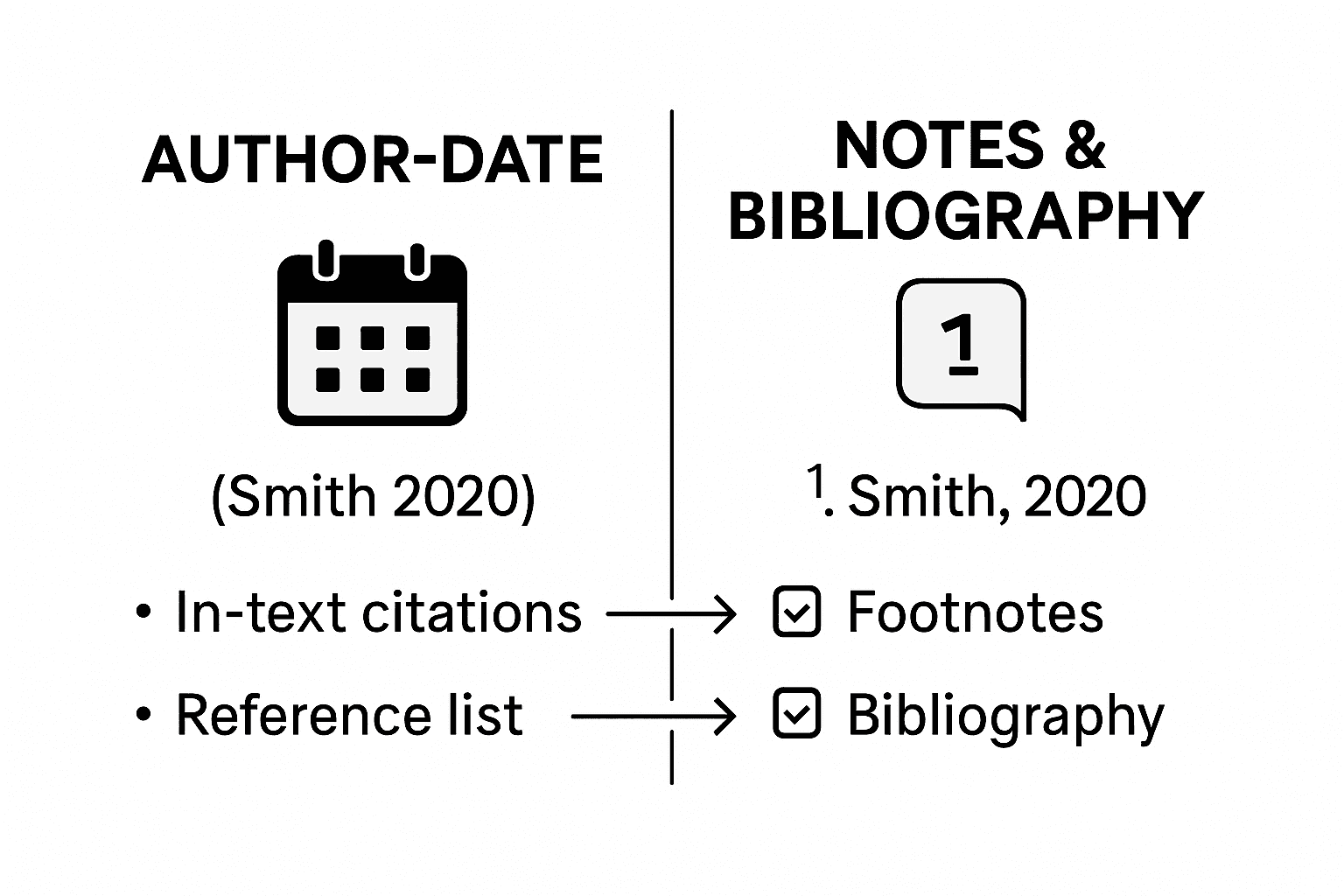
In the Notes and Bibliography system, researchers use footnotes or endnotes to provide detailed source information, accompanied by a comprehensive bibliography at the document's conclusion. This method is particularly popular in humanities disciplines and allows for more extensive commentary and context about sources. Conversely, the Author-Date system employs parenthetical in-text citations with a corresponding reference list, which is more commonly used in scientific and social science publications.
The key difference between these two Chicago citation approaches lies in their presentation style. Notes and Bibliography style allows for more narrative explanation within citations, while Author-Date provides a more direct, streamlined reference method. Researchers must carefully select the appropriate system based on their academic discipline, publication requirements, and the specific conventions of their field.
Pro Research Tip: Choose your Chicago citation style strategically by consulting your department's specific guidelines and examining published works in your academic discipline to ensure precise formatting and consistent scholarly communication.
Here's a concise comparison of Chicago's two primary citation systems:
| Aspect | Author-Date | Notes and Bibliography |
|---|---|---|
| Citation Placement | Parenthetical in-text | Superscript with footnotes/endnotes |
| Source List Name | Reference list | Bibliography |
| Common Academic Fields | Sciences, Social Sciences | Humanities, Arts |
| Flexibility for Commentary | Minimal, direct references | Allows detailed contextual notes |
Understanding the nuanced differences between Chicago Manual of Style citation systems is crucial for academic writing precision. The two primary methods - Author-Date and Notes and Bibliography - serve distinct purposes across various academic disciplines, with each offering unique approaches to source documentation and scholarly attribution.
The Author-Date citation system is predominantly used in scientific and social science fields, featuring concise parenthetical references embedded directly within the text. This method provides immediate source identification, typically including the author's last name and publication year. Researchers appreciate its streamlined approach, which allows readers to quickly trace source information without disrupting the document's narrative flow. In contrast, the Notes and Bibliography system is favored in humanities disciplines, utilizing superscript numbers in the text that correspond to detailed footnotes or endnotes, offering more extensive contextual commentary and bibliographic information.

Key distinctions between these citation styles extend beyond mere formatting. The Author-Date method prioritizes brevity and direct referencing, making it ideal for research that requires quick source verification. Notes and Bibliography style, however, permits more extensive scholarly discussion within citations, allowing researchers to provide additional context, critique, or supplementary insights about their sources. Academic writers must carefully select their citation approach based on disciplinary conventions, publication requirements, and the specific nuanced communication needs of their research.
Pro Research Tip: Always confirm the preferred citation style with your specific academic department or publication guidelines, as individual institutions may have unique requirements that modify standard Chicago Manual of Style formatting approaches.
Mastering the intricacies of Chicago style citation formatting requires understanding the specific requirements for different academic disciplines and research contexts. The two primary Chicago citation methods demand precise attention to detail to ensure academic integrity and proper source acknowledgment.
In the Author-Date system, in-text citations follow a standardized parenthetical format that typically includes the author's last name, publication year, and page number when referencing specific passages. For example, a citation might appear as (Smith, 2022, p. 45), providing immediate context for readers about the source of the referenced information. This approach allows for quick source verification while maintaining a clean, uninterrupted narrative flow in academic writing.

The Notes and Bibliography method presents a more nuanced approach to citations, utilizing superscript numbers within the text that correspond to detailed footnotes or endnotes. These notes provide comprehensive bibliographic information, allowing researchers to include additional commentary, context, or explanatory details that might disrupt the main text. Academic writers must carefully select and consistently apply the appropriate citation method based on their specific discipline's conventions, ensuring precision and scholarly credibility in their documentation.
Pro Research Tip: Create a comprehensive citation style guide for yourself that includes specific examples of correct formatting for both Author-Date and Notes and Bibliography styles, helping you maintain consistency throughout your academic writing.
Navigating the complex world of Chicago style citations requires a systematic approach to documenting different types of sources. Academic writers must understand the nuanced formatting requirements for various reference materials, ensuring precise and consistent documentation across different research contexts.
In the Author-Date citation system, different source types demand specific formatting protocols. For a standard print book, the in-text citation would typically appear as (Author Last Name, Year). For example, (Johnson, 2021) would reference a book by Johnson published in 2021. When citing a specific passage, include the page number: (Johnson, 2021, p. 45). Journal articles follow a similar pattern but might include additional details like volume and issue numbers when relevant. Online sources require careful attention, often including a DOI or web address if no page numbers are available.
The Notes and Bibliography approach offers more flexibility in source documentation. A book citation in a footnote would include full bibliographic information the first time it appears, with subsequent citations using a shortened form. This method allows for more extensive commentary and provides researchers with comprehensive source details. Academic writers must carefully track their citations, ensuring each source is documented completely and consistently throughout their research document.
Pro Research Tip: Create a digital or physical reference sheet with example citations for each source type, helping you quickly verify correct Chicago style formatting for books, articles, websites, and other research materials.
Maintaining academic integrity requires meticulous attention to citation details, especially within the complex Chicago style formatting guidelines. Researchers must be vigilant about potential pitfalls that can compromise the scholarly credibility of their work.
Common citation errors can significantly undermine academic documentation, with mistakes often emerging in three primary areas: footnote placement, bibliography formatting, and inconsistent referencing. In the Notes and Bibliography system, writers frequently misplace punctuation within footnotes, omit critical bibliographic elements, or fail to maintain consistent formatting between in-text citations and the final bibliography. These seemingly minor errors can create substantial challenges for readers attempting to verify sources or understand the research's scholarly foundation.
The Author-Date citation method presents its own set of potential pitfalls. Researchers must carefully track page numbers, ensure consistent author name formatting, and accurately represent source publication details. Particular attention should be paid to online sources, which often require additional verification steps. Academic writers must develop a systematic approach to citation, creating personal reference guides and double-checking their documentation against the Chicago Manual of Style's most current guidelines.
Pro Research Tip: Develop a personal citation checklist that includes specific verification steps for each source type, helping you catch potential formatting errors before submitting your final document.
Use this quick reference for common Chicago citation errors and prevention tips:
| Error Type | Typical Issue | Prevention Strategy |
|---|---|---|
| Footnote Placement | Wrong location or missing content | Double-check after each citation |
| Bibliography Formatting | Inconsistent or missing details | Use a checklist or citation guide |
| Author-Date Consistency | Mismatched author/year/page entries | Cross-reference source list entries |
| Online Source Citation | Missing URL or DOI | Confirm digital access information |
Navigating the complexities of Chicago in-text citation can be overwhelming, especially when you strive to maintain impeccable academic integrity. This article highlights the critical challenges of choosing between Author-Date and Notes and Bibliography styles while avoiding common citation errors. You want to ensure your citations are precise, consistent, and fully compliant with the Chicago Manual of Style to protect your credibility and avoid plagiarism risks.

Discover how Samwell.ai, an advanced AI-driven platform, can transform your research and writing process. With features like the 'Power Editor' for meticulous citation adjustments and real-time AI detection tools, you gain the power to produce flawless, original papers that strictly follow citation standards such as Chicago Author-Date. Don't let complex citation rules delay your success. Take control now and visit Samwell.ai to experience effortless, trustworthy academic writing assistance designed to keep your work authentic and impactful.
The Chicago Manual of Style includes two primary citation systems: Notes and Bibliography and Author-Date. The Notes and Bibliography system utilizes footnotes or endnotes along with a bibliography, while the Author-Date system uses parenthetical in-text citations with a reference list.
Selecting the correct Chicago citation style is crucial because it ensures proper attribution of sources and aligns with the conventions of your specific academic discipline. Different fields prioritize different methods for clarity and coherence in scholarly writing.
In the Author-Date system, in-text citations are formatted using parentheses that include the author's last name, the year of publication, and the page number if necessary. For example, a citation would appear as (Smith, 2022, p. 45).
Common errors in Chicago style citations include incorrect footnote placement, inconsistent formatting in the bibliography, and missing critical citation details. To prevent these errors, develop a personal citation checklist and always double-check your references.