Loading...

Most American college essays lose critical marks because students confuse plot summary with true analysis. Grasping literary analysis is essential for anyone who wants to move beyond surface reading and construct meaningful arguments about texts from British novels to European plays. This guide uncovers practical methods and core concepts that empower you to interpret, argue, and write with confidence, setting you apart in any English literature classroom.
| Point | Details |
|---|---|
| Literary Analysis as Active Exploration | It transforms reading into an active process, emphasizing critical interpretation over mere summary. |
| Methodological Diversity | Various approaches, such as hermeneutic, feminist, and postcolonial analysis, provide unique perspectives for deeper understanding. |
| Importance of Contextual Examination | Analyzing historical and cultural contexts is essential for uncovering a text's deeper meanings. |
| Avoiding Common Pitfalls | Steer clear of conflating summary with analysis and ensure interpretations are supported by textual evidence. |
Literary analysis is a sophisticated intellectual process that transforms reading from a passive experience into an active exploration of textual meaning. At its core, it represents a systematic approach to understanding literature beyond surface narratives, diving deep into underlying themes, authorial techniques, and complex narrative structures. Literary analysis involves critical interpretation that goes far beyond simply summarizing plot points or describing characters.
Understanding literary analysis requires recognizing it as an argumentative process. Unlike basic reading, this approach demands developing a clear, debatable thesis about a text's meaning, themes, or techniques. Scholars and students construct persuasive interpretations by carefully examining how various literary components interact - including metaphor, characterization, plot development, historical context, and narrative voice. These elements become building blocks for constructing nuanced arguments about a work's deeper significance.
The primary goal of literary analysis is not to restate what happens in a text, but to reveal how and why it happens. This means critically examining the author's choices, exploring symbolic representations, understanding character motivations, and connecting textual details to broader cultural or philosophical contexts. Critical reading involves offering an interpretation supported by textual evidence, scholarly insights, and rigorous analytical thinking.
Pro tip: Always develop your literary analysis around a central, arguable claim that emerges directly from close textual examination, not from preconceived notions or external assumptions.
Literary analysis encompasses a rich and diverse array of methodological approaches, each offering unique perspectives for interpreting textual meaning. Research methods in literary studies vary widely, ranging from close reading techniques to complex theoretical frameworks that explore social and cultural contexts. These methods are not isolated techniques but interconnected strategies for unpacking the intricate layers of literary works.
Some primary approaches include hermeneutic analysis, which focuses on understanding and interpreting texts through deep contextual examination. Feminist literary criticism explores gender dynamics and representations, while postcolonial analysis investigates how colonial histories shape narrative structures. Textual analysis approaches like new historicism examine literary works through specific cultural and historical lenses, revealing how texts reflect and challenge societal power dynamics.
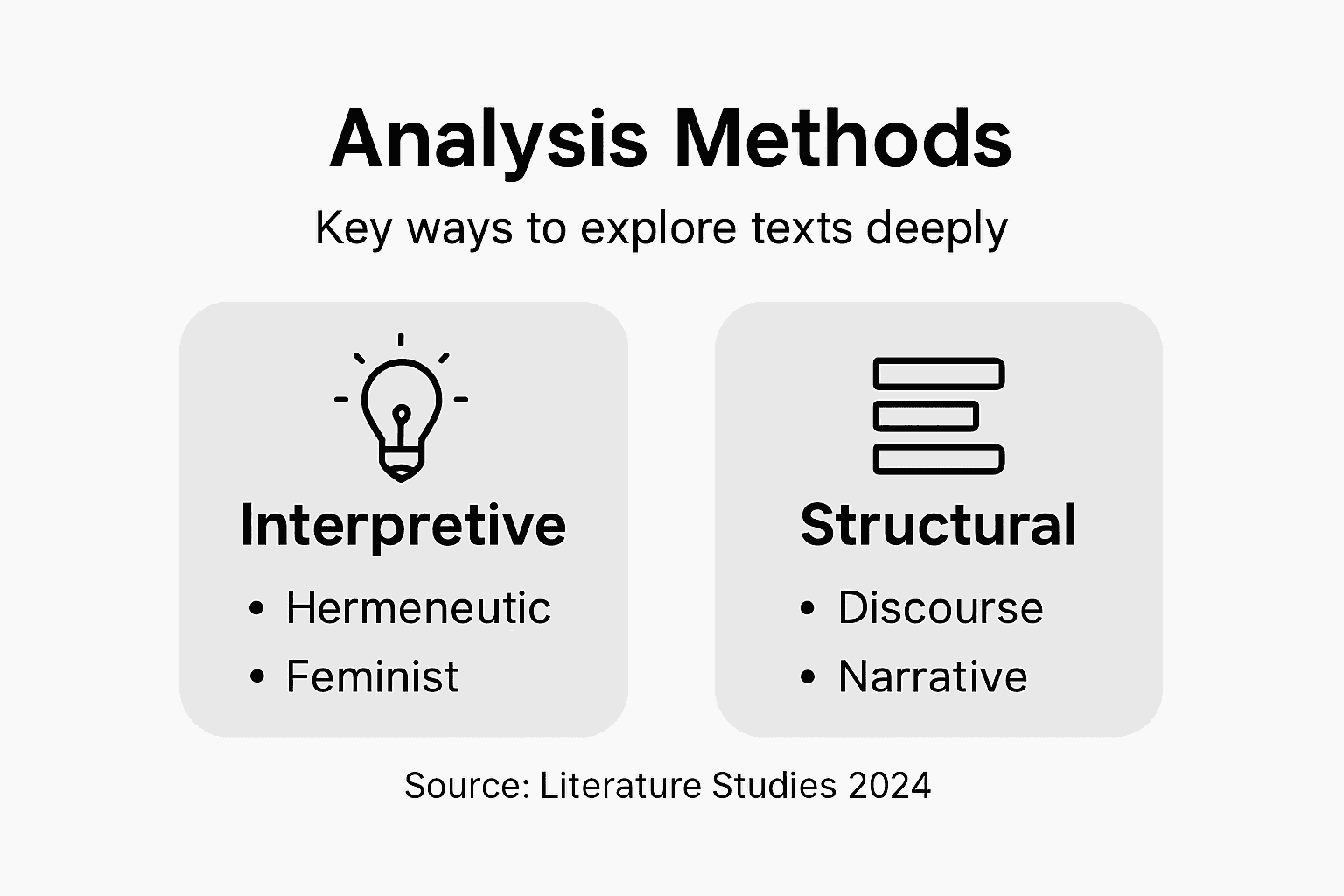
Other significant methods include discourse analysis, which examines language patterns and rhetorical strategies, and cognitive poetics, which investigates how readers mentally process and construct meaning from texts. Comparative analysis allows scholars to explore relationships between different texts, authors, or literary traditions, revealing broader patterns of literary expression. Each method provides a unique toolkit for understanding literature's complexity, demonstrating that literary analysis is not a singular approach but a multifaceted intellectual endeavor.
Pro tip: Experiment with multiple analytical methods when studying a text to develop a more comprehensive and nuanced understanding of its deeper meanings and cultural significance.
Here's a comparison of major literary analysis methods and their focus areas:
| Method | Key Focus | Typical Application |
|---|---|---|
| Hermeneutic Analysis | Contextual understanding | Deep exploration of meaning |
| Feminist Criticism | Gender relationships | Examining female representation |
| Postcolonial Analysis | Colonial impact | Investigating historical context |
| New Historicism | Cultural power dynamics | Linking text to social issues |
| Discourse Analysis | Language use | Analyzing speech and rhetoric |
| Cognitive Poetics | Reader perception | Studying mental interpretation |
| Comparative Analysis | Cross-text relationships | Comparing themes and styles |
Key elements in literary analysis form a complex framework for understanding literary works beyond their surface narratives. These fundamental components include narrative structure, characterization, thematic development, and various literary devices that collectively contribute to a text's deeper meanings. Analyzing these elements requires a systematic approach that goes beyond simple plot summary, demanding critical thinking and nuanced interpretation.

Critical analysis involves examining multiple dimensions of a literary work. Narrative perspective plays a crucial role in understanding how stories are constructed and experienced. This includes investigating the narrator's reliability, point of view, and the way narrative voice shapes readers' perceptions. Literary analysis techniques also require careful consideration of contextual elements such as historical background, cultural influences, and the author's biographical information that might illuminate the text's deeper significance.
Literary devices serve as powerful tools for deeper textual interpretation. Metaphors, symbolism, imagery, and rhetorical strategies are not mere decorative elements but critical mechanisms for conveying complex ideas. Scholars must pay attention to how these devices interact within the text, revealing layers of meaning that might not be immediately apparent. Comparative analysis, examining how different literary elements work together, can uncover intricate relationships between form, content, and broader cultural narratives.
Pro tip: Develop a systematic approach to literary analysis by creating a detailed annotated reading that tracks narrative elements, literary devices, and your initial interpretations.
The following table consolidates core elements and techniques involved in robust literary analysis:
| Element | Purpose | Example in Practice |
|---|---|---|
| Narrative Structure | Organize story progression | Plot twists and pacing |
| Characterization | Develop believable characters | Motivations and backgrounds |
| Thematic Development | Uncover underlying messages | Symbolism and recurring motifs |
| Literary Devices | Add meaning and depth | Use of metaphor or imagery |
Interpreting literary works demands a sophisticated approach that goes beyond surface-level reading. Effective interpretation requires developing a nuanced framework that connects textual details with broader theoretical perspectives. Interpretive strategies involve recognizing patterns, identifying significant textual elements, and mapping these observations onto critical theoretical approaches such as psychoanalytic, feminist, or postcolonial frameworks.
The process of literary interpretation is fundamentally an intellectual dialogue between the reader and the text. Scholarly literary interpretation requires careful examination of contextual elements, including historical background, cultural influences, and the author's biographical context. Scholars must develop a multi-layered approach that considers how different theoretical lenses can reveal hidden meanings, power dynamics, and complex narrative structures that are not immediately apparent.
Successful interpretation involves building a coherent argument supported by textual evidence. This means moving beyond personal reactions to construct a reasoned analysis that considers alternative perspectives. Scholars should practice close reading techniques, paying attention to linguistic nuances, symbolic representations, and the intricate ways literary devices communicate complex ideas. Comparative analysis and cross-referencing with other scholarly interpretations can provide additional depth and credibility to one's literary analysis.
Pro tip: Develop a systematic annotation method that tracks textual evidence, potential interpretive angles, and connections to broader theoretical frameworks.
Common pitfalls in literary analysis can significantly undermine the effectiveness of academic writing. Many students fall into predictable traps that weaken their critical arguments. The most fundamental error is conflating plot summary with genuine analysis, which transforms a potentially insightful paper into a mere narrative retelling. Effective literary analysis requires moving beyond chronological description to construct meaningful interpretations supported by rigorous textual evidence.
Scholarly interpretation demands critical reflection that avoids several common mistakes. Students often make the error of presenting overly subjective interpretations without substantive textual support, treating literary analysis as a platform for personal opinion rather than a scholarly investigation. Another significant pitfall involves making sweeping generalizations about a text's meaning without acknowledging the complexity of literary interpretation. Successful analysis requires nuanced arguments that recognize multiple potential readings while maintaining a clear, evidence-based perspective.
Additional mistakes to avoid include neglecting contextual understanding, relying on superficial readings, and failing to engage with alternative critical perspectives. Scholars must be willing to challenge their initial interpretations, seek out counterarguments, and develop analytical approaches that demonstrate intellectual rigor. This means moving beyond surface-level observations to explore the deeper symbolic, historical, and cultural dimensions of literary works. Developing a sophisticated analytical approach requires intellectual humility and a commitment to thorough, evidence-driven interpretation.
Pro tip: Always substantiate your literary analysis with direct textual evidence and be prepared to critically examine your own interpretative assumptions.
Struggling to transform your reading into insightful literary analysis that reveals deeper meanings and builds strong critical arguments? You are not alone. Many students find it challenging to move beyond mere plot summaries and develop well-supported interpretations of complex texts. Samwell.ai understands the pain points outlined in "Analysis in Literature: Unlocking Deeper Meaning," such as navigating thematic development, employing multiple analysis methods, and avoiding common pitfalls like unsupported opinions.

Take your literary analysis to the next level using Samwell.ai's advanced AI tools. Benefit from:
Do not let complexity slow you down. Visit Samwell.ai now to experience how AI-powered writing assistance can help you craft nuanced, evidence-based literary analyses that stand out. Begin mastering literary interpretation with confidence and precision today.
Literary analysis is a systematic approach to understanding literature by exploring its underlying themes, authorial techniques, and complex narrative structures, moving beyond mere plot summary to interpret deeper meanings.
To develop a thesis, focus on a clear, debatable claim that emerges from close examination of the text, rather than preconceived notions. Your thesis should reflect an interpretation that connects various literary components.
Common methods include hermeneutic analysis, feminist criticism, postcolonial analysis, new historicism, discourse analysis, cognitive poetics, and comparative analysis, each offering unique perspectives on understanding literary works.
Avoid conflating plot summary with analysis, making unwarranted generalizations, and relying solely on subjective interpretations. Always substantiate claims with textual evidence and engage critically with alternative perspectives.