Loading...

Finishing your essay can sometimes feel harder than writing the rest of it. Wrapping up your thoughts in a clear, impactful way is a challenge every writer faces. When the conclusion falls flat, your whole argument can lose its power.
If you want your final sentences to leave a real impression, you need strategies that go beyond just restating your ideas. This guide will show you practical techniques for writing concluding sentences that connect your main points, highlight their significance, and leave your reader with something memorable. Get ready to unlock new ways to bring your writing to a strong and satisfying close.
| Takeaway | Explanation |
|---|---|
| 1. Concluding sentences unify your essay | They synthesize key points and reaffirm the thesis while linking arguments to broader implications. |
| 2. Avoid redundancy in summaries | Use fresh language and perspectives to summarize your arguments without simply repeating what has already been said. |
| 3. Transition words enhance clarity | Strategic use of transition words provides logical connections, improving coherence and guiding readers through your argument. |
| 4. Do not introduce new information | Ensure that your concluding sentence focuses on synthesizing existing ideas rather than presenting unfamiliar concepts that can confuse readers. |
| 5. End with a thought-provoking statement | Leave readers with a compelling final thought that encourages reflection or further inquiry beyond your essay's content. |
A concluding sentence is more than just a summary. It is the strategic finale that ties together your essay's entire narrative and leaves a lasting impression on your reader. Think of it as the closing argument that reinforces your central thesis and propels your argument's significance beyond the paper itself.
The primary purpose of a concluding sentence is multifaceted:
Writing a powerful concluding sentence requires understanding its role as a bridge between your specific arguments and the wider intellectual landscape. It should do more than merely restate what you've already written. Instead, it should demonstrate the broader significance of your research or argument.
A great concluding sentence transforms your essay from a simple collection of paragraphs into a cohesive intellectual narrative.
To craft an effective concluding sentence, consider how your argument relates to larger academic or real-world contexts. What broader questions does your research raise? How might your insights contribute to ongoing scholarly discussions?
Pro tip: Practice creating concluding sentences that zoom out from specific details to reveal wider intellectual horizons, leaving readers with a sense of meaningful discovery.
Crafting a concluding sentence that summarizes your key points without falling into the trap of mindless repetition is an art form. Your goal is to synthesize your argument's essence while providing fresh insight that propels your reader's understanding forward.
To effectively summarize without redundancy, consider these strategic approaches:
The secret lies in synthesizing ideas strategically. Instead of restating each paragraph verbatim, look for thematic connections that demonstrate how your individual arguments interlock to form a comprehensive narrative.
A strong conclusion transforms isolated points into a compelling intellectual journey.
Your concluding sentence should act like a intellectual prism refracting your arguments into a more expansive understanding. By shifting your language and perspective, you signal to readers that your essay is not just about reciting facts but about generating meaningful insights.
Think of your concluding sentence as a strategic zoom lens that moves from microscopic details to a panoramic view of your argument's significance.
Pro tip: Draft your concluding sentence by asking yourself what larger question or implication emerges from your specific arguments.
Your concluding sentence is the final thread that weaves your entire essay back to its foundational argument. It is not just a summary but a strategic reconnection to your original thesis that demonstrates how your arguments have fulfilled or expanded upon your initial premise.
Connecting your conclusion to the thesis requires more than simple repetition. Instead, you want to:
The art of reconnection lies in reflecting on research aims with a fresh perspective. Your concluding sentence should signal to readers that you have not just described a topic but critically explored its nuances and potential impact.
A powerful conclusion transforms your thesis from a mere statement into a compelling intellectual journey.
Think of your concluding sentence as a prism that refracts your original thesis into a more complex and illuminating spectrum of understanding. By showing how your specific arguments contribute to a larger intellectual landscape, you elevate your essay from a simple description to a meaningful contribution.
Remember that your goal is to leave readers with a sense that your essay has thoroughly investigated the thesis while simultaneously opening doors to further exploration and thinking.
Pro tip: Draft your concluding sentence by asking how your specific arguments have deepened or transformed the perspective suggested in your original thesis statement.
Transition words are the subtle bridges that guide your readers through the intellectual landscape of your essay. They are not mere decorative elements but strategic tools that create logical connections and enhance the overall coherence of your writing.
Effective transition words for concluding sentences include:
These linguistic signposts do more than connect sentences. They illuminate relationships between ideas and help readers understand the progression of your argument. By carefully selecting transition words, you create a sense of intellectual momentum that carries your reader from specific details to broader insights.
Transition words are the silent conductors that orchestrate the symphony of your academic argument.
Think of transition words as the invisible architecture of your essay. They signal shifts in perspective, highlight cause and effect relationships, and provide intellectual context that transforms a collection of paragraphs into a cohesive narrative.
When crafting your concluding sentence, choose transition words that not only connect ideas but also elevate the sophistication of your writing. Your goal is to demonstrate how individual arguments interconnect to form a comprehensive understanding.
Pro tip: Read your concluding sentence aloud and listen for how smoothly the transition word guides the reader from your specific arguments to a broader perspective.
Your concluding sentence is a destination, not a departure point. Introducing fresh arguments or complex ideas at the end of your essay can leave readers confused and undermine the carefully constructed narrative you have developed throughout your paper.
Potential pitfalls of introducing new information include:
The concluding sentence should synthesize existing ideas, not spawn new intellectual threads. Effective conclusions focus on synthesis and broader implications rather than expanding your argumentative landscape.
A powerful conclusion illuminates what is already known rather than introducing what remains unexplored.
Think of your concluding sentence as a panoramic lens that pulls back to reveal the comprehensive view of your argument. Your goal is to provide closure, perspective, and meaning by reflecting on the arguments you have already presented.
Remember that the conclusion is your final opportunity to demonstrate the significance of your research and leave a lasting intellectual impression on your readers.
Pro tip: Before finalizing your concluding sentence, review it carefully to ensure you are reflecting on existing ideas rather than generating new ones.
Your concluding sentence is more than a summary. It is your final opportunity to transform a collection of arguments into a memorable intellectual experience that resonates long after the reader has finished your essay.
Strategic ways to leave a lasting impression include:
The goal is to extend the essay's intellectual reach beyond its immediate context. Your final thought should spark curiosity, challenge assumptions, or invite deeper contemplation.
A powerful concluding sentence does not end a conversation but begins one.
Think of your final thought as an intellectual invitation. You are not just closing an argument but opening a doorway to broader understanding. The most effective concluding sentences make readers pause, reflect, and see the topic from a fresh perspective.
Consider how your specific arguments connect to larger questions or universal experiences that transcend the immediate text. Your goal is to leave readers with a sense of intellectual momentum and potential.
Pro tip: Draft multiple versions of your final thought and select the one that most powerfully transforms your specific argument into a broader insight.
Artificial intelligence has transformed academic writing, offering sophisticated support for crafting precise and compelling concluding sentences. These advanced tools go beyond simple grammar checking to provide nuanced suggestions that can elevate your essay's final moments.
Key benefits of AI writing tools include:
By exploring AI writing assistance, students can transform their concluding sentences from mundane summaries to powerful intellectual statements. These tools analyze your entire essay's context to generate recommendations that maintain your unique voice while enhancing clarity and impact.
AI tools are not replacements for human creativity but powerful collaborators in academic writing.
Think of AI writing tools as intelligent writing partners that offer objective perspectives on your concluding sentence. They can help you identify subtle ways to strengthen your argument's final impression without losing the essence of your original thought.
Most advanced AI writing platforms now offer contextual analysis that goes beyond surface-level corrections. They understand academic writing conventions and can suggest improvements that align with scholarly communication standards.
Pro tip: Always review and personalize AI-generated suggestions to ensure they genuinely reflect your academic voice and argument.
Below is a comprehensive table summarizing the key strategies and points for crafting an effective concluding sentence as discussed in the article.
| Aspect | Description | Key Considerations |
|---|---|---|
| Purpose of Concluding Sentence | Functions as the strategic finale tying the essay together and presenting broader implications. | Focus on synthesis, reaffirming the thesis, and presenting wider intellectual significance. |
| Avoiding Repetition | Summarize key points using varying language and connecting arguments to broader context. | Reframe core ideas without duplicating content; create thematic connections. |
| Connection to Thesis | Reinvolve the thesis to validate and expand upon its claims. | Show deeper implications and provide closure through reflection on the essay's themes. |
| Use of Transition Words | Employ words like "Consequently," "Ultimately," and "As a result" to ensure seamless narrative flow. | Choose words that logically connect ideas and elevate the writing's sophistication. |
| Excluding New Information | Concluding sentences should synthesize presented arguments without introducing new topics. | Focus on providing closure and extracting broader significance. |
| Leaving a Final Thought | End with a provocative question or broader implication that invites reflection and extends intellectual engagement. | Craft sentences that resonate and provoke further exploration. |
| AI Support for Writing | Utilize AI tools for phrasal refinements, tone consistency, and enhancing impact. | Combine AI suggestions with personal edits for authentic and scholarly conclusions. |
Writing a strong concluding sentence is crucial to synthesizing your main ideas and connecting back to your thesis, yet many students struggle to craft that perfect intellectual closure without repeating themselves or introducing new information. If you find yourself stuck on how to create a memorable final thought that smoothly transitions and leaves a lasting impression, you are not alone. This challenge requires not only critical thinking but also precise language and strategic phrasing.
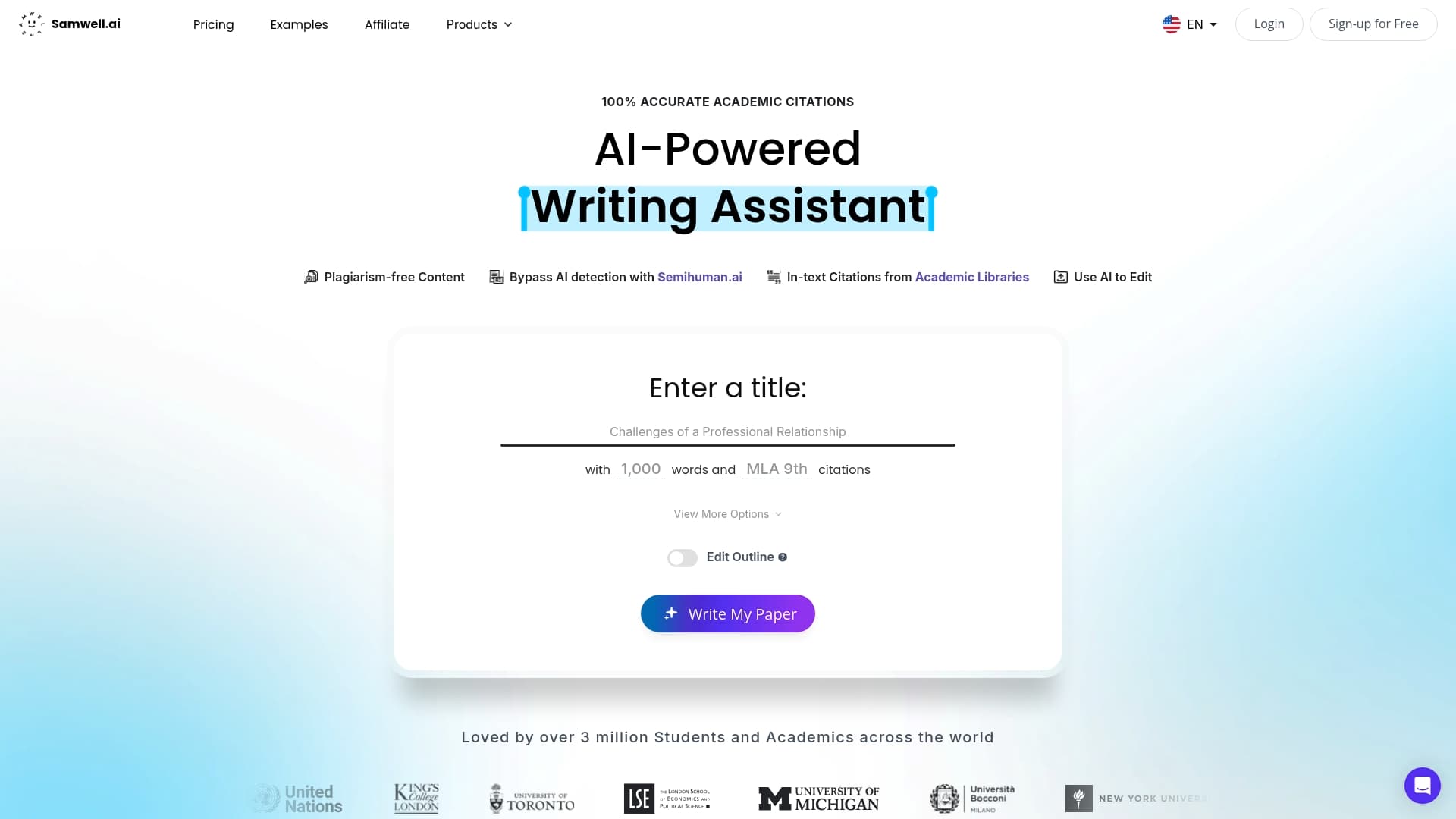
Experience the power of Samwell.ai, an AI-driven platform designed specifically to enhance your academic writing process. Whether you need help reframing your thesis in your conclusion, finding the right transition words, or avoiding redundancy, Samwell.ai’s Power Editor and advanced AI tools provide personalized suggestions to polish your concluding sentences. Don’t miss your chance to transform your essay's final moments into a compelling intellectual journey that leaves your readers thinking. Visit Samwell.ai now to get started and unlock smarter, clearer, and more impactful conclusions.
The purpose of a concluding sentence is to synthesize key points and reaffirm the central thesis of your essay. It should tie together your arguments and highlight their broader significance, providing your reader with intellectual closure.
You can summarize main ideas by reframing key points using different language and connecting individual arguments to their broader implications. Focus on thematic connections to create a cohesive narrative without redundancy.
Effective transition words such as "consequently," "therefore," and "ultimately" can seamlessly guide readers to the conclusion of your essay. Incorporate these transitions to improve the flow and coherence of your final thoughts.
To connect your conclusion back to your thesis, reframe it with new understanding and demonstrate how your arguments validate the original claim. This will reinforce the impact of your research and show how it contributes to the larger context of your topic.
You can leave final thoughts by posing a provocative question, suggesting broader implications, or connecting to universal human experiences. Choose an approach that invites further reflection and discussion on your topic.
No, you should avoid introducing new information in your concluding sentence, as it can confuse readers and disrupt the flow of your essay. Instead, focus on synthesizing and reflecting on the ideas you have already presented.