Loading...

Staring at a 3000-word essay requirement can make any university student pause, especially when word count feels like a moving target depending on formatting. Clarifying how those 3000 words translate to pages matters for proper planning, time management, and meeting your professor's expectations. With academic guidelines highlighting that standard formatting yields about 10 to 12 pages for 3000 words, this guide will break down the process so you can focus on research and strong writing rather than guesswork.
| Point | Details |
|---|---|
| Understanding Word Count | A 3000-word essay typically spans 10 to 12 pages, depending on formatting choices like font and spacing. Knowing this helps in planning and structuring your work effectively. |
| Importance of Planning | Create a detailed outline to allocate your word count across sections, which aids in maintaining focus and organization throughout your writing. |
| Formatting Matters | Your choice of font, line spacing, and margins can significantly impact the page count of your essay, requiring attention to meet professor expectations. |
| Avoid Common Mistakes | Students should verify their word count, avoid unnecessary padding, and understand any specific formatting guidelines to prevent losing points on assignments. |
When you're assigned a 3000-word essay, you're looking at a substantial piece of academic writing that sits between a basic research paper and a full thesis chapter. This word count typically translates to approximately 10 to 12 pages in standard academic formatting (double-spaced with 1-inch margins and a standard font like Times New Roman or Arial at 12 points). The exact page count depends on several factors: your font choice, line spacing, margin widths, and how much space your citations and formatting take up. Understanding what 3000 words actually means in the context of academic work helps you plan your research, structure your argument, and manage your writing timeline effectively.
In academic settings, word count serves as a specific constraint that shapes how you develop your ideas. Unlike page counts, which can fluctuate based on formatting choices, a word count gives you a precise target. Three thousand words provides enough space to develop a nuanced argument with substantial evidence, multiple perspectives, and thorough analysis. This length commonly appears in upper-level undergraduate courses where professors expect you to go beyond surface-level discussion. You'll have room to introduce your topic, present your thesis, develop several supporting arguments with specific examples, address counterarguments, and reach a meaningful conclusion. The constraint also trains you to be selective about your sources and deliberate about which evidence truly strengthens your position.
The relationship between word choice and academic writing quality becomes especially important at this length. Research shows that mastery of academic vocabulary directly impacts both comprehension and production of academic texts, with particular emphasis on high-frequency academic words that appear across disciplines. Your 3000 words should be composed primarily of precise, discipline-specific language rather than casual or filler phrases. This means every hundred words needs to advance your argument meaningfully. When you're crafting comparatively longer essays, planning becomes critical to ensure you maintain focus throughout rather than padding your work with unnecessary repetition.
Many students underestimate the planning phase for a 3000-word assignment. Spending time creating a detailed outline prevents you from wandering off topic and helps you allocate your word count strategically across sections. A typical breakdown might look like this: introduction (250-300 words), body sections (2200-2400 words distributed among 3-4 main points), and conclusion (250-300 words). This structure gives you clear targets for each section and keeps your writing organized. The word count itself becomes a helpful organizational tool rather than just a requirement to meet.
Pro tip: Use your word processor's word count tool to track progress as you write, aiming to hit word counts for each section before moving forward. This prevents last-minute scrambling and helps you notice which sections need expansion or trimming early in the revision process.
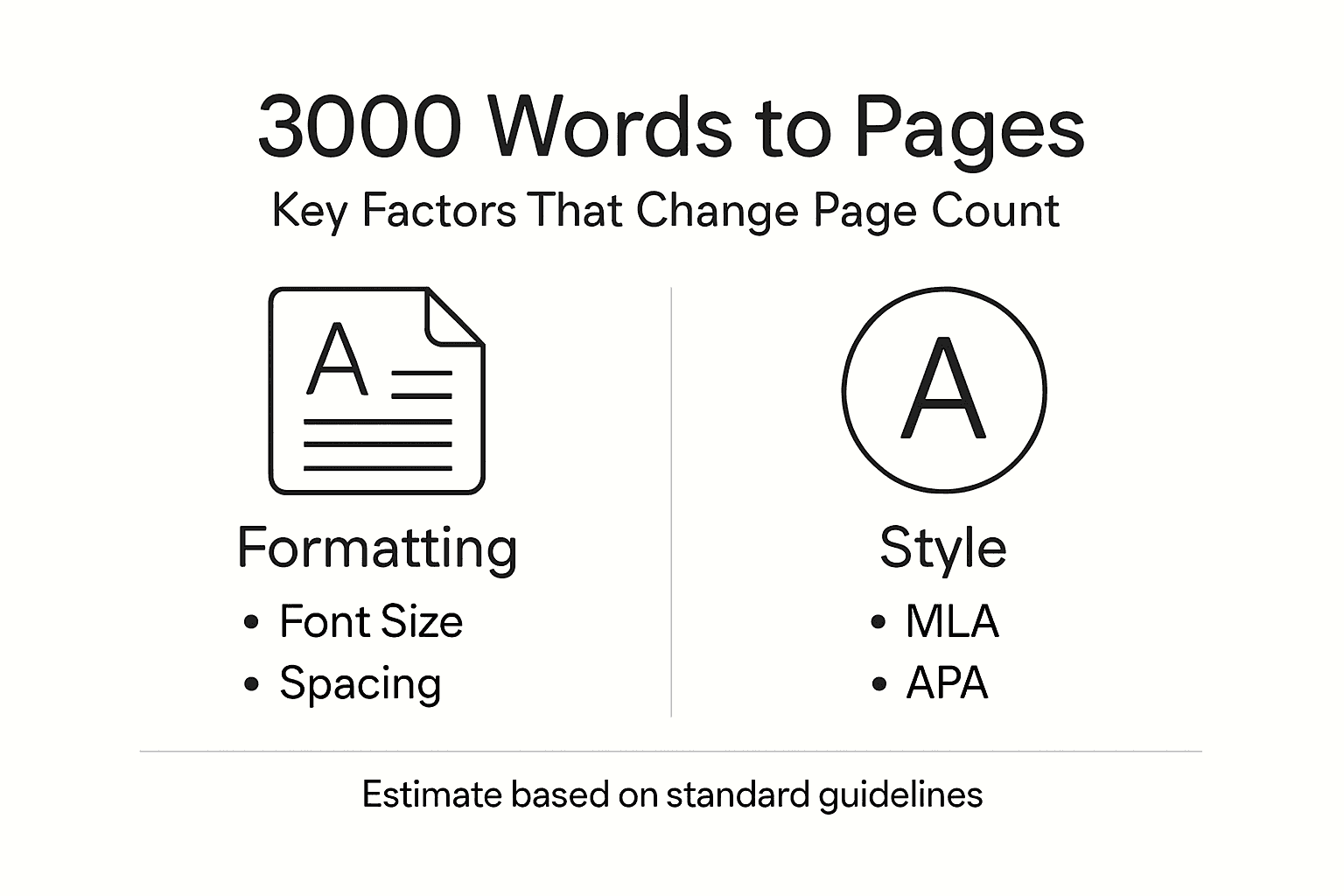
Formatting choices dramatically impact how many pages your 3000-word essay will actually occupy. The relationship between words and pages is not fixed, which means two students with identical word counts could end up with vastly different page lengths depending on their formatting decisions. Your choice of font, line spacing, margin width, and even paragraph indentation collectively determine whether your essay runs 8 pages or 14 pages. Understanding these variables gives you control over the final appearance of your work and helps you meet professor expectations without guessing.
The standard academic format sets clear expectations for most college assignments. APA style guidelines recommend 12 point Times New Roman font with double spacing and 1 inch margins on all sides. Under these exact specifications, you can expect approximately 250 to 300 words per double spaced page. This means your 3000 word paper falls squarely in the 10 to 12 page range. However, switching away from these standards creates immediate shifts. Single spacing cuts your page count roughly in half, while 1.5 line spacing places you somewhere in the middle. Similarly, reducing your margins from 1 inch to 0.75 inches on each side adds roughly one extra line per page, compressing your total page count downward.
Font selection presents another layer of complexity. Font type and spacing significantly affect readability and how efficiently words fit on a page. Times New Roman, a traditional serif font, occupies less horizontal space than sans serif fonts like Verdana or Calibri. If you switch from Times New Roman 12 to Calibri 12, you might see your page count increase by 5 to 10 percent because each line accommodates fewer words. Font size matters even more dramatically. Moving from 12 point to 11 point shrinks your page count by roughly 15 percent, while jumping to 13 point expands it considerably. Some professors lock you into specific formatting requirements, but when you have flexibility, understanding these trade offs helps you present your work strategically.
Here's a quick reference for how different formatting choices affect a 3000 word paper:
When your professor specifies a format, stick with it exactly. Attempting to manipulate formatting to meet page requirements or to avoid them reads as unprofessional and may violate assignment guidelines. Some instructors specify page counts instead of word counts, which means you need to work backward to determine your target word count based on their formatting requirements. If they ask for 12 pages in standard APA format, that translates to roughly 3000 to 3600 words. Always clarify formatting expectations upfront rather than discovering midway through writing that your format doesn't match requirements.
Pro tip: Set your formatting before you begin writing rather than adjusting it afterward, so you can see your actual page count progress as you work and avoid last minute scrambling to meet or trim page requirements.
Here's how key formatting factors influence a 3000-word academic paper:
| Formatting Factor | Impact on Page Count | Impact on Appearance | Effect on Readability |
|---|---|---|---|
| Line spacing | Changes overall length | Affects density of text | Double spacing aids scanning |
| Font type | Alters pages required | Serif fonts look traditional | Non-serif can increase space |
| Font size | More pages if increased | Larger font seems more open | Small font strains eyes |
| Margin width | Fewer pages with narrow | Margins affect balance | Wide margins clear structure |
| Section headers | Adds length with space | Breaks up content clearly | Enhances navigation |
Your choice of citation style affects far more than just how you format your sources. Different academic disciplines favor different styles, and each one carries its own rules about margins, fonts, headings, spacing, and overall document layout. When you're writing a 3000-word paper, these style differences can shift your final page count by a full page or more. Understanding what your assignment requires prevents you from discovering halfway through that your formatting doesn't match expectations, which means starting over or frantically reformatting at the last minute.
MLA style dominates humanities courses like literature, history, and languages. MLA citation emphasizes the author and page number in parenthetical citations, making it straightforward for readers to locate sources. MLA papers use double spacing and one-inch margins just like APA, but they skip the running head and title page that APA requires. Instead, MLA simply calls for your name, instructor name, course number, and date in the top left corner of the first page, then your last name and page number in the top right. This creates a slightly cleaner first page compared to APA. MLA citations appear in a works cited page at the end, organized alphabetically by author.
APA style reigns in the social sciences, education, business, and psychology fields. APA style uses author-date citations with specific formatting requirements for sections like the abstract and running head. APA requires a title page with your paper title, your name, your institution, and a running head, which automatically shifts your paper toward more pages. Your 3000 words might occupy 10 to 12 pages in MLA format but could stretch to 11 to 13 pages in APA because of these additional required elements. APA also demands an abstract summarizing your paper in 150 to 250 words, adding another half page before your actual content begins.
Beyond MLA and APA, Chicago style appears in history and some humanities courses, while IEEE style dominates engineering and computer science. Chicago offers two systems: notes and bibliography (more common in humanities) or author-date (similar to APA). IEEE uses numbered citations in brackets and appears frequently in technical papers. Your professor specifies which style to use, and using the wrong one signals carelessness about assignment details.
Here's how formatting differences impact your page count for 3000 words:
The running head and title page that APA requires essentially add an automatic page to your document before your content even starts. If your professor asks for 12 pages and you're using APA, that likely means 12 pages total including the title page and abstract, not 12 pages of body content. Clarifying these expectations with your professor prevents the frustration of completing an assignment only to discover it doesn't meet formatting requirements.
Pro tip: Select your citation style and format your document template before writing a single word, then adjust your margins, fonts, and spacing to match your chosen style exactly, ensuring consistency throughout and accurate page count tracking.
See how major citation styles differ in structure and effect:
| Style | Common Field | Special Requirements | Typical Page Range |
|---|---|---|---|
| APA | Social sciences | Title page, abstract | 12 to 14 pages |
| MLA | Humanities | Header only, no title | 10 to 12 pages |
| Chicago | History/Humanities | Title page optional | 10 to 12 pages |
| IEEE | Engineering | Numbered citations | 6 to 8 pages |
Seeing how other students approached 3000-word assignments gives you concrete reference points for your own work. Real examples show you what successful writing at this length actually looks like, how much space different sections consume, and what professors consider complete and thorough. Rather than guessing whether your draft is on track, you can compare your progress against actual student work that earned strong grades. This grounding in real assignments beats generic advice because you see actual choices made by writers similar to you.

Admissions offices publish examples of successful student essays that illustrate how applicants convey their ideas, values, and character effectively, with many ranging from 500 to over 3000 words. These published examples provide actual benchmarks showing how writers handled similar length constraints. A humanities student examining a successful 3000-word literary analysis essay can observe how the writer structured their argument across roughly 12 pages, allocated space for textual evidence, and built toward a conclusion. An engineering student reviewing a 3000-word technical report can see how professional writers balance explanations, diagrams, and data within similar word counts. The beauty of these examples lies in their specificity. You're not reading advice about good writing. You're reading actual good writing.
State education departments also publish grade-level writing exemplars with annotations showing proficiency across different lengths and assignment types. These annotated examples include detailed commentary explaining why certain choices work, what strengthens structure, and how grammar and mechanics support clarity. A 3000-word exemplar in your discipline comes with margin notes explaining transitions, pointing out topic sentences, and highlighting where evidence effectively supports claims. This annotated approach teaches you not just what good writing looks like but why those specific choices matter. You develop an eye for quality rather than simply following rules.
When examining student examples, pay attention to specific patterns. Notice where the introduction ends and body content begins. Count how many main arguments the writer develops across their pages. Observe how much space goes toward introducing sources versus analyzing them. Look at paragraph length and see whether they stay roughly consistent or vary strategically. Check how the writer transitions between ideas and whether those transitions feel smooth or abrupt. Notice the ratio of direct quotations to paraphrased material. These concrete observations train your instincts far better than any checklist.
Another practical approach involves asking your professor or teaching assistant whether they have successful student papers from previous years that you can examine. Many instructors keep sample papers specifically for this purpose. Reviewing an A-level paper from your actual class gives you the highest fidelity information because you know that exact professor approved and graded it. You see what succeeded in your specific classroom context rather than guessing about generic standards. Some students even ask permission to keep strong papers they write, building a personal reference library for future assignments.
Pro tip: Find one exemplar essay in your discipline that matches your assignment length, read it in full first for overall impression, then re-read it carefully while noting the page count for each major section, using those observations to plan your own section targets.
Students frequently stumble over the relationship between word count and page length, making errors that undermine their work or create last-minute panic. These mistakes range from simple miscalculations to fundamentally misunderstanding what professors are actually asking for. The good news is that most of these pitfalls are entirely preventable once you know what to watch for. Understanding where students go wrong gives you a roadmap for avoiding those exact problems in your own assignments.
One persistent mistake involves padding essays with unnecessary words to hit a target word count. Students add extra adjectives, repeat ideas in different ways, or use unnecessarily complex phrasing thinking it sounds more academic. This approach backfires spectacularly because professors read constantly and recognize filler instantly. A bloated 3000-word paper reads worse than a tight 2800-word paper with genuine substance. Effective writing requires clear word choice and sentence structures that maintain appropriate length while improving clarity and coherence. Rather than inflating your word count, focus on developing your ideas more thoroughly, adding stronger evidence, or exploring counterarguments. Quality always beats quantity.
Another critical error involves misreporting or miscounting your actual word and page length. Students finish an assignment, glance at the word count without verifying it's accurate, and submit work that falls short of requirements. Some word processors count words differently depending on what you include. Footnotes, citations, and headers might or might not be counted depending on your settings. Common errors in academic writing involve misreporting page or word counts and failure to follow assignment guidelines exactly, which can lead to under or over length papers requiring revisions or receiving penalties. Always verify your count by checking your word processor's statistics directly. Select all your content, check the word count, and compare it against the requirement. Do this verification multiple times before submitting because a single error wastes everyone's time.
Students also frequently miscalculate what page count actually means. You might write 3000 words thinking it will produce 10 pages, then format it and discover it's 13 pages in the style your professor requires. This happens because you didn't account for the specific formatting rules before starting to write. Some students assume page count and word count are interchangeable when they emphatically are not. A 3000-word document can legitimately range from 8 to 14 pages depending entirely on formatting choices. This gap between expectation and reality creates stress that's entirely avoidable.
Here are the most common specific mistakes to avoid:
Pro tip: Before you write a single paragraph, confirm your professor's exact formatting requirements in writing, then set up your document template matching those specifications, and check your word count every 500 words to maintain awareness of your progress throughout the writing process.
Struggling to balance word count requirements while maintaining clear structure and precise academic language? This article highlights the challenges students face when writing extensive essays, such as managing word counts, formatting correctly in APA or MLA styles, and avoiding filler content that weakens the quality of their argument. If you want to confidently hit targets like 3000 words without sacrificing clarity or academic integrity, it is essential to plan, track, and polish your writing effectively.
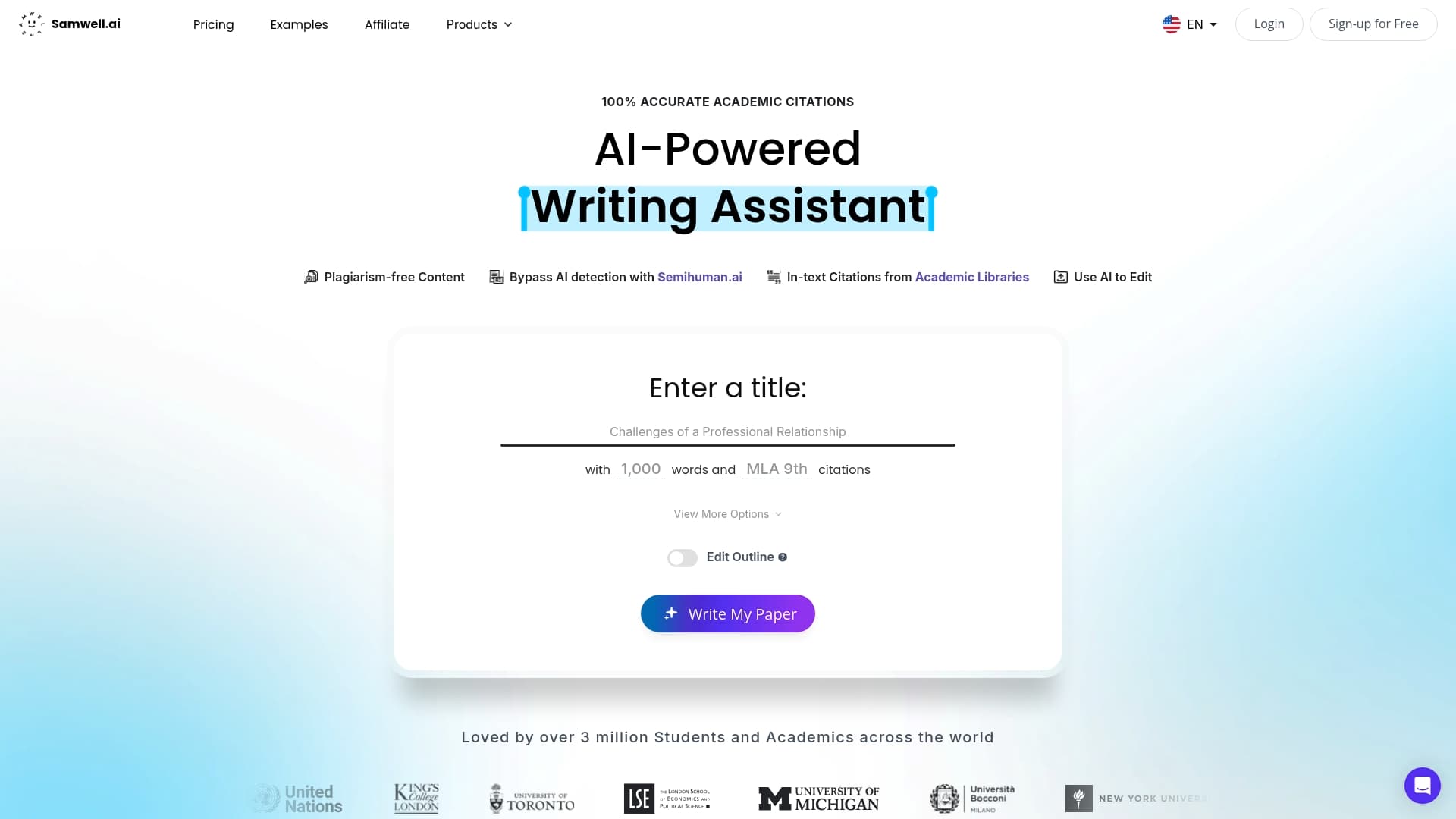
Unlock your potential with Samwell.ai, the AI-driven platform designed specifically to handle complex academic papers. Use powerful tools like Guided Essays to create organized outlines and the Power Editor to expand or refine your content precisely within assignment length limits. Ensure your essay meets formatting standards while reducing plagiarism risks through Semihuman.ai technology. Don’t wait until the last minute—start crafting a top-quality 3000-word essay with confidence today at Samwell.ai. Your next level of academic success begins here.
A 3000-word essay typically spans 10 to 12 pages when using standard formatting, such as double-spacing and 1-inch margins with a 12-point font like Times New Roman.
Page count can be influenced by font type, font size, line spacing, and margin width. For instance, using single spacing will reduce the page count, while a larger font size will increase it.
Creating a detailed outline and setting word count targets for each section, such as the introduction, body, and conclusion, helps in managing your overall word count effectively.
Different citation styles, like APA and MLA, have specific formatting requirements that can impact page count. For example, APA usually requires a title page and abstract, which can add an extra page compared to MLA formatting.