Loading...

Struggling to draft a three-page essay for your college course can feel overwhelming, especially with strict formatting and originality expectations. Mastering the art of a well-structured academic essay is more than meeting a page count—it means presenting clear arguments and credible analysis while following trusted standards like APA Style. This guide breaks down proven strategies to help you organize ideas, follow citation rules, and craft original work with confidence for American university assignments.
| Point | Details |
|---|---|
| Effective 3-Page Essay Structure | A well-structured essay includes an introduction, body paragraphs, and a conclusion, each clearly contributing to the overall argument. |
| Importance of APA Formatting | Adhering to APA formatting guidelines ensures consistency and professionalism in academic papers, supporting academic integrity. |
| Strategic Argument Development | Each paragraph should begin with a strong topic sentence and include evidence that connects to the thesis, creating a clear and logical flow of ideas. |
| Utilizing AI Tools | AI tools can assist in drafting and refining essays, but students must ensure that the final work reflects their unique voice and adheres to academic standards. |
In academic writing, a 3-page essay represents a concise yet comprehensive format for presenting scholarly arguments and analysis. Unlike longer research papers, these essays demand precision, clarity, and focused argumentation within a limited word count. Academic essay structures typically require students to develop a clear thesis, provide substantive evidence, and synthesize ideas effectively.
The standard structure of a 3-page essay generally encompasses three critical components:
Successful 3-page essays distinguish themselves through strategic content management. Concise academic writing requires writers to be intentional about every word, ensuring that each paragraph contributes directly to the overall argument. This means avoiding unnecessary elaboration and maintaining a laser-focused approach to presenting ideas.
Key characteristics that define an effective 3-page academic essay include:
Pro tip: Before writing, create a detailed outline that allocates specific word counts for each section to ensure balanced and comprehensive coverage.

Academic writing requires precise formatting standards, with APA Style representing a critical framework for scholarly communication. APA formatting guidelines provide comprehensive rules that ensure consistency, readability, and academic integrity across research documents. These guidelines extend far beyond simple appearance, serving as a universal language for scholarly communication.
Key APA formatting requirements include:
The structural components of APA formatting are designed to create a uniform and professional document. Manuscript preparation standards emphasize not just visual consistency, but also clarity of presentation. This means each section of your paper—from the title page to the references—must follow specific guidelines that facilitate easy comprehension and academic credibility.
Special attention must be paid to different elements of APA formatting:
Pro tip: Create a personal APA formatting checklist to verify each requirement before submitting your academic paper.
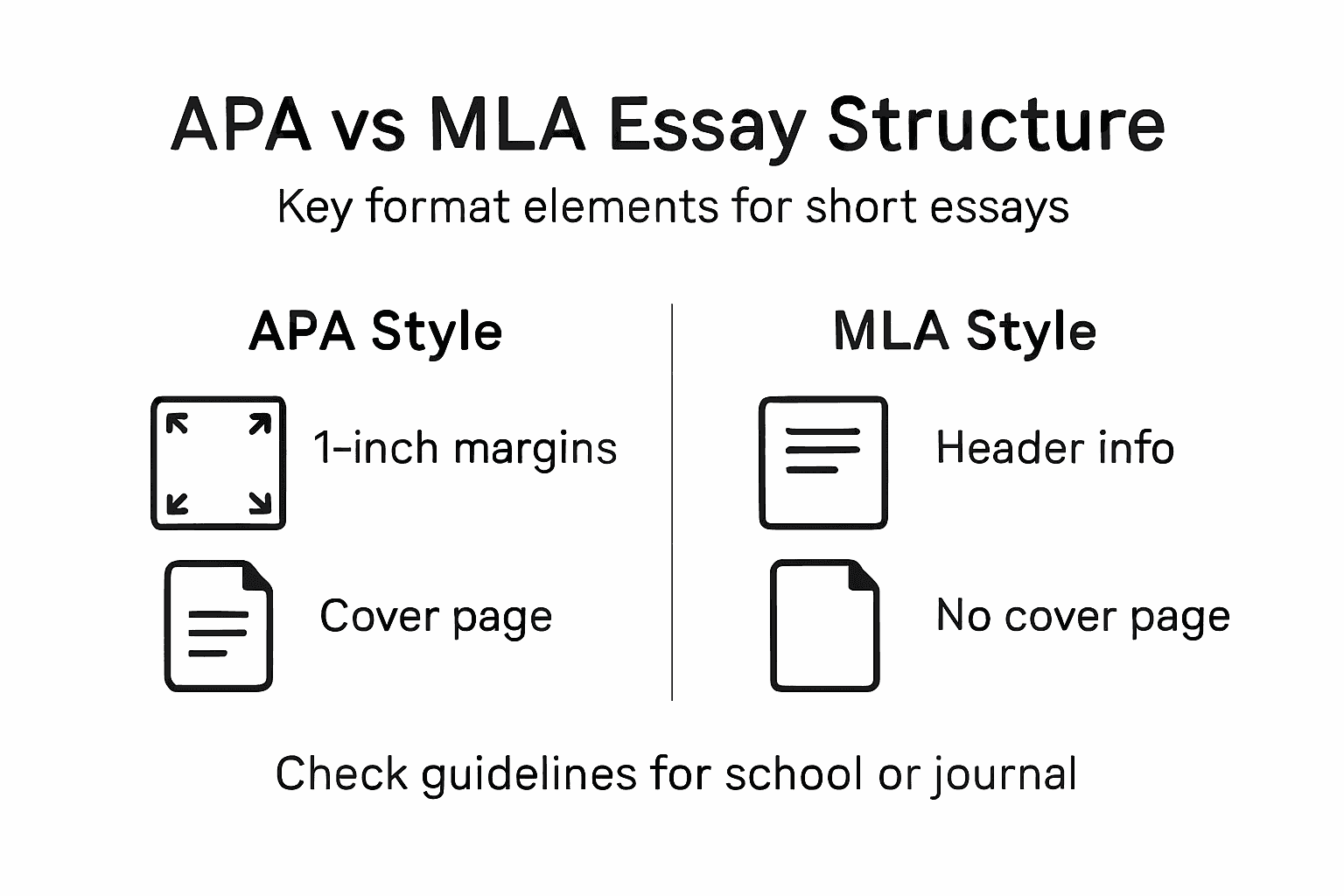
Here's how APA formatting compares with MLA for short academic essays:
| Feature | APA Style Requirements | MLA Style Requirements |
|---|---|---|
| Title Page | Separate, required | Title info on first page |
| In-text Citations | Author, year (Smith, 2023) | Author, page (Smith 12) |
| Reference List | "References" section | "Works Cited" page |
| Header and Pagination | Page number top right | Last name, page top right |
| Font & Spacing | 12pt, double spaced | 12pt, double spaced |
Crafting a compelling academic essay requires strategic argument development and meticulous paragraph construction. Argumentative essay strategies emphasize the importance of presenting a clear thesis and supporting it through logically organized paragraphs. Each paragraph serves as a building block in your overall argument, demanding precision and thoughtful progression of ideas.
Key components of an effectively structured paragraph include:
Successful academic writing demands more than simply presenting information. Paragraph development techniques require writers to introduce a central idea, provide substantive evidence, and critically analyze how that evidence supports the broader argument. This means transforming raw information into a persuasive narrative that guides readers through your intellectual reasoning.
To construct powerful paragraphs, consider these critical strategies:
Pro tip: Create a reverse outline after drafting your essay to verify that each paragraph maintains logical progression and supports your central argument.
Developing a distinctive academic voice requires carefully navigating the complex landscape of scholarly writing. Thesis development strategies emphasize creating unique perspectives that go beyond simple information repetition. This means crafting arguments that demonstrate critical thinking, personal insight, and rigorous intellectual engagement with your chosen topic.
Key strategies for maintaining academic originality include:
Successful academic writing demands more than technical correctness. Authorial voice techniques require writers to balance objectivity with personal perspective, using linguistic markers that engage readers while maintaining scholarly credibility. This delicate balance involves choosing words that are both professionally precise and intellectually compelling.
To develop a distinctive academic approach, consider these critical techniques:
Pro tip: Read academic journals in your field to internalize the sophisticated language and analytical approaches used by established scholars.
In the rapidly evolving landscape of academic writing, artificial intelligence has emerged as a powerful ally for students seeking to enhance their essay quality. Generative AI writing strategies provide innovative approaches to drafting, researching, and refining academic papers. These tools offer unprecedented support in brainstorming, structuring arguments, and improving overall writing clarity.
Key benefits of AI writing tools include:
Successful integration of AI requires a nuanced approach. AI academic writing techniques emphasize the importance of maintaining academic integrity while leveraging technological assistance. Students must critically evaluate AI-generated content, ensuring that the final work reflects their unique intellectual contribution and adheres to scholarly standards.
To effectively utilize AI writing tools, consider these strategic approaches:
Pro tip: Treat AI tools as collaborative assistants, not replacement writers, by critically reviewing and personalizing every suggestion.
Here's a summary of ways AI tools can support academic writers effectively:
| AI Application Area | Student Benefit | Usage Tip |
|---|---|---|
| Drafting Assistance | Speeds up initial outlining | Review and personalize text |
| Grammar Checking | Raises clarity and readability | Accept or reject suggestions |
| Argument Organization | Enhances logical flow | Rearrange for your argument |
| Citation Suggestions | Speeds up source compilation | Double-check all references |
Writing a focused 3-page essay requires precision, clarity, and strong argument organization to meet academic standards like APA formatting and maintain originality. If you're struggling to balance these demands while crafting a compelling thesis and well-structured paragraphs, you are not alone. Samwell.ai understands the challenge of managing concise content that still demonstrates critical analysis and a distinctive academic voice. Our AI-powered platform is designed to help you generate and refine essays that meet these exact needs with ease and confidence.
Take control of your academic writing now by using Samwell.ai's advanced AI tools for customized essay generation, guided outlines, and a powerful editing suite. Whether you want to ensure your 3-page essay adheres to proper APA formatting or need help integrating supporting evidence seamlessly, Samwell.ai offers a unique Semihuman.ai technology that protects originality and enhances quality. Don't wait until the deadline—start structuring your essay for success today with Samwell.ai and experience a smarter way to write essays that captivate and convince.
A 3-page essay is a concise academic writing format that presents a focused argument or analysis within a limited word count, typically structured with an introduction, body paragraphs, and a conclusion.
A 3-page essay should be structured with three main components: an introduction that presents the thesis, body paragraphs that develop supporting arguments with evidence, and a conclusion that synthesizes key points and reinforces the main argument.
Key elements of APA formatting include 1-inch margins, double-spacing, 12-point Times New Roman or Calibri font, page numbers in the top right corner, and a hanging indent for reference lists.
To ensure originality, present novel interpretations, ask innovative questions, and critically evaluate evidence, while using precise language and integrating multiple scholarly perspectives to create a distinctive academic voice.