Loading...

TL;DR:
- AI writing assistance enhances all stages of academic work by supporting brainstorming, drafting, citation management, and proofreading. To maintain integrity, students should generate drafts with AI, humanize the content, and rewrite key sections to preserve their voice and original ideas. Effective use involves directing AI tools responsibly, verifying output, and contributing personal insight to produce authentic, well-crafted papers.
Writing assistance is the use of AI-powered tools and structured methods that improve writing clarity, originality, structure, and academic compliance for students and researchers. Platforms like Grammarly and Manuscripts.ai have redefined what academic support looks like, moving far beyond spell-check into real-time proofreading, citation generation, and plagiarism detection. The result is a new category of academic workflow where AI handles the mechanical burden and students focus on argument and insight. This article explains what modern writing assistance offers, how to use it without compromising academic integrity, and which tools are worth your time.
AI-powered writing assistance covers far more ground than grammar correction. Today's tools operate as full-cycle academic partners, supporting every stage from blank page to final submission.
The core capabilities most students rely on include:
The best platforms combine all of these into a single workspace. Brainstorming, outlining, drafting, and revising in one environment removes the friction of switching between tools and keeps your workflow focused.
Pro Tip: When using an AI writing helper for citation support, always verify the generated reference against the original source. AI tools occasionally misformat author names or publication years, and a single citation error can cost you points on a research paper.
Academic integrity is the line every student must hold when using AI writing assistance. The risk is not using AI at all. The risk is using it wrong.
The recommended workflow follows three distinct stages:
"AI suggestions serve as conversation starters, enabling writers to preserve the narrative's soul." — Manuscripts.ai
This workflow matters because academic institutions now run submissions through AI detection tools as a standard part of grading. Raw AI output detection has become routine, and proper humanization combined with genuine revision renders prose indistinguishable from purely human writing.
The deeper issue is editorial contribution. If a piece lacks original reporting, argument, or voice, no humanization tool will fix it. Your professor is not just checking for AI patterns. They are checking whether you have something to say. That part is still entirely yours.
Pro Tip: Before submitting any AI-assisted paper, run it through your institution's preferred AI detection tool yourself. Catching flagged passages before submission gives you time to revise rather than explain.
Understanding AI detection in academic integrity is now a practical skill, not just an ethical concern. Students who understand how detection works write better, more defensible papers.
Not every AI writing tool is built for academic work. Here is how the most widely used platforms compare on the features that matter most to students and researchers.
| Tool | Proofreading | Citation support | AI humanizer | Academic suitability | Free tier |
|---|---|---|---|---|---|
| Grammarly | Excellent | Limited | No | High | Yes |
| Manuscripts.ai | Good | Strong | Yes | Very high | Limited |
| QuillBot | Good | Paraphrase focus | Partial | Moderate | Yes |
| Samwell | Strong | MLA/APA/Chicago | Yes (Semihuman.ai) | Very high | Yes |
A few distinctions worth noting beyond the table:
The best AI writing tools for 2025 and 2026 share one trait: they integrate into your existing document workflow rather than forcing you to rebuild your process around them.
Using AI writing assistance effectively is a skill. Most students who struggle with it are either over-relying on raw output or under-using the tools at the revision stage.
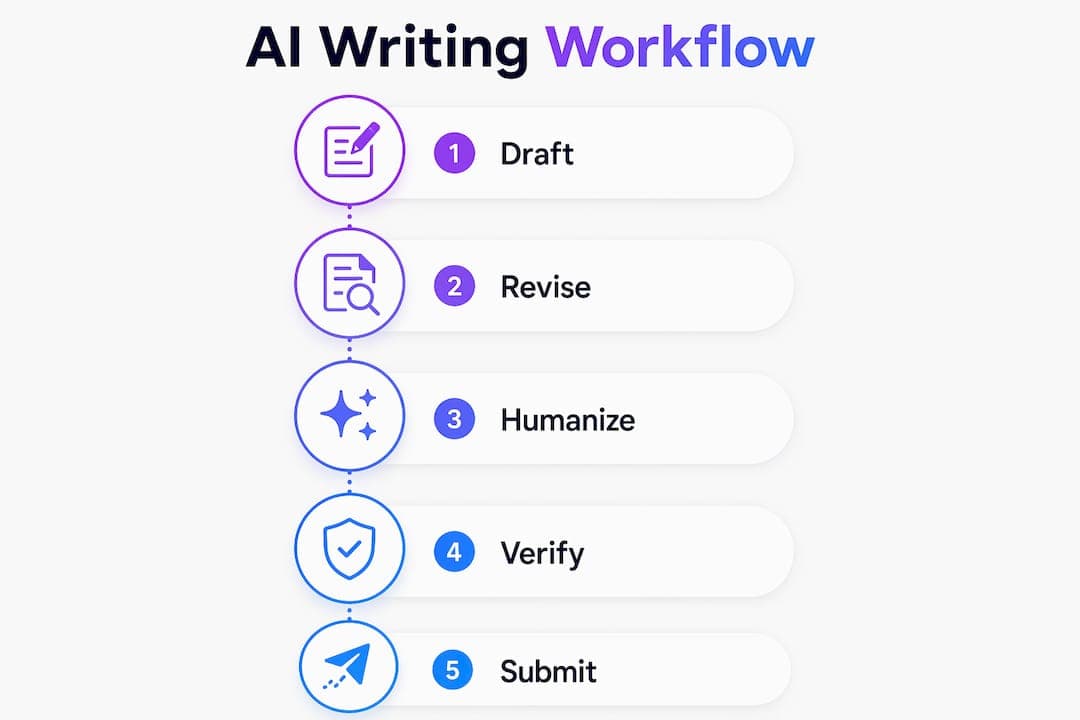
Start with structure, not sentences. Use your AI writing helper to generate an outline before you write a single paragraph. A clear structure prevents the most common academic writing failure: a paper that covers the topic but never builds a coherent argument. Effective AI writing assistance depends on giving nuanced prompts that specify your thesis, audience, and required sources from the beginning.

Use AI for draft refinement, not draft replacement. The most productive workflow treats AI output as a rough scaffold. Write your own introduction and conclusion first. These are the sections your reader remembers most, and they should carry your voice without compromise. Then use AI to fill in body paragraphs, which you revise heavily before submission.
Incorporate human editing at every stage. Grammar tools catch mechanical errors. They do not catch logical gaps, weak evidence, or arguments that contradict your thesis. Read your draft aloud after AI revision. If a sentence sounds like it came from a press release rather than a person, rewrite it.
The following habits separate students who use AI well from those who get caught or produce mediocre work:
Pro Tip: Set a personal rule: every paragraph in your final submission must contain at least one sentence you wrote from scratch, without AI input. This forces genuine engagement with your argument and makes the paper defensible if questioned.
The goal of using AI for essays is not to remove effort. It is to redirect effort toward the parts of writing that actually require human judgment: argument, evidence, and voice.
Effective writing assistance combines AI efficiency with genuine human editorial contribution at every stage of the academic writing process.
| Point | Details |
|---|---|
| AI covers the full writing cycle | Modern tools handle brainstorming, drafting, citation, and proofreading in one workspace. |
| Workflow order matters | Draft with AI, humanize the output, then manually rewrite key sections to preserve your voice. |
| Tool choice depends on your needs | Grammarly suits daily editing; Manuscripts.ai and Samwell suit full academic paper workflows. |
| Integrity requires your contribution | AI cannot supply original argument or evidence. Those must come from you. |
| Detection is now standard | Running your own AI detection check before submission is a practical, not optional, step. |
The conversation about AI writing assistance in academia has been dominated by two camps: those who treat it as cheating by default and those who treat it as a shortcut to a finished paper. Both positions miss the point.
What I have observed, working closely with academic writing workflows over the past several years, is that the students who benefit most from AI tools are the ones who already know how to write. They use AI to accelerate the parts of the process they find tedious, like formatting citations or generating a first-pass outline, and they bring genuine intellectual work to the parts that matter. The students who struggle are the ones who hand the entire assignment to an AI and submit whatever comes back.
The uncomfortable truth is that AI writing assistance reveals your relationship with your own ideas. If you have something to say, AI helps you say it faster and more clearly. If you do not, AI produces a paper that sounds like every other AI-generated paper, and experienced professors notice immediately. Not because of detection software, but because the paper has no argument. It has coverage.
My advice is to treat AI the way a good researcher treats a research assistant. You direct the work. You verify the output. You take responsibility for the final product. That is not a limitation of AI tools. That is the correct use of them.
The future of academic writing is not AI replacing students. It is students who know how to use AI producing better work, faster, with fewer mechanical errors, while still doing the intellectual labor that education is designed to develop.
— Tilen
Samwell is built specifically for students and academics who need more than a grammar checker. The platform combines AI draft generation, a Power Editor for targeted paragraph-level revisions, Guided Essays for structured outlines, and real-time AI detection checks that keep pace with evolving detection technology.
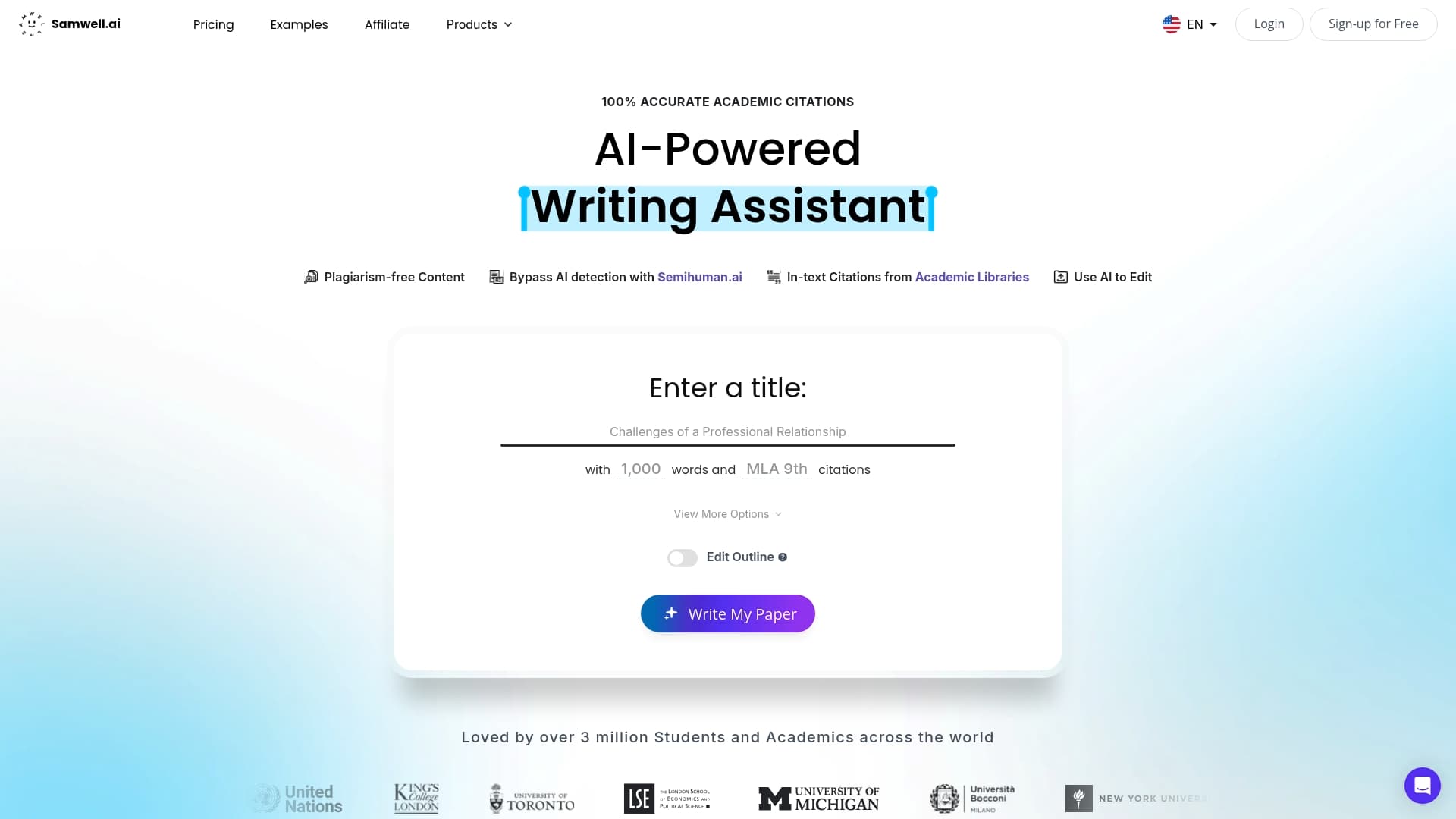
Samwell's Semihuman.ai technology minimizes plagiarism risk and produces content that reads as genuinely human, addressing the detection problem that other tools leave unresolved. The platform supports MLA, APA, and Chicago citation formats and allows you to specify your own sources for customized, academically compliant output. Over 1,000,000 students and academic professionals from leading universities use Samwell to write better papers without compromising integrity. Start your next essay at samwell.ai.
Writing assistance refers to tools and methods that help students improve their writing quality, structure, and originality. Modern AI-powered platforms like Grammarly and Samwell offer real-time proofreading, citation support, and plagiarism checks within a single workspace.
Follow the draft-revise-verify workflow: generate a draft with AI, humanize the output to remove AI phrasing patterns, and manually rewrite key sections to reflect your own voice and argument. Academic integrity depends on genuine editorial contribution, not just AI avoidance.
The best tool depends on your needs. Grammarly excels at sentence-level editing and tone feedback. Manuscripts.ai suits long-form and research writing. Samwell combines draft generation, citation management, and AI detection checks in one platform designed specifically for academic use.
Yes. Platforms like Grammarly and Samwell include plagiarism detection that compares your draft against published databases and flags overlapping passages before submission. Always run a check before submitting any research paper or essay.
Using AI as a drafting and editing aid is not inherently academic dishonesty, but policies vary by institution. The key distinction is whether you contribute original argument, evidence, and voice to the final paper. Submitting raw AI output without revision or intellectual contribution crosses the line at most universities.