Loading...

TL;DR:
- Writing an MLA formatted essay involves strict adherence to a set of standardized rules for layout, citations, and references.
- Following the MLA Handbook ensures consistency with margins, font, spacing, and heading structure, which students must master.
Writing an essay in MLA format means following a standardized set of formatting and citation rules set by the Modern Language Association, the governing body for style in humanities disciplines. The MLA Handbook, now in its 9th edition, defines every detail from margin width to how you credit a source. Students in English, history, and the arts encounter these rules constantly, and getting them right affects both grades and credibility. This guide walks you through every major requirement, from the first line of your document to the final entry on your Works Cited page.
MLA format is a complete document standard, not just a citation style. It controls how your page looks, how you structure your first page, how you quote sources, and how you list them at the end. The Modern Language Association designed these rules so that any reader, anywhere, can locate your sources without confusion. MLA formatting provides a predictable framework that reduces friction during grading and peer review.
The MLA Handbook 9th edition is the authoritative source for all current rules. If your instructor says "use MLA," they mean this edition unless they specify otherwise. Knowing the standard cold gives you a real advantage because formatting errors are among the most common reasons students lose points on otherwise strong papers.
The foundation of any MLA style essay format is the page setup. Get this right before you write a single word of your essay.
Pro Tip: Set your Tab key to exactly 0.5 inches in your word processor before you start typing. This guarantees consistent indents across every paragraph without manual adjustment.
The page header is one detail students frequently skip. Your last name followed by a space and the page number should appear in the same font and size as the body text. Most word processors let you set this once in the header settings so it repeats automatically.

MLA does not use a separate title page for standard essays. Instead, MLA requires a four-line heading in the upper left corner of the first page. Follow this exact order:
After the four-line heading, center your essay title on the next line. The title uses standard title capitalization: capitalize major words and lowercase minor words like "a," "the," and "and." Do not bold, underline, italicize, or put the title in quotation marks unless it contains a title that would normally be formatted that way. Your essay text begins on the very next line after the title, with a standard 0.5-inch paragraph indent.
A common mistake is creating a separate cover page. Unless your instructor explicitly asks for one, never add a separate title page to an MLA essay. It wastes space and signals unfamiliarity with the standard. For a detailed visual walkthrough of the first page layout, the MLA first page guide covers every element with examples.
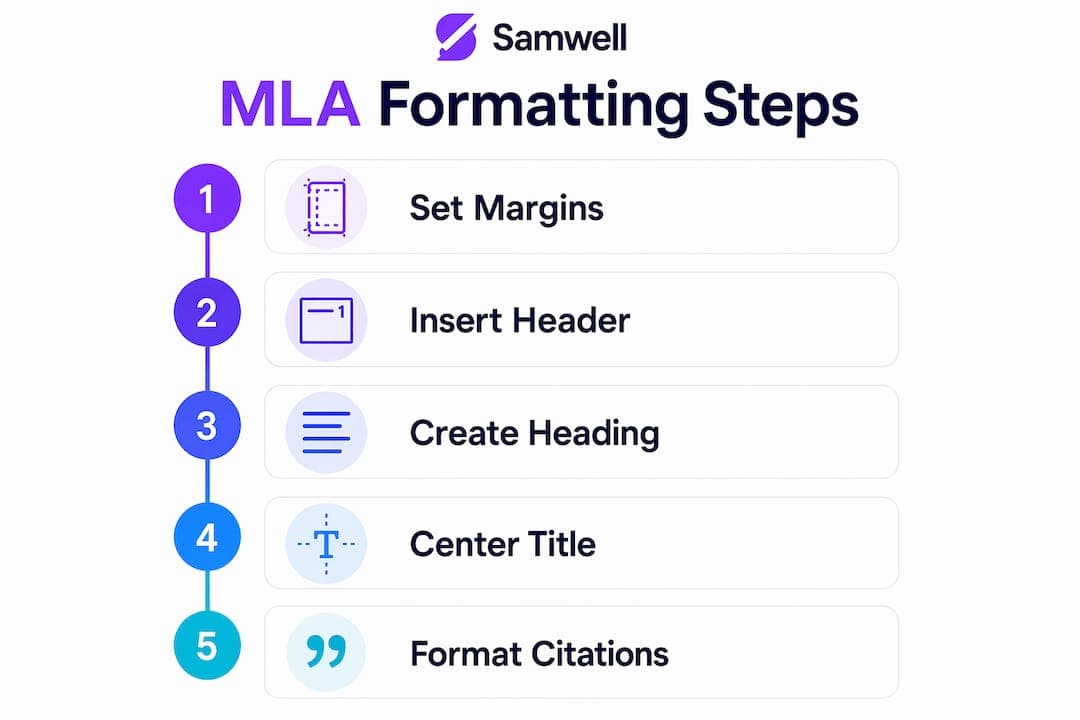
MLA uses parenthetical citations, meaning the source credit appears inside parentheses within your text. The rules are specific and unforgiving.
Standard in-text citation rules:
Pro Tip: Read your citation out loud after writing it. If you hear yourself saying "p." or a comma before the number, delete it. The format is always name then number, nothing between them.
Block quotes follow different rules entirely. Any quotation longer than four lines of prose must be formatted as a block quote. Indent the entire passage 0.5 inches from the left margin. Use no quotation marks around the text. The parenthetical citation for a block quote appears after the final period, not before it. This reverses the standard rule and catches many students off guard. For a full breakdown of citation rules, the MLA citation guide for students covers every source type with examples.
The Works Cited page is the final page of your MLA research paper format. It lists every source you cited in the body of the paper, and only those sources. Sources you read but did not cite do not belong here.
The Works Cited page must start on a new page. Center the title "Works Cited" at the top. Do not bold or italicize it. Double-space all entries and between them. Alphabetize entries by the author's last name. If there is no author, alphabetize by the first major word of the title. Every entry uses a hanging indent: the first line is flush left, and all subsequent lines indent 0.5 inches.
MLA 9th edition organizes each entry using the container system. The sequence of elements runs as follows:
| Element | Example |
|---|---|
| Author | Morrison, Toni. |
| Source title | Beloved. |
| Container title | Norton Critical Editions, |
| Contributors | edited by Justine Tally, |
| Version | 2nd ed., |
| Publisher | W. W. Norton, |
| Date | 2019, |
| Location | pp. 1–324. |
Not every source uses all eight elements. A webpage entry, for example, may include a URL as the location instead of page numbers. The MLA container system applies to books, articles, websites, films, and any other source type. Writing centers recommend building your Works Cited page as you write, adding each source the moment you cite it. That habit prevents missed references and last-minute scrambles.
Most MLA errors fall into a short list of repeatable mistakes. Knowing them in advance is the fastest way to avoid losing points.
Use a complete MLA formatting checklist before submitting any paper. Running through a checklist takes five minutes and catches the errors that cost the most points.
Correct MLA formatting requires consistent application of page setup, heading structure, citation rules, and Works Cited formatting from the first line to the last.
| Point | Details |
|---|---|
| Page setup comes first | Set 1-inch margins, 12 pt Times New Roman, double spacing, and Tab-key indents before writing. |
| First page replaces a title page | Use the four-line heading block and a centered title; never add a separate cover page. |
| Citations follow a strict pattern | Write author last name and page number with no comma and no "p." before the number. |
| Block quotes reverse punctuation | Place the parenthetical citation after the final period, not before it. |
| Works Cited is not a bibliography | List only sources you cited, alphabetize them, and apply a 0.5-inch hanging indent to every entry. |
Students often treat MLA formatting as a bureaucratic hurdle, something to rush through after the real writing is done. That framing costs them. Proper adherence to MLA 9th edition formatting signals academic professionalism and attention to detail, and it directly influences how instructors perceive the credibility of your research.
The formatting rules exist for a practical reason. When every essay follows the same structure, instructors can verify sources in seconds. That efficiency benefits you because it keeps the focus on your argument, not on hunting down a citation. A paper that is hard to verify feels less trustworthy, regardless of how good the underlying research is.
What I have seen consistently is that students who master MLA early, treating it as a skill rather than a chore, write with more confidence. They stop second-guessing margins and citations mid-draft and spend that mental energy on their actual argument. The format becomes invisible, which is exactly what it is supposed to be.
Start with the page setup. Get the heading block right. Build the Works Cited page as you go. Those three habits alone eliminate the majority of MLA errors before they happen.
— Tilen
MLA formatting has a lot of moving parts, and missing even one rule can cost you points on an otherwise strong paper. Samwell is an AI writing platform used by over 1,000,000 students and academics that handles MLA compliance as part of the writing process, not as an afterthought.
Samwell generates and formats MLA essays with correct citations, proper heading structure, and a formatted Works Cited page built in. The Power Editor lets you expand or refine specific sections while keeping formatting intact. Guided Essays provide structured outlines so your argument and your format develop together. Real-time AI detection checks keep your work original. If you want to spend less time on formatting rules and more time on your argument, Samwell is worth trying.
MLA 9th edition requires 12 pt Times New Roman or a comparable serif font. The same font applies to the entire document, including the header and Works Cited page.
Standard MLA essays do not use a separate title page. Use a four-line heading block in the upper left corner of the first page instead, followed by a centered essay title.
Use a shortened version of the source title in quotation marks followed by the page number, for example: ("Climate Policy" 8). This applies to websites, unsigned articles, and similar sources.
Works Cited lists only the sources you cited in your paper. A bibliography includes all sources you consulted, whether cited or not. MLA format uses Works Cited exclusively.
The parenthetical citation for a block quote appears after the final period of the quoted passage, not before it. This is the opposite of the rule for standard in-text citations.