Loading...

TL;DR:
- AI detection analyzes text to estimate the likelihood of AI authorship, serving as a probabilistic tool rather than definitive proof. It supports human review in academic and publishing contexts but has high false positive and negative rates that require cautious interpretation. Combining detection results with drafts, author declarations, and style comparisons creates a responsible workflow that enhances integrity without misjudgment.
AI detection is defined as the process of analyzing text to estimate the probability that it was generated by an artificial intelligence system rather than a human writer. For students and educators, understanding why use AI detection matters is not optional. Academic integrity depends on it. Tools like Grammarly's AI detector and Pangram AI apply machine learning to identify linguistic patterns that signal AI authorship, giving educators a starting point for review. AI detection is not plagiarism checking. It is a separate, probabilistic discipline that addresses a different category of academic integrity risk entirely.
AI detection tools serve one primary function: flagging text that exhibits the statistical fingerprints of AI-generated writing so that a human reviewer can investigate further. AI detectors function as probabilistic signals rather than definitive verdicts, which means every result requires human interpretation before any action is taken. That distinction matters enormously in academic contexts where a false accusation can damage a student's record.

The importance of AI detection extends beyond the classroom. Editors, publishers, and businesses use detection tools to verify content authenticity and protect the credibility of published material. For educators, the core benefit is transparency: detection tools create a structured reason to open a conversation about writing process, source use, and authorship. That conversation is where real learning happens.
Understanding the evolving role of AI text detection in academia helps both students and educators set realistic expectations. Detection is a tool, not a tribunal.
AI detection tools apply machine learning models trained on large datasets of both human-written and AI-generated text. Advanced algorithms analyze linguistic features including sentence structure, word choice, uniformity, and repetition to estimate the probability that a given passage originated from an AI system. The output is a score, not a fact.
Several specific techniques define how modern detectors operate:
These methods work best on longer texts with clear stylistic signals. Short answers, formal academic writing, and heavily edited drafts can all confuse detectors because their linguistic patterns overlap with AI output. A 200-word response written in formal academic English may score high for AI probability even when written entirely by a human student.
Pro Tip: Never interpret a single AI detection score in isolation. Run the same text through two different tools and compare results. Significant disagreement between tools is itself a signal that the text sits in an ambiguous zone requiring deeper human review.
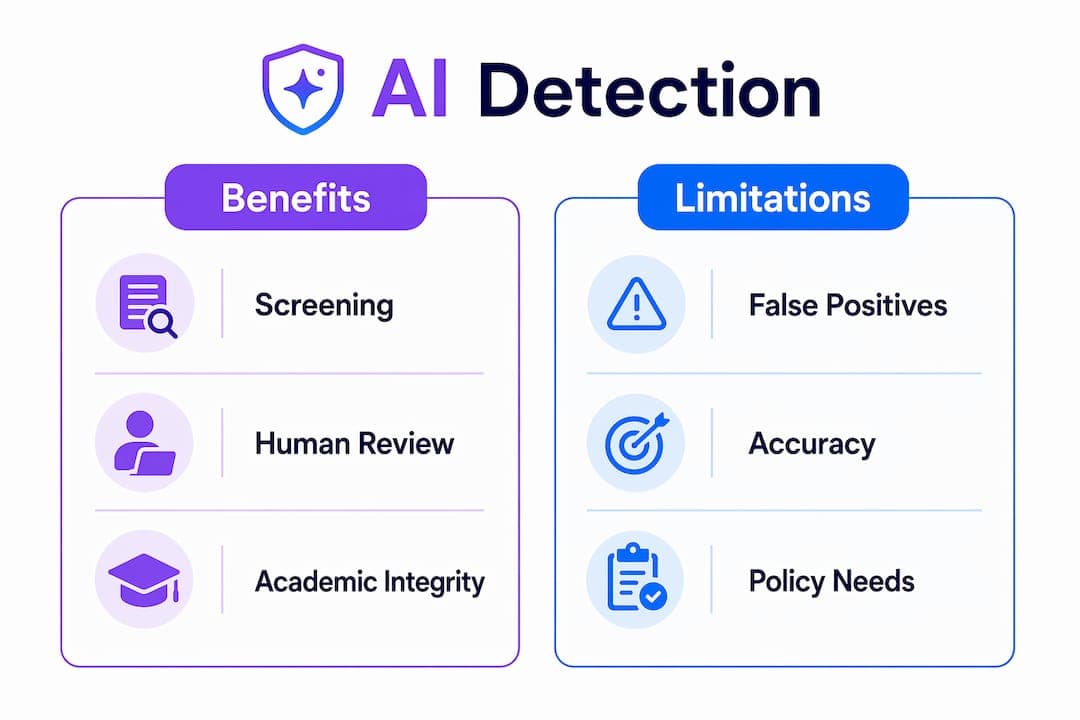
The benefits of AI detection in academic settings are real but bounded. On the positive side, detection tools give educators a systematic way to flag writing that warrants closer review. They support consistency: rather than relying on a teacher's intuition alone, a scored output creates a documented starting point. They also signal to students that AI-generated submission carries a measurable risk of detection, which itself functions as a deterrent.
The limitations, however, are significant enough to shape policy. False positive rates reach up to 68.6% in documented studies, meaning a detector may flag genuinely human-written text as AI-generated in more than two thirds of cases under certain conditions. False negative rates reach up to 99.6%, meaning a detector may miss AI-generated text almost entirely in other conditions. Those numbers come from University of Florida IEEE Symposium research and represent the operational reality educators must plan around.
| Benefit | Limitation |
|---|---|
| Flags text for human review | False positives up to 68.6% in some contexts |
| Creates documented screening records | False negatives up to 99.6% in other contexts |
| Deters casual AI submission | Unreliable on short or formal texts |
| Supports consistent intake workflows | Cannot confirm authorship independently |
| Extends integrity checks beyond plagiarism | Vendor accuracy claims often reflect best-case conditions |
Institutions pair detector signals with human review and policy safeguards precisely because accuracy varies so widely. The takeaway for educators is clear: design your policy around worst-case error rates, not the accuracy percentages listed on a vendor's homepage. A detection score is the beginning of an inquiry, not the end of one.
Plagiarism checkers and AI detectors solve different problems, and conflating them creates serious misunderstandings about what each tool's output actually means. Plagiarism checkers like Turnitin search submitted text against databases of published sources, previously submitted papers, and web content to identify copied or closely paraphrased material. A high similarity score means the text matches existing sources.
AI detectors analyze linguistic patterns and text originality rather than searching for source matches. A piece of text can be entirely original, with zero plagiarism score, and still score high for AI probability. Conversely, a student could plagiarize a human-written source and receive a low AI detection score. The two tools address separate integrity risks and must be used separately.
Pro Tip: Build a two-step intake workflow: run submissions through a plagiarism checker first to catch source matching, then run through an AI detector to flag stylistic anomalies. Treat each output as one data point in a broader review, not as a standalone verdict.
The practical risk of mixing up these tools is real. An educator who expects a plagiarism checker to catch AI-generated text will miss AI submissions entirely. An educator who treats an AI detection score as evidence of plagiarism may wrongly accuse a student of copying sources when no such copying occurred. Understanding what AI writing actually is helps clarify why these two tools must remain conceptually separate in any integrity workflow.
Combined use enhances verification. Running both tools on the same submission gives educators two independent signals covering different risk categories, which together build a more complete picture of a submission's authenticity.
Responsible use of AI detection requires a structured workflow rather than ad hoc score checking. The following steps reflect current best practices drawn from institutional governance models and published research.
Students benefit from understanding this workflow too. Knowing that detection is probabilistic and that educators look for corroborating signals encourages honest disclosure and genuine engagement with the writing process. The challenges AI tools create for students are real, and transparent policies help navigate them fairly.
AI detection tools are probabilistic screening instruments that require human judgment, corroborating evidence, and clear institutional policy to function responsibly in academic settings.
| Point | Details |
|---|---|
| Detection is probabilistic | AI detection scores estimate likelihood, not authorship. Never treat them as proof. |
| False rates are high | False positives reach 68.6% and false negatives reach 99.6% in documented studies. |
| Detection differs from plagiarism checking | Plagiarism tools find source matches; AI detectors analyze linguistic style. Use both separately. |
| Multi-signal governance works best | Combine detection scores with drafts, declarations, and style comparisons before drawing conclusions. |
| Conversations beat accusations | Use detection results to open dialogue with students, not to trigger automatic penalties. |
I have watched institutions make two opposite mistakes with AI detection. The first is dismissing these tools entirely because the error rates are high. The second is treating a detection score as a digital confession. Both approaches fail students and educators.
The more I study how these tools actually function, the more I think the framing needs to shift. AI detectors are warning lights on a dashboard. A warning light does not tell you what is wrong. It tells you to pull over and check. That is exactly how detection scores should be used. A high score means: look closer, ask questions, gather more information. It does not mean: penalize immediately.
What I find genuinely useful about AI detection is the discipline it introduces into writing assessment. When educators build workflows around detection, they naturally start asking for drafts, revision histories, and process documentation. Those practices improve writing instruction regardless of whether AI was involved. The detection tool becomes a catalyst for better pedagogy, not just a policing mechanism.
The institutions getting this right, including the NeurIPS 2026 model, combine conservative detection thresholds with author declarations and behavioral pattern analysis. That approach respects the tool's limitations while still using it meaningfully. It is the model worth following.
— Tilen
Samwell helps over 1,000,000 students and academic professionals write research papers that meet the highest standards of originality and citation compliance. The platform's real-time AI detection checks are built directly into the writing workflow, so you can see how your paper reads before submission rather than after.
Samwell's Semihuman.ai technology produces writing that passes detection checks while maintaining academic quality, giving you the transparency your institution expects. Whether you need a structured outline through Guided Essays or targeted edits through the Power Editor, Samwell keeps your work both original and credible. Start your next research paper with Samwell and write with the confidence that comes from knowing your integrity is protected from the first draft.
AI detection analyzes linguistic patterns in text to estimate the probability of AI authorship, while plagiarism checking searches for content matches against published sources. The two tools address different academic integrity risks and must be used separately.
AI detection tools are valuable as initial screening instruments that flag text for human review, not as standalone evidence. Used alongside drafts, author declarations, and style comparisons, they support a more complete integrity workflow despite their accuracy limitations.
Yes. False positive rates reach up to 68.6% in documented research, meaning human-written text can be flagged as AI-generated. This is why no institution should take disciplinary action based on a detection score alone.
Treat the score as a probability estimate that triggers further review, not as a finding. Compare the flagged submission against known writing samples, request drafts, and discuss the result with the student before drawing any conclusions.
The NeurIPS 2026 multi-threshold approach combines conservative detection thresholds with author declarations and submission pattern analysis. This model minimizes false positives and aligns detection with broader institutional policy rather than relying on any single tool's output.