Loading...

TL;DR:
- Updating citation formats is essential to maintain academic credibility and comply with current standards like APA 7th, MLA 9th, and Chicago 17th. Failure to update can cause delays, reduce discoverability in AI systems, and raise questions about source accuracy, ultimately harming your reputation. Using a workflow that combines reliable reference management, metadata verification, and AI-assisted formatting ensures precise and current citations, safeguarding your research integrity and publication success.
Updating citation formats is the single most direct way to protect your academic credibility, avoid manuscript rejection, and meet the compliance requirements of journals, professors, and institutional review boards. The three dominant standards in 2026 are APA 7th, MLA 9th, and Chicago 17th, and submitting work formatted to an older edition is one of the most common reasons papers receive revision requests before they are even reviewed on merit. Citation format updates are not cosmetic changes. They reflect how disciplines communicate, how digital sources are identified, and how AI systems evaluate the credibility of academic work.
Citation formats change because academic communication itself changes. The shift from print to digital publishing alone forced every major style organization to rethink how sources are identified, linked, and verified. Disciplinary priorities drive formatting in ways that are not arbitrary: sciences use author-date systems to signal recency, humanities prioritize argument flow with footnotes, and engineering formats emphasize precision and traceability. Each update cycle reflects those priorities becoming more refined.
Three specific forces push citation formats forward:
Pro Tip: Always check the specific edition required by your target journal or institution before you begin formatting. The style name alone (APA, MLA, Chicago) is not enough. The edition number is what determines compliance.
The practical consequence of ignoring format updates is delay. Submitting obsolete formats like APA 6th triggers revision requests that push your submission back in the queue, sometimes by weeks. For graduate students facing thesis deadlines, that delay has real academic consequences.

Academic integrity depends on exact correspondence between your in-text citations and your reference list. Inconsistent capitalization between sentence case and title case is the most frequent citation error reviewers flag, and it is almost always a symptom of mixing old and new style conventions. When a reviewer sees formatting inconsistencies, the immediate question is whether the sources themselves were handled with the same carelessness.
The consequences scale with the severity of the error. Minor formatting errors typically result in revision requests or grade deductions, while substantive citation errors, such as misrepresenting a source or omitting a reference entirely, can trigger academic misconduct proceedings. Most institutions formally distinguish between the two, but the line between a formatting mistake and a misrepresentation is thinner than most students realize.
"AI prioritizes freshness and verifiability, making citation updates crucial to maintain research credibility and discoverability in an increasingly automated academic ecosystem."
Digital discoverability adds another layer of urgency. Content updated within 13 weeks accounts for roughly 50% of AI-cited sources, and content that has not been updated in over three months loses citation share three times faster. That finding applies directly to academic work: papers with current, verifiable citations are more likely to be surfaced by AI-assisted literature review tools, recommendation engines, and citation indexes. Outdated citation formats signal to these systems that the work may not reflect current standards, which reduces its visibility in automated searches.
The practical implication is direct. If your paper cites a 2023 dataset but formats the citation using a 2015 style convention with no DOI, the citation is technically broken. AI systems and database crawlers cannot verify it, and human reviewers will notice the inconsistency. Both outcomes reduce the credibility of your work before anyone reads your argument.
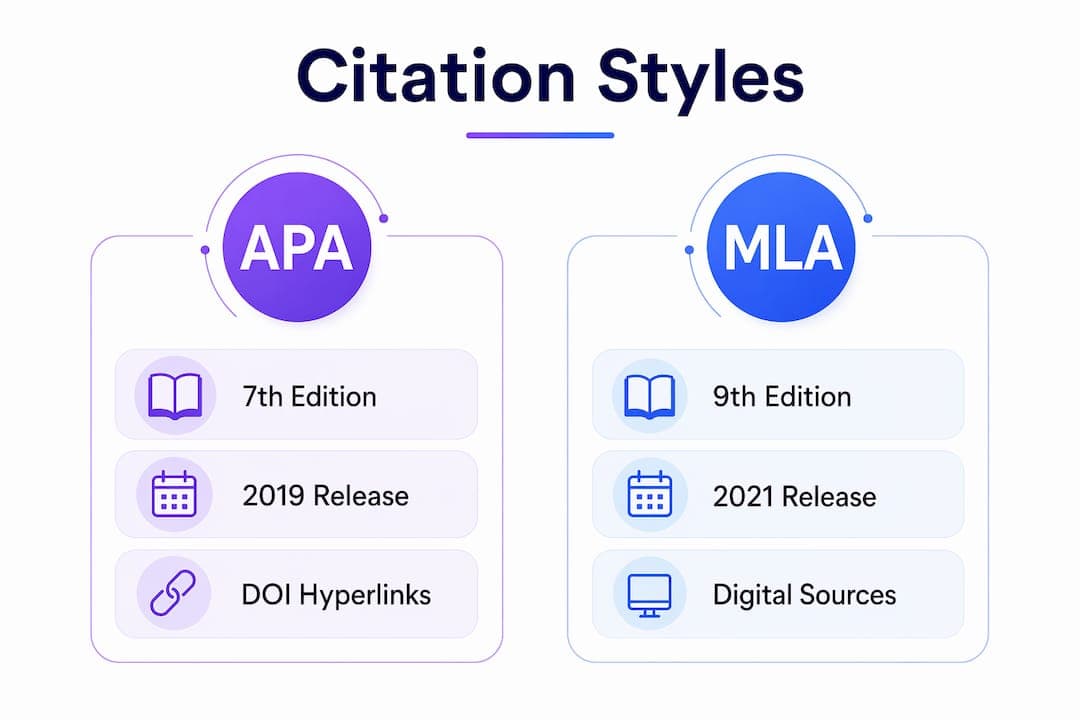
Understanding the update cycles of the major styles helps you know when to check for changes and what to look for. The table below summarizes the current editions, their release years, key features, and the disciplines they primarily serve.
| Style | Current edition | Year released | Key update features | Primary disciplines |
|---|---|---|---|---|
| APA | 7th edition | 2020 | DOIs as hyperlinks, no publisher location, updated pronoun guidance | Psychology, social sciences, education |
| MLA | 9th edition | 2021 | Flexible author name conventions, updated digital source formats | Humanities, literature, language arts |
| Chicago | 17th edition | 2017 | Two parallel systems (notes-bibliography and author-date), updated digital source rules | History, arts, some social sciences |
| Harvard | Varies by institution | Ongoing | No single governing body; institution-specific updates | Sciences, business, some humanities |
| IEEE | 11th edition | 2024 | Numbered reference system, updated standards for datasets and software | Engineering, computer science, technology |
APA 7th emphasizes recency through its DOI hyperlink requirement, which makes every cited source directly traceable. MLA 9th introduced a more flexible approach to author names and expanded its guidance on citing digital sources, reflecting how humanities scholars now work with online archives and multimedia. Chicago 17th maintains its two-system structure but updated its rules for electronic sources substantially.
The Harvard style is a special case. Because no single organization governs it, Harvard formatting varies by institution and department. If your university uses Harvard referencing, the correct approach is to consult your institution's specific style guide rather than any generic Harvard citation resource. The same logic applies to discipline-specific styles like AMA (American Medical Association) for medical writing or Bluebook for legal scholarship.
Verifying the correct version is straightforward. Check your journal's author guidelines, your institution's academic writing center, or the official style organization's website. Do this at the start of a project, not at the submission stage.
A reliable citation workflow has three components: a reference manager as your source of record, official metadata for verification, and AI tools for speed. Each component has a specific role, and substituting one for another creates gaps.
Pro Tip: A hybrid citation workflow using reference managers as your source of record, official metadata for verification, and AI as a formatting assistant produces the most accurate results. Never rely on any single tool alone.
The importance of citation updates extends beyond compliance. Researchers who maintain current, accurate citations build a reputation for rigor that reviewers and editors notice. That reputation compounds over a career.
Updating citation formats protects academic integrity, prevents publication delays, and ensures your work is discoverable by both human reviewers and AI-assisted academic systems.
| Point | Details |
|---|---|
| Current editions matter | APA 7th, MLA 9th, and Chicago 17th are the active standards; older editions trigger revision requests. |
| Integrity depends on accuracy | Exact one-to-one matching between in-text citations and reference lists is required for academic compliance. |
| AI visibility requires freshness | Content with current, verifiable citations is surfaced more often by AI-driven literature tools. |
| Use a three-part workflow | Combine reference managers, official metadata verification, and AI formatting tools for reliable results. |
| Verify before submission | Check every citation against the current style manual and the original published source before submitting. |
I have reviewed hundreds of papers where the argument was strong, the research was solid, and the submission still came back with a revision request. The reason, more often than not, was citation formatting. Not the ideas. Not the methodology. The formatting. That pattern tells you something important about how academic gatekeeping actually works.
The assumption most students and early-career researchers carry is that citation formatting is a finishing task, something you tidy up at the end. That assumption is wrong. When you format citations using an outdated edition, you are not just making a cosmetic error. You are signaling to reviewers that you did not check the current requirements, which raises questions about what else you did not check. The importance of citation standards in academic writing is not bureaucratic. It is reputational.
The AI dimension makes this more urgent in 2026 than it was five years ago. Literature review tools, citation indexes, and AI-assisted research platforms all evaluate source verifiability. A citation with a broken or missing DOI is effectively invisible to these systems. Researchers who keep their citations current are not just complying with rules. They are making their work findable.
My practical advice: treat citation verification as a research skill, not an administrative task. Build it into your workflow from the first source you collect, not the night before submission.
— Tilen
Managing citation format updates across multiple projects, style guides, and submission deadlines is genuinely difficult. Samwell is built to reduce that friction for students and researchers who need accurate, current citations without spending hours cross-referencing style manuals.
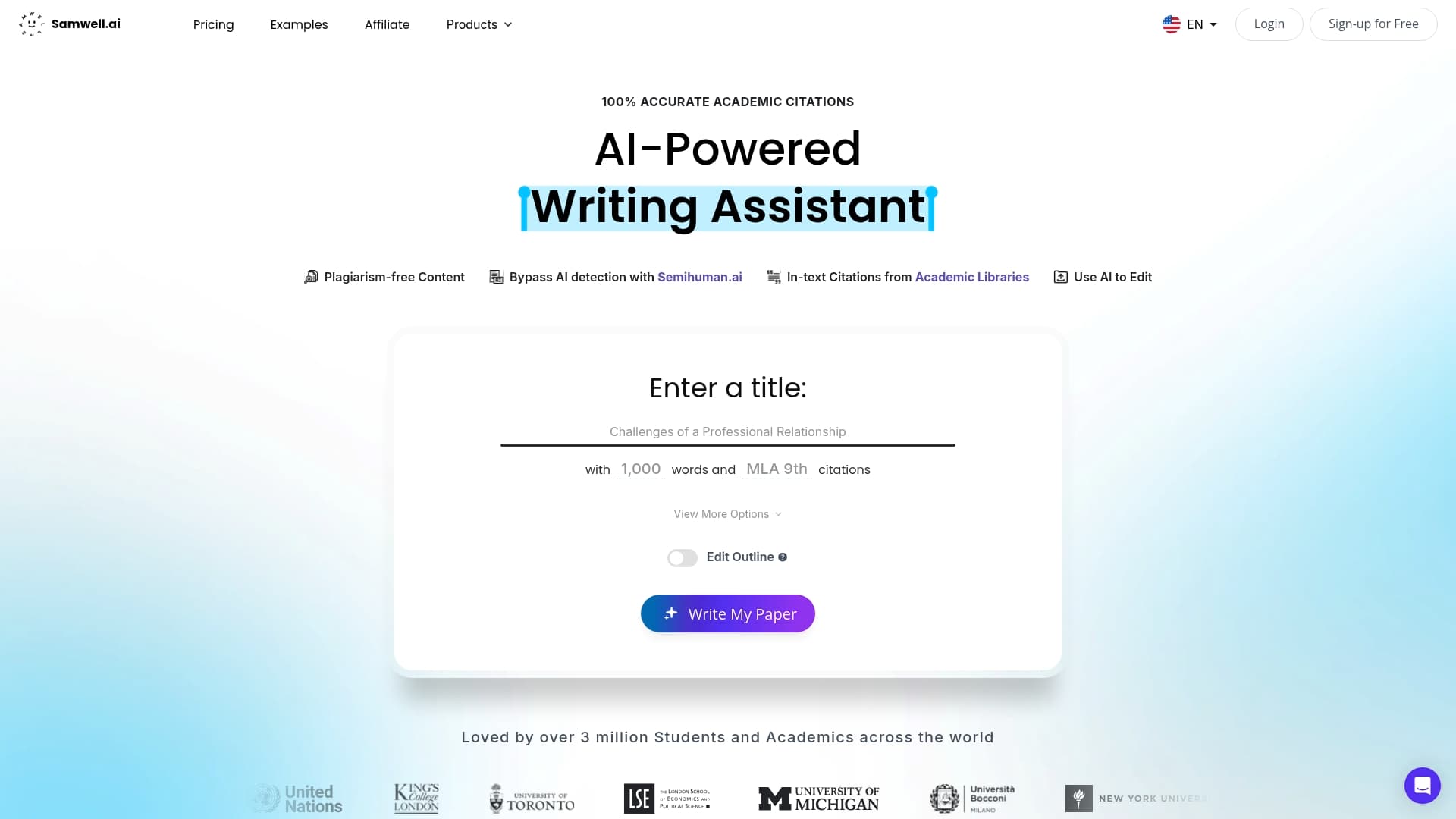
Samwell supports APA, MLA, Chicago, and other major citation formats, and its tools are updated to reflect current edition requirements. The Power Editor lets you target specific citation errors and correct them in context, while Guided Essays help you structure papers with properly formatted references from the start. Over 1,000,000 students and academic professionals use Samwell to produce credible, well-cited work that meets institutional and publication standards. If citation accuracy is slowing down your research process, Samwell is worth exploring.
Citation formats are updated to address new source types, digital publishing requirements, and evolving disciplinary communication norms. APA, MLA, and Chicago each release new editions when accumulated changes, such as DOI formatting rules or digital source conventions, require a systematic revision.
Minor formatting errors typically result in revision requests or grade deductions, while substantive citation errors can escalate to academic misconduct reviews. Journals and institutions distinguish between the two, but both outcomes delay your submission.
Check your journal's author guidelines or your institution's academic writing center for the required edition. The style name alone is not sufficient. You need the specific edition number to format correctly.
Zotero and EndNote are reliable when their style files are kept current. Citation managers require manual checks for errors like wrong edition numbers or missing DOIs, and their output is only as accurate as the metadata you import.
AI citation tools speed up formatting but frequently produce errors including fabricated titles and incorrect DOIs. Use them to reformat verified citations, not to generate citations from unverified sources.