Loading...

TL;DR:
- A well-structured essay guides readers clearly from a thesis to detailed support, enhancing persuasion and comprehension.
- Organizing content into introduction, body, and conclusion with proportional word limits forms the foundation of effective academic writing.
- Using layered, dependent arguments rather than list-like points strengthens the overall coherence and credibility of your essay.
A structured essay is defined as any written argument organized around a clear introduction, developed body paragraphs, and a purposeful conclusion that together guide the reader from question to answer. Why structured essays matter comes down to one fact: without organization, even strong ideas fail to persuade. Structure is not a bureaucratic requirement imposed by teachers. It is the mechanism that turns raw thinking into a coherent argument. Tools like Grammarly, frameworks like PEEL (Point, Evidence, Explanation, Link), and academic standards from institutions like the University of the Sunshine Coast all confirm that organization is the foundation of effective academic writing.

Structure gives your reader a roadmap. When a reader opens your essay, they need to know within the first paragraph what you are arguing and why it matters. Without that orientation, even a brilliant insight gets lost. The importance of structured essays is not just about following rules. It is about respecting your reader's attention and making your argument as easy to follow as possible.
A structured essay also decreases cognitive load, freeing students to focus on developing quality ideas rather than scrambling to organize them mid-draft. That shift in mental energy is significant. When you are not worried about where your next point goes, you can focus on making that point sharper, more specific, and better supported.
Academic writing rewards clarity above almost everything else. Professors and competition judges are reading dozens of essays at a time. A well-organized piece signals competence before the reader even evaluates the argument itself.
Every effective essay shares three functional parts: an introduction that states the thesis, a body that develops and supports it, and a conclusion that synthesizes the argument. Each part carries a specific job, and the proportion of words you assign to each part matters as much as the content itself.
The 10/80/10 rule is a professional standard that allocates 10% to the introduction, 80% to the body, and 10% to the conclusion. This ratio exists because the body is where your argument lives. Skimping on body paragraphs to write a long introduction is one of the most common structural mistakes students make.
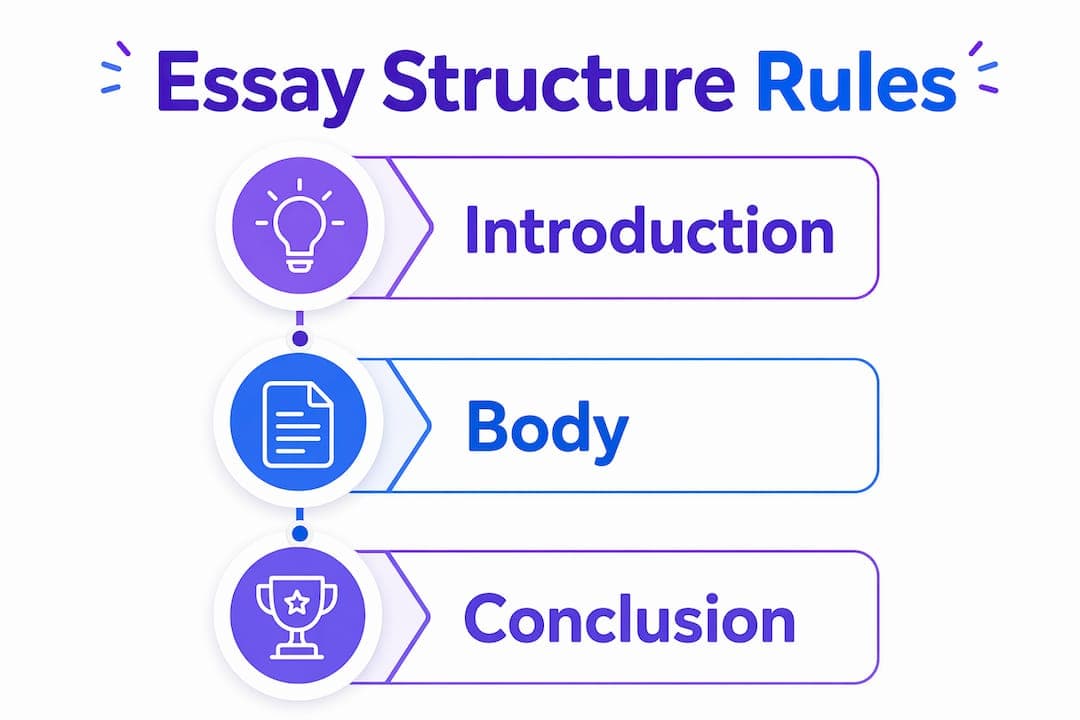
For a standard 1,000-word essay, the body should be roughly 75% of the total word count, with the introduction and conclusion each taking 10 to 15 percent. That means roughly 750 words of actual argument, evidence, and analysis. The table below shows how this breaks down in practice.
| Essay part | Word count (1,000-word essay) | Primary function |
|---|---|---|
| Introduction | 100 to 150 words | State thesis, frame the question, signal structure |
| Body paragraphs | 750 to 800 words | Develop argument, present evidence, analyze |
| Conclusion | 100 to 150 words | Synthesize argument, address broader implications |
The conclusion deserves special attention. Strong conclusions do more than restate the thesis. They extend the argument by addressing broader implications or acknowledging limitations. A conclusion that simply repeats your introduction wastes the reader's time and signals shallow thinking.
You can explore a detailed breakdown of each part in this guide to essential essay components, which covers how each section functions at the sentence level.
Structure transforms a list of points into a layered argument. The difference matters enormously in academic writing. A list-based essay presents three or four points in sequence, each one independent of the others. A layered argument builds each paragraph on the logic of the previous one, so the essay gains force as it progresses.
High-level academic essays avoid list-based points entirely, preferring dependent arguments where each paragraph logically follows and strengthens the overall claim. This is the standard used by judges at the John Locke Essay Competition, one of the most prestigious undergraduate writing competitions in the world. Their criteria reward essays where the argument compounds rather than accumulates.
Placing your thesis within the first 150 words is not just a stylistic preference. Winning essays in the John Locke competition consistently feature a clear, arguable thesis early in the piece. That early commitment forces you to write with purpose rather than circling toward a point.
The benefits of a clear structure extend beyond argument quality:
On that last point: engaging seriously with one strong counterargument strengthens your thesis more effectively than dismissing several weaker ones. Structure gives you the space to do that properly.
Pro Tip: Use the PEEL method (Point, Evidence, Explanation, Link) for each body paragraph. It forces you to connect every piece of evidence back to your thesis, which is exactly what layered argumentation requires.
The most persistent myth about essay structure is that it kills creativity. This belief often comes from overexposure to the five-paragraph essay, which critics like Dr. Terry Underwood have called a "zombie pedagogy" that limits discovery-based writing but survives through institutional inertia. The critique is fair. A rigid five-paragraph formula can reduce complex arguments to a mechanical checklist.
But the solution is not to abandon structure. It is to use structure as a thinking tool rather than a template. Structure stimulates thinking rather than restricting it. When you plan your argument in advance, you often discover gaps in your reasoning that you would have missed if you had written linearly without a plan.
Here are four practical ways to maintain your creative voice within a structured framework:
Pro Tip: If you feel constrained by structure, write a free-draft first to capture your ideas, then impose structure during revision. The structure is for your reader, not your first draft.
The most common mistake students make is writing from the first sentence to the last in a straight line. Experienced writers draft non-linearly, developing body paragraphs first based on a planned outline, then writing the introduction and conclusion to match. This approach prevents the introduction from making promises the body cannot keep.
A reliable process looks like this: plan your central argument, assign specific evidence to each body paragraph, write all body paragraphs, then write the introduction, and finally write the conclusion. Tools like Grammarly support this process by flagging clarity and cohesion issues after the draft is complete, not during planning. An essay structure checklist can also help you verify that each section is doing its job before you submit.
The table below compares the traditional linear approach with a modular drafting method:
| Approach | Process | Risk |
|---|---|---|
| Traditional linear | Write introduction first, then body, then conclusion | Introduction makes claims the body cannot support |
| Modular drafting | Plan outline, write body first, then introduction and conclusion | Requires discipline to resist writing linearly |
Tracking word count by section is also worth doing. If your introduction runs to 300 words in a 1,000-word essay, you have already used 30% of your budget before making a single argument. The academic standards for essay length are clear: proportion signals priority, and your body paragraphs should always get the most space.
Pro Tip: Before you write a single sentence, write your thesis at the top of a blank document and keep it visible throughout the drafting process. Every paragraph you write should be answerable to that thesis.
Structured essays succeed because they direct the reader's attention, build arguments logically, and signal academic competence through organization and proportion.
| Point | Details |
|---|---|
| Structure enables clarity | Organized essays reduce cognitive load, letting readers follow your argument without confusion. |
| Proportion signals priority | The 10/80/10 rule keeps the bulk of your writing focused on argument and analysis. |
| Layered arguments outperform lists | Each paragraph should build on the previous one, not simply add another independent point. |
| Structure supports creativity | Use structure as a thinking tool during revision, not a constraint during drafting. |
| Draft non-linearly | Write body paragraphs first, then craft the introduction and conclusion to match your argument. |
I have read hundreds of student essays over the years, and the ones that fall flat almost never fail because of a weak idea. They fail because the idea never gets a fair hearing. The argument is buried in the third paragraph, the introduction promises something the body does not deliver, or the conclusion simply repeats what came before. Structure fixes all three of those problems before they happen.
What I find most useful to tell students is this: structure is not something you impose on your writing after the fact. It is something you use to think more clearly before you write a word. When you know your thesis, know your three or four supporting arguments, and know how they connect, the actual writing becomes faster and less stressful. That is not a small benefit for a student facing a deadline.
The five-paragraph essay gets a bad reputation, and some of that criticism is deserved. But the students who struggle most with academic writing are not the ones who learned too much structure. They are the ones who never internalized any structure at all. The goal is not to follow a formula. The goal is to understand why the formula exists well enough to know when to break it.
— Tilen
Samwell is built specifically for students who want to write better essays without spending hours staring at a blank page.

Samwell's Guided Essays feature generates structured outlines based on your thesis and topic, so you always start with a clear framework rather than guessing at organization. The Power Editor lets you expand and refine individual sections, keeping your word count proportions on track. Real-time AI detection checks and support for MLA and APA citation standards mean your essay meets academic requirements from the first draft. Over 1,000,000 students from leading universities already use Samwell to write essays that are clearer, better organized, and more persuasive. If structure is what separates a good essay from a great one, Samwell gives you that structure from the start.
Essay structure matters because it directs the reader's attention, builds arguments logically, and signals academic competence. Organized writing reduces cognitive load, making it easier for professors and judges to evaluate your ideas on their merits.
The 10/80/10 rule allocates 10% of your word count to the introduction, 80% to the body, and 10% to the conclusion. This proportion keeps the bulk of your writing focused on argument and analysis, which is where academic grades are won.
The number of paragraphs depends on your argument, not a fixed formula. A 1,000-word essay typically has three to five body paragraphs, each developing one distinct point that connects to the central thesis.
Structure does not limit creativity. It provides a framework that frees you to focus on developing strong ideas rather than organizing them mid-draft. The five-paragraph essay can feel restrictive, but flexible structure used as a thinking tool actually supports more original arguments.
Write the introduction after you have drafted your body paragraphs. Experienced writers draft non-linearly, building the body first so the introduction accurately reflects the argument rather than making promises the body cannot keep.