Loading...

Over half of american students cite academic writing as their most challenging coursework requirement. The need for clear thinking, strong evidence, and methodical argumentation can feel demanding even for seasoned scholars. Mastering these key principles not only strengthens educational achievement but shapes research credibility and intellectual growth. Understanding academic writing means gaining access to foundational skills that support success in both higher education and professional fields.
| Point | Details |
|---|---|
| Core Principles of Academic Writing | Academic writing emphasizes clarity, objectivity, and analytical depth, requiring precise language and structured arguments. |
| Types of Academic Writing | Major forms include research articles, literature reviews, essays, theses, and conference papers, each serving specific scholarly purposes. |
| Purpose in Research and Education | It facilitates knowledge dissemination, critical thinking development, and interdisciplinary communication, enhancing scholarly contributions. |
| Maintaining Integrity | Upholding academic integrity through proper citation and original thought is essential to preserve credibility and ethical standards in research. |
Academic writing is a sophisticated intellectual process that goes far beyond simply putting words on a page. At its core, it represents a structured approach to communicating complex ideas with precision, objectivity, and scholarly rigor. Unlike casual writing, academic writing requires systematic organization that transforms raw thoughts into coherent, evidence-based arguments.
The fundamental characteristics of academic writing center on clarity, objectivity, and analytical depth. Researchers must craft their work with a formal tone that prioritizes logical progression and evidence-based reasoning. This means presenting arguments that are meticulously supported by credible sources, carefully examining multiple perspectives, and maintaining a professional distance from the subject matter. Academic writing demands writers synthesize information critically, moving beyond surface-level descriptions to offer nuanced, well-reasoned insights.
Key principles that define academic writing include:
Successful academic writing transforms complex ideas into accessible, compelling narratives that contribute meaningful knowledge to specific disciplines. By adhering to these core principles, writers create scholarly work that communicates sophisticated concepts with intellectual integrity and professional excellence.
Academic writing encompasses a diverse range of formats and styles, each designed to communicate scholarly information with precision and intellectual rigor. Academic writing forms are meticulously crafted to meet specific research and communication objectives, enabling scholars to share knowledge effectively across various disciplines.
The primary types of academic writing can be categorized into four fundamental approaches. Descriptive writing provides comprehensive information and factual details about a specific topic, serving as a foundational method of scholarly communication. Analytical writing takes this further by reorganizing information into meaningful categories and exploring complex relationships between concepts. Persuasive writing aims to convince readers by presenting well-reasoned arguments supported by credible evidence, while critical writing involves in-depth evaluation and sophisticated interpretation of existing research and theoretical frameworks.
Key forms of academic writing include:
Each form of academic writing requires unique skills and adherence to specific conventions. Scholars must carefully select the appropriate format to effectively communicate their intellectual contributions, ensuring their work meets the rigorous standards of scholarly discourse and advances knowledge within their respective academic disciplines.

Academic writing represents a critical mechanism for knowledge generation, preservation, and transmission across diverse intellectual landscapes. Academic paper mastery enables scholars to communicate complex ideas with precision, creating a structured dialogue that advances understanding within specific disciplines.
At its core, academic writing serves multiple fundamental purposes in research and educational contexts. It functions as a sophisticated tool for knowledge dissemination, allowing researchers to share groundbreaking discoveries, theoretical frameworks, and empirical findings with a global scholarly community. In educational settings, academic writing becomes a powerful instrument for developing critical thinking skills, teaching students how to analyze information, construct logical arguments, and engage with complex intellectual concepts systematically.
Key purposes of academic writing include:
Ultimately, academic writing transcends mere documentation. It represents a dynamic process of intellectual exploration, challenging existing paradigms, generating new knowledge, and fostering a continuous, collaborative dialogue that pushes the boundaries of human understanding across diverse academic disciplines.
Academic writing is a powerful catalyst for developing sophisticated cognitive skills that extend far beyond simple information reproduction. Critical thinking essay techniques transform intellectual engagement, pushing writers to move beyond surface-level understanding and delve into nuanced, evidence-based analysis.
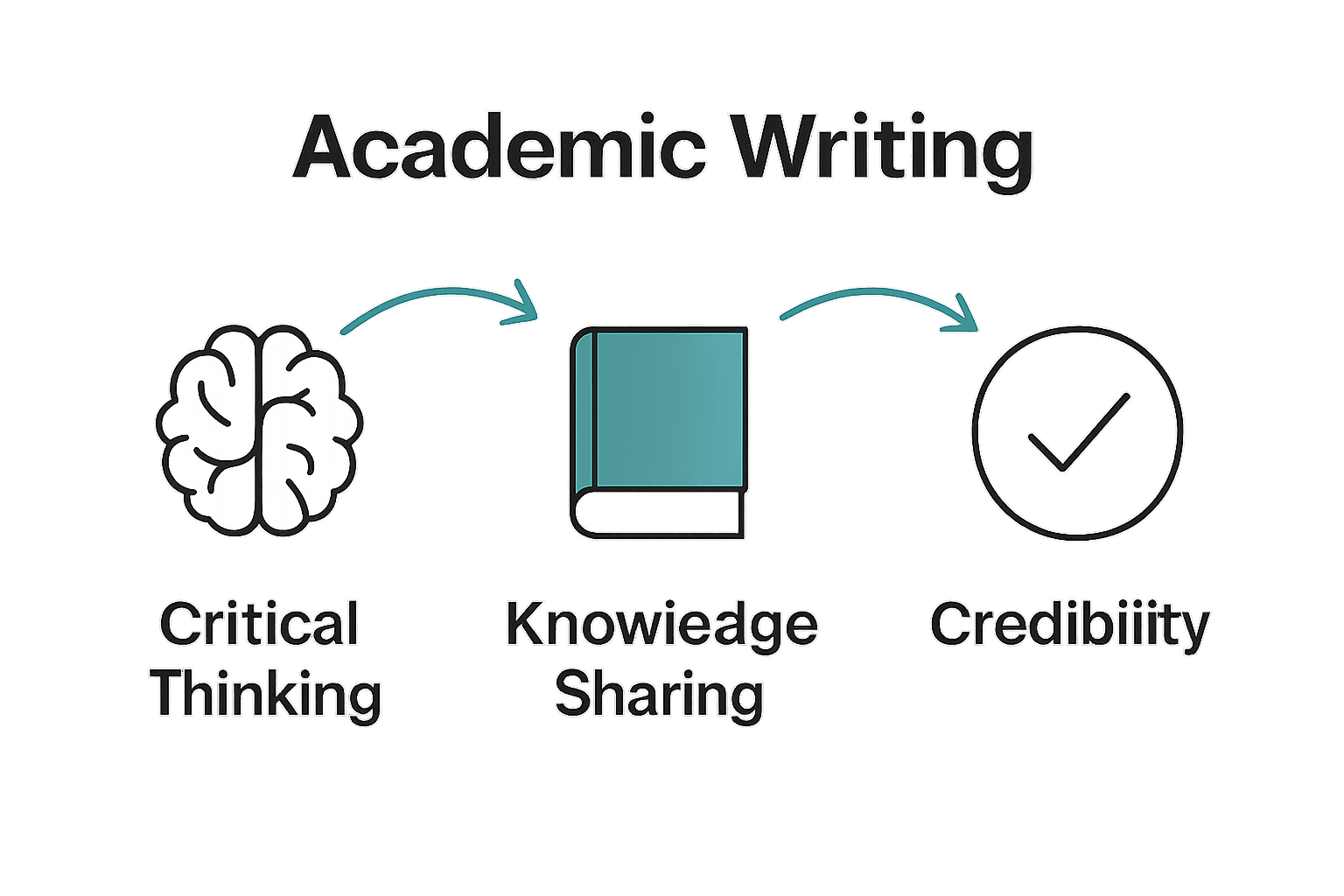
The process of academic writing fundamentally reshapes how individuals approach complex information. Critical thinking emerges as a core outcome, requiring writers to systematically evaluate sources, recognize underlying assumptions, synthesize diverse perspectives, and construct rigorous arguments supported by credible evidence. This intellectual discipline demands more than passive knowledge absorption - it compels scholars to actively challenge existing paradigms, identify knowledge gaps, and contribute meaningful insights to their respective fields.
Key mechanisms through which academic writing enhances critical thinking include:
Ultimately, academic writing serves as a transformative intellectual practice. It not only documents scholarly knowledge but also cultivates a robust critical mindset that empowers researchers and students to think more deeply, challenge conventional wisdom, and contribute meaningfully to the ongoing global conversation of ideas.
Academic integrity represents the foundational ethical framework that distinguishes scholarly work from mere information reproduction. Understanding types of academic dishonesty reveals the complex landscape of potential ethical breaches that researchers and students must carefully navigate.
Plagiarism stands as the most significant threat to academic credibility, encompassing intentional and unintentional appropriation of another's intellectual property. Academic integrity demands meticulous attention to proper citation, paraphrasing, and attribution practices. Writers must develop sophisticated skills to integrate external sources seamlessly while maintaining their unique intellectual voice, carefully distinguishing between acceptable referencing and potential misconduct.
Key strategies for maintaining academic integrity include:
Ultimately, academic integrity transcends mere rule-following. It represents a profound commitment to intellectual honesty, respect for scholarly discourse, and the collaborative advancement of human knowledge across diverse disciplines.
Struggling to maintain academic integrity, build strong critical thinking, or properly structure complex research papers Can you benefit from a tool that ensures precision in language and original content While the article highlights the challenges of mastering academic writing, such as avoiding plagiarism and crafting clear, evidence-based arguments, you do not have to face these hurdles alone Samwell.ai offers a transformative solution designed specifically for students and researchers seeking to produce high-quality academic work with confidence

Experience the power of Samwell.ai, an advanced platform combining AI-driven essay generation with strict adherence to citation standards like MLA and APA Use our unique Semihuman.ai technology to minimize plagiarism risks and enhance your writing with the Power Editor, which helps you expand and refine arguments seamlessly If you want a clear roadmap, explore our Guided Essays feature for structured outlines crafted to boost your critical analysis skills Act now to turn daunting academic projects into manageable tasks and join over 1,000,000 users who trust Samwell.ai to elevate their scholarly work
Academic writing is a structured approach to communicating complex ideas with precision, objectivity, and scholarly rigor. It involves creating evidence-based arguments and requires systematic organization to transform raw thoughts into coherent narratives.
Academic writing is crucial for knowledge dissemination, critical analysis, skill development, and professional preparation. It allows researchers to share findings, helps students develop critical thinking skills, and fosters interdisciplinary communication.
The key principles of academic writing include precision in language, scholarly documentation, structured argumentation, and critical analysis. These principles ensure that arguments are logically constructed and well-supported by credible sources.
Academic writing enhances critical thinking by requiring writers to evaluate sources, synthesize diverse perspectives, and construct evidence-based arguments. It encourages challenging established theories and encourages deep, nuanced examination of existing knowledge.