Loading...

TL;DR:
- AI detection identifies whether text was generated by AI, but current tools are probabilistic and often unreliable.
- Educators should combine human review, process evidence, and contextual understanding to fairly assess student work.
AI detection is the process of identifying whether text has been generated by artificial intelligence rather than a human writer. For students, educators, and researchers, this distinction carries real consequences: institutional trust, grading fairness, and the credibility of published scholarship all depend on it. Tools like GPTZero and OpenAI's now-discontinued classifier represent the first generation of this technology, and their limitations reveal just how complex the role of AI detection has become. The science behind these tools is advancing fast, but so are the problems they create.
AI detection technology relies on five primary methodologies: watermarking, structural marking, metadata analysis, logging, and AI text classification. Each targets a different signal that distinguishes machine-generated text from human writing. Understanding how these methods operate helps you evaluate what any given tool can and cannot tell you.

Watermarking embeds invisible patterns into text at the generation stage, making it traceable back to a specific model. Structural marking looks for formatting regularities that AI systems tend to produce. Metadata analysis examines file properties and creation timestamps. Logging tracks which accounts or API keys generated specific outputs. AI text classification, the most widely deployed method, uses machine learning models trained on large corpora of human and AI text to assign a probability score.
The classification approach depends heavily on two linguistic features: perplexity and burstiness. Perplexity measures how predictable a sequence of words is. AI-generated text tends to be low-perplexity because language models favor statistically probable word choices. Burstiness captures variation in sentence length and complexity. Human writing tends to burst between short punchy sentences and longer analytical ones, while AI output stays more uniform. Detectors trained on these signals can identify patterns invisible to the human eye.
Pro Tip: When you read a detector's output, look for the confidence score, not just the binary verdict. A 55% AI probability and a 95% AI probability carry very different implications for any decision you make.
The machine learning classifiers behind tools like GPTZero analyze statistical patterns across thousands of features simultaneously. They are not reading for meaning. They are reading for the fingerprint of a probability distribution. That distinction matters when you start asking what these tools get wrong.
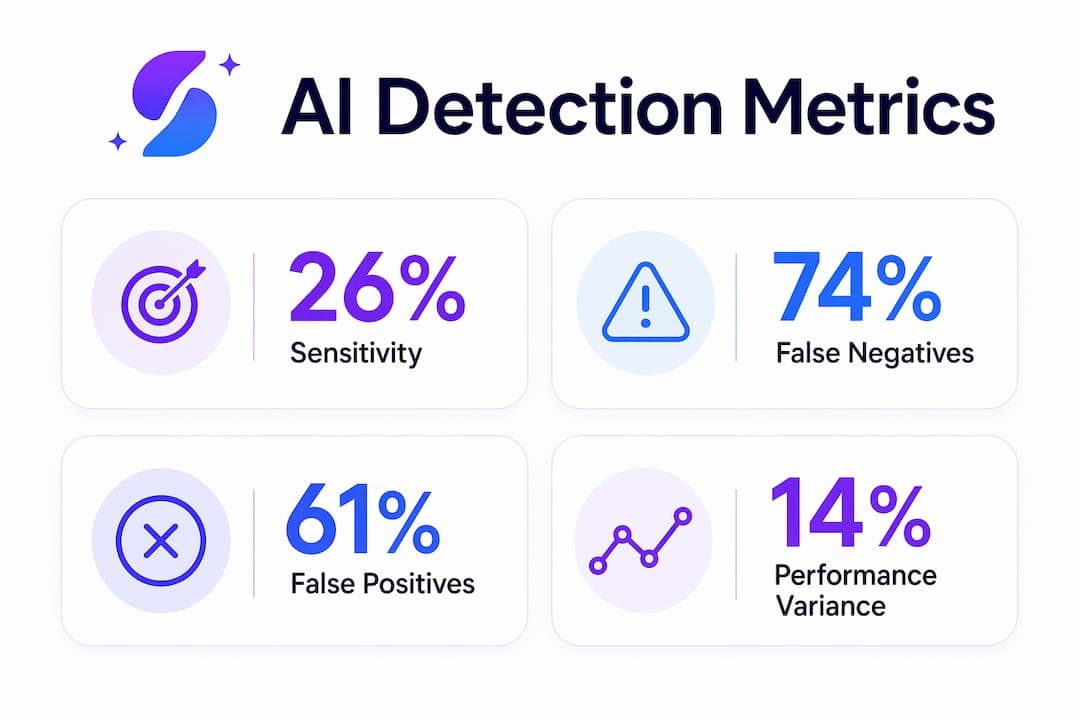
The limitations of AI detection technology are severe enough that several researchers argue current tools should not be used as sole evidence in academic misconduct cases. The data supports that position.
OpenAI's classifier had a sensitivity of just 26%, meaning it missed approximately 74% of AI-generated texts. It also misclassified 9% of human-written texts as AI-generated. OpenAI discontinued it in 2023 because the accuracy was too low to be useful. That is not a minor calibration problem. A tool that misses three out of four AI texts while falsely accusing one in eleven human writers is not a reliable enforcement mechanism.
The fairness problem is even more acute for non-native English speakers. Stanford HAI research found that 61.3% of TOEFL essays were flagged as AI-generated by at least one detector, and 19.8% were flagged by all seven detectors tested. Near-zero false positives appeared on essays written by U.S.-born students. This disparity exists because non-native speakers often write in lower-perplexity patterns, favoring simpler, more predictable sentence structures. The detector reads careful, deliberate writing as suspicious.
The table below summarizes the core diagnostic metrics every educator should understand before acting on a detection result.
| Metric | Definition | Why it matters |
|---|---|---|
| Sensitivity | % of AI texts correctly identified | Low sensitivity means many AI texts go undetected |
| Specificity | % of human texts correctly cleared | Low specificity means innocent students get flagged |
| False discovery rate | % of flagged texts that are actually human | High rates make positive results unreliable |
| Prevalence | Estimated % of AI use in a population | Shapes how meaningful any detection score actually is |
AI detection as a triage tool requires knowing the prevalence of AI use in your specific student population. If only 5% of students use AI, even a highly accurate detector will produce more false positives than true positives. This is the same logic applied in medical screening. A test with 90% accuracy sounds reliable until you apply it to a population where the condition is rare.
Robustness is a third major challenge. Instruction diversity in student prompts increases detector performance variance by up to 14.4 F1-score standard deviations in realistic essay settings. When students write with different constraints, word limits, or stylistic instructions, the same underlying AI model produces text that detectors evaluate very differently. This means detection accuracy is not a fixed property of a tool. It shifts with every assignment.
Pro Tip: Before adopting any AI detector for institutional use, request the tool's published sensitivity, specificity, and false positive rates on non-native English writing. If the vendor cannot provide these figures, treat the tool's output as unverified.
Regulatory and technical communities are responding to these limitations with new frameworks, though none have solved the core problems yet.
The EU AI Act, specifically Article 50(2), requires AI-generated content to be marked in a machine-readable way. The European Commission's technical assessment evaluates detection methodologies across five criteria: effectiveness, reliability, robustness, accessibility, and interoperability. This is the most systematic regulatory framework applied to AI detection so far, and it explicitly rejects the idea that any single method is sufficient.
The C2PA (Coalition for Content Provenance and Authenticity) system takes a different approach. Rather than analyzing text after the fact, C2PA embeds cryptographic provenance data at the point of creation, creating a verifiable chain of custody for digital content. The concept is sound, but C2PA's current implementation shows security flaws including inconsistent timestamps and conflicting validator outputs. These inconsistencies undermine the system's core promise of trustworthy verification.
Researchers are also pushing for multi-metric evaluation frameworks that move beyond binary AI/human verdicts. The key developments shaping the field include:
The trajectory is clear: regulators and researchers both see AI detection as a probabilistic signal that requires human interpretation, not an automated verdict system.
Translating the technical picture into practical guidance requires accepting one uncomfortable truth: no AI detector currently available is reliable enough to serve as the sole basis for an academic misconduct finding. That does not mean detection tools are useless. It means they must be used correctly.
Here is a framework for responsible use:
Treat detection scores as probabilistic signals. A high AI-probability score opens an investigation. It does not close one. Ask for drafts, notes, and process evidence before drawing conclusions.
Apply human review to every flagged submission. False positives cause real harm, including wrongful misconduct accusations and reputational damage to students who wrote their own work. A human reviewer can assess context that no algorithm captures.
Adjust your interpretation for ESL and technical writers. Non-native English speakers and writers in highly constrained genres (lab reports, legal briefs, technical summaries) produce text that systematically scores higher on AI-probability scales. Applying uniform thresholds across all student populations is not equitable.
Cross-verify with multiple tools. No single detector has demonstrated consistent accuracy across all writing contexts. Using GPTZero alongside other classifiers and comparing outputs gives a more complete picture than any single score.
Build policies around process evidence. Require students to submit outlines, annotated drafts, or revision histories alongside final papers. Process evidence is harder to fabricate than a clean final document and gives educators a richer basis for evaluation.
Stay current with AI writing trends in academia. Detection technology and AI writing tools are both evolving rapidly. Policies written in 2024 may already be outdated by the time you read this.
For researchers, the implications extend to peer review. Journals that use AI detectors to screen submissions face the same false positive risks as universities. A paper written by a non-native English speaker on a technical topic may score high on AI-probability for the same structural reasons that TOEFL essays do. Editorial boards need the same diagnostic literacy that educators do.
AI detection tools are probabilistic instruments, not truth machines, and every institutional policy that treats them otherwise creates measurable harm.
| Point | Details |
|---|---|
| Detection is probabilistic | No current tool reliably distinguishes AI from human text with sufficient accuracy for sole use in misconduct cases. |
| False positives target ESL writers | Non-native English speakers face disproportionately high false positive rates, making uniform thresholds inequitable. |
| Prevalence shapes interpretation | Knowing how common AI use is in your student population is required to correctly interpret any detection score. |
| Regulatory standards are emerging | The EU AI Act and C2PA represent early frameworks, but neither has resolved core reliability and interoperability gaps. |
| Human review is non-negotiable | Every flagged submission requires human evaluation and process evidence before any institutional action is taken. |
The research on AI detection has convinced me of something most institutional policies have not yet accepted: we are deploying these tools at the wrong end of the process. Educators are using detectors to catch students after submission, when the more productive use is to build AI literacy and process transparency before a single word is written.
The false positive data is not just a technical inconvenience. It is evidence that the tools we are trusting to enforce fairness are themselves producing unfair outcomes at scale. When 61.3% of TOEFL essays trigger at least one detector, and near-zero U.S.-born student essays do the same, we are not catching cheaters. We are encoding a linguistic bias into our academic integrity infrastructure.
I have also found that the binary framing of "AI or human" misses the more interesting and more honest question: how did this student engage with the writing process? A student who used an AI tool to generate an outline, then wrote and revised every sentence themselves, has done something categorically different from one who submitted a raw model output. Current detectors cannot distinguish between these cases. Human judgment, combined with process evidence, can.
The EU AI Act's framing of detection as a risk-managed workflow rather than a binary verdict is the right model. Institutions that adopt this framing now will be better positioned when the next generation of AI writing tools makes today's detectors even less reliable. The goal is not to win an arms race with AI. The goal is to understand what students actually know and can do.
— Tilen
Academic integrity does not require avoiding AI entirely. It requires using AI responsibly, with full transparency and genuine intellectual engagement.
Samwell is built for exactly this balance. Its plagiarism-free essay tools combine Semihuman.ai technology with real-time AI detection checks, so you know where your paper stands before you submit. The Power Editor lets you refine and expand your own arguments rather than outsourcing them. Guided Essays provide structured outlines that keep your thinking at the center of the work. Over 1,000,000 students from leading universities use Samwell to produce original, credible academic writing. If you want to understand AI detection for students and write with confidence, Samwell gives you the tools to do both.
AI detection identifies whether submitted text was generated by an AI model rather than written by a student. Its role is to support academic integrity policies, but current tools require human review and process evidence before any misconduct finding is made.
Detectors rely on perplexity and burstiness metrics that overlap with careful, deliberate human writing. Non-native English speakers are especially affected, with research showing 61.3% false positive rates on TOEFL essays compared to near-zero rates on essays by U.S.-born students.
Accuracy varies significantly by tool and writing context. OpenAI's classifier had a sensitivity of only 26%, missing nearly three-quarters of AI-generated texts. No current tool has demonstrated consistent accuracy across all student populations and assignment types.
Instruction diversity and writing constraints increase detector performance variance by up to 14.4 F1-score standard deviations, meaning the same AI model can produce text that scores very differently depending on how the prompt was written. Adversarial editing further reduces detection reliability.
Treat the flag as a starting point for investigation, not a conclusion. Request drafts, outlines, and revision histories. Apply human judgment to the full context of the submission, and consult your institution's AI policy before taking any formal action.