Loading...

TL;DR:
- MLA citation combines brief in-text notes with a detailed Works Cited page to credit sources. Correct formatting ensures academic integrity and enables readers to locate cited sources accurately.
An MLA citation is a standardized method for crediting sources in academic writing, combining a brief in-text parenthetical note with a detailed Works Cited entry at the end of your paper. The Modern Language Association publishes the MLA Handbook (9th edition) as the authoritative standard for this system. Every time you quote, paraphrase, or summarize a source, you need both components working together. Getting this right protects your academic credibility and keeps you clear of plagiarism charges. This guide covers every major rule, from the format of a parenthetical note to the layout of a full Works Cited page, with examples you can apply immediately.
In-text citations are mandatory in MLA style whenever you use exact wording, paraphrase, or summarize another person's work. The standard format places the author's last name and the page number inside parentheses, with no comma between them: (Smith 123). That single rule trips up more students than any other part of the system.
The parenthetical note goes at the end of the sentence, before the period. If you name the author in your sentence, you only need the page number in parentheses. For example: Smith argues that climate policy requires bipartisan support (45). When a source has no page number, such as a website, include only the author's name or a shortened title if no author is listed.
Two-author sources use both last names connected by "and": (Garcia and Lee 78). For three or more authors, use the first author's last name followed by "et al.": (Johnson et al. 112). The MLA Handbook 9th edition standardizes this practice to maintain clarity and brevity across long reference lists.
Direct quotes require quotation marks and a parenthetical note. Paraphrases and summaries also require a citation, a fact many students overlook. For quotes longer than four lines, the MLA Handbook advises using a block quotation format: indent the passage half an inch, double-space it, and omit quotation marks. The parenthetical note follows the final period of the block, not before it.
Pro Tip: Research librarians advise keeping parenthetical references brief. The more you integrate the author's name into your sentence, the shorter and cleaner your parenthetical note becomes.
The Works Cited page is the backbone of your MLA source citation system. Every in-text citation in your paper must match an entry on this page, and every entry must correspond to a source you actually cited. A misformatted Works Cited entry can make a source unfindable, which directly undermines your paper's credibility.

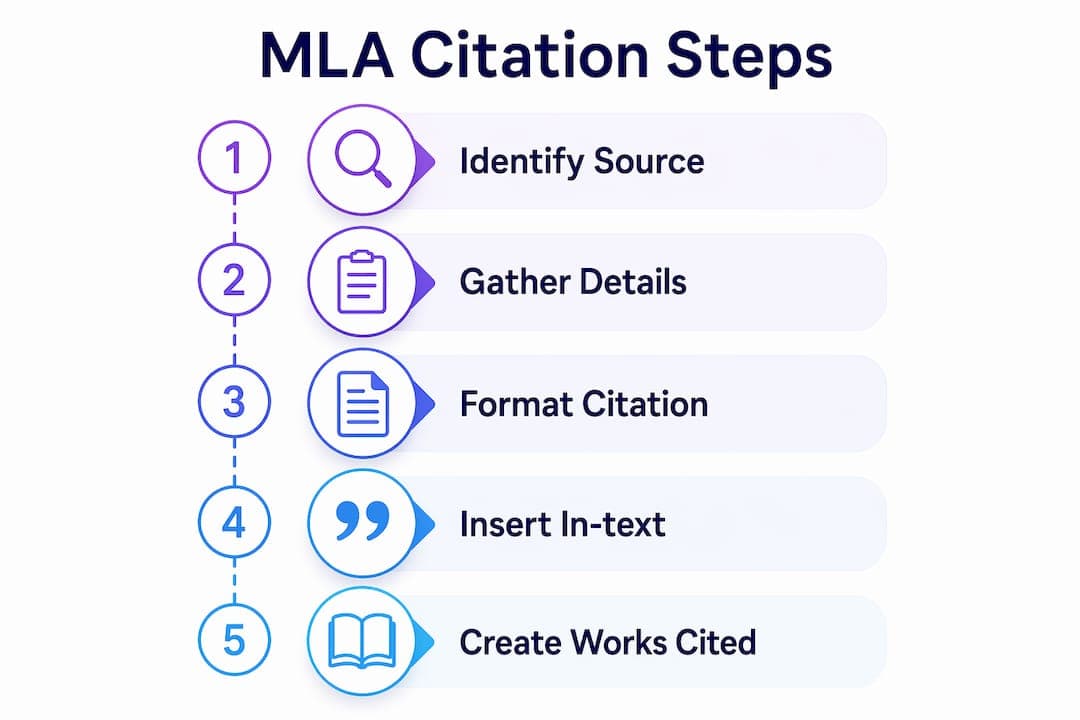
MLA 9th edition uses a flexible "core elements" system rather than rigid templates for each source type. You list applicable elements in a fixed order and simply omit any that do not apply to your source. The nine elements are:
This system works across books, articles, websites, films, and podcasts without needing a separate template for each. That flexibility is one of the most underappreciated features of the 9th edition.
Entries are double-spaced with no extra space between them, and each entry uses a hanging indent of 0.5 inches for all lines after the first. This formatting creates a clean, professional reference list that is easy to scan. The title "Works Cited" appears centered at the top of the page, and entries are listed in alphabetical order by the author's last name.
| Formatting element | Rule |
|---|---|
| Spacing | Double-spaced throughout, no extra space between entries |
| Indent | Hanging indent of 0.5 inches on lines after the first |
| Title | "Works Cited" centered, not bolded or italicized |
| Order | Alphabetical by author's last name |
| Same author, multiple works | Three hyphens and a period replace the name after the first entry |
MLA 9th edition recommends including stable URLs or DOIs for online sources. Omit "https://" unless the link is unclear without it. Prioritize a DOI over a URL when both are available, since DOIs remain stable even when a website changes its structure.
The Works Cited page and a bibliography are not the same thing, and mixing them up carries real academic consequences. The Works Cited page includes only the sources you actually cited in your paper. A bibliography may list every source you consulted during research, whether or not you cited it directly.
MLA 9th edition specifies the Works Cited format for standard academic papers. Including sources you never cited in your Works Cited page can signal poor research practice to instructors. Educators stress that adhering strictly to MLA's standard avoids grading penalties and keeps your paper honest.
The practical difference comes down to this:
When your instructor asks for a Works Cited page, list only what you cited. When they ask for a bibliography, list everything you read. Confusing the two is one of the most common errors in student papers, and it is entirely avoidable.
Most citation errors fall into a small set of repeating patterns. Knowing them in advance saves you from losing points on work you already put effort into.
Pro Tip: Before submitting any paper, run a full MLA formatting checklist against your Works Cited page. Checking each entry against the nine core elements takes less than five minutes and catches most formatting errors before your instructor does.
One habit that prevents most of these mistakes: build your Works Cited entries as you write, not after. Reconstructing source details from memory at midnight before a deadline is where errors multiply.
Accurate MLA citation requires a correctly formatted in-text parenthetical note for every borrowed idea, matched to a complete Works Cited entry built from the nine core elements of MLA 9th edition.
| Point | Details |
|---|---|
| In-text citation format | Use author's last name and page number with no comma: (Smith 42). |
| Works Cited page layout | Double-space all entries, use 0.5-inch hanging indents, and alphabetize by author's last name. |
| Works Cited vs. bibliography | List only sources you cited in your paper, not every source you consulted. |
| Multiple authors | Use "et al." for three or more authors in in-text citations; list all authors in Works Cited. |
| Core elements system | MLA 9 uses nine flexible elements applied in fixed order, omitting any that do not apply. |
Students often treat citation formatting as a bureaucratic hurdle rather than a communication tool. That framing is a mistake. A Works Cited entry exists so a reader can find the exact source you used. When the entry is wrong, the source becomes unfindable, and your argument loses its foundation.
I have seen papers with genuinely strong analysis get marked down because the citation list was sloppy. Instructors notice when a DOI is missing, when hanging indents are applied backward, or when a paraphrase has no parenthetical note. These are not trivial details. They signal whether you understand the scholarly conversation you are entering.
The 9th edition's core elements system is actually more forgiving than earlier versions. You do not need a separate template for every source type. You apply the same nine elements in the same order, omit what does not apply, and move on. Once you internalize that logic, formatting a new source type takes seconds rather than minutes.
My advice: learn the system manually first. Use tools like Samwell to handle the heavy lifting once you understand the rules, not as a substitute for understanding them. Students who skip the manual learning phase tend to accept incorrect auto-generated citations without catching the errors. The role of MLA format in academic writing goes beyond grades. It is the standard language of scholarly attribution, and fluency in it pays off across every course that requires research.
— Tilen
Formatting citations correctly takes time, especially when you are managing a full course load and multiple deadlines. Samwell is an AI-powered writing platform used by over 1,000,000 students that generates plagiarism-free academic essays with properly formatted MLA citations built in.
Samwell's Semihuman.ai technology minimizes plagiarism risk while following MLA citation guidelines across in-text notes and Works Cited entries. You can provide your own sources and instructions, and the Power Editor lets you expand or refine any section. For students who need citation accuracy support alongside strong writing, Samwell handles the formatting so you can focus on the argument.
The standard format is the author's last name followed by the page number in parentheses, with no comma: (Smith 42). Place the parenthetical note before the sentence's closing period.
Use a shortened version of the source's title in the parenthetical note instead of an author's name. Italicize titles of longer works and use quotation marks for shorter ones.
A Works Cited page lists only the sources you cited in your paper. A bibliography lists all sources consulted, whether cited or not. MLA 9th edition uses the Works Cited format for standard academic papers.
In the in-text citation, use the first author's last name followed by "et al.": (Johnson et al. 112). In the Works Cited entry, list all authors in the order they appear on the source.
MLA 9th edition recommends including a stable URL or DOI for online sources. Omit "https://" unless the link is unclear without it, and prioritize a DOI over a URL when both are available.