Loading...

TL;DR:
- MLA in-text citations use the author-page format, placing the last name and page number inside parentheses at the end of a sentence. Accurate citations prevent plagiarism and support academic integrity by making sources traceable and credible.
MLA article citation in text is defined as the author-page method of crediting sources directly within the body of an academic paper, using the author's last name and a page number to point readers to the full entry in the Works Cited list. The MLA 9th edition, the current standard for academic writing in 2026, governs every rule covered here. Getting these citations right is not a formality. Accurate in-text citations protect your academic credibility, prevent plagiarism, and make your argument traceable. This guide covers every major scenario you will encounter, from standard citations to missing authors and missing page numbers.
MLA in-text citations follow the author-page format, placing the author's last name and the page number inside parentheses at the end of the sentence. The citation appears before the closing period, not after it. A standard example looks like this: (Smith 42). No comma separates the author's name from the page number. That comma-free format is distinctively MLA style and one of the most common points of confusion for students.
MLA in-text citations come in two accepted styles: parenthetical and narrative. Understanding both gives you flexibility in how you write.
Both styles are accepted under MLA 9th edition rules, but you must use one style consistently within each paragraph. Mixing them mid-paragraph signals careless editing to any professor or reviewer.
Pro Tip: If you name the author in your sentence, you have already written a narrative citation. Just add the page number in parentheses right after the author's name or at the end of the clause, and you are done.

The narrative style works especially well when you want to foreground the author's authority. Saying "Smith argues" signals to the reader that you are engaging with a specific scholar's position, not just borrowing a fact.
The number of authors on a source changes the format of your in-text citation. MLA 9th edition has clear rules for each scenario, and following them exactly prevents common errors.
The "et al." rule applies to four or more authors in some style guides, but MLA 9th edition applies it to three or more. That distinction matters when you are switching between MLA and APA in different classes.
Pro Tip: Check your Works Cited entry first. The author order in your in-text citation must match the order listed in the Works Cited entry, not alphabetical order or the order you find most logical.
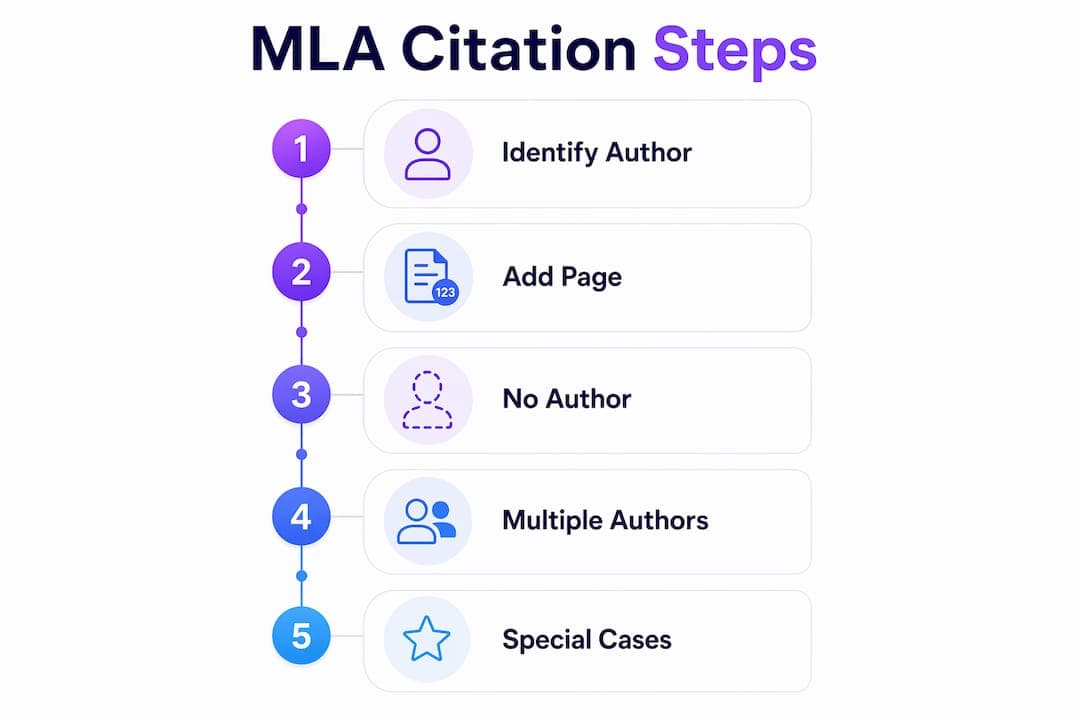
A common pitfall is adding a comma between the two authors' names in a two-author citation. Writing (Nguyen, and Castellano 93) is incorrect. The comma belongs only in the Works Cited list, not in the parenthetical citation itself. For a deeper look at two-author citation rules, the formatting logic extends to narrative citations as well.
When an article has no listed author, MLA replaces the author's name with a shortened version of the article's title. The format depends on the type of source. For articles and shorter works, the title goes in quotation marks. For books and longer works, it goes in italics.
This approach ensures proper identification of sources without listed authors and keeps the citation linked to the correct Works Cited entry. The shortened title must match the beginning of the full title in the Works Cited list so the reader can find it without confusion.
One scenario students often miss: organizational or government sources. When a government agency or organization is the author, use the organization's name in the citation. If the name is long, you can abbreviate organizational authors after defining the abbreviation in your text. Example: (World Health Organization 5) or (WHO 5) if you have already introduced the abbreviation.
For a complete walkthrough of MLA in-text citation for journal articles, the no-author scenario follows the same logic across article types.
Digital sources, websites, and many online articles do not have page numbers. MLA's rule here is direct: when a source has no page number, omit the page number entirely rather than guessing or adding a placeholder. This is not an error. It is the correct procedure.
| Scenario | Citation format | Example |
|---|---|---|
| Standard article with pages | Author + page number | (Rivera 22) |
| No page number available | Author only | (Rivera) |
| Paragraph number available | Author + par. + number | (Smith, par. 4) |
| Section heading available | Author + section title | (Jones, "Results") |
| No author, no page number | Shortened title only | ("Climate Data") |
When a digital source provides paragraph numbers, you can use those instead. The format is (Smith, par. 4), with a comma between the author's name and "par." Note that this is one of the few places a comma appears inside an MLA parenthetical citation. That comma signals you are using an alternative locator, not a page number. For digital sources with paragraph numbers, this format helps readers locate the exact passage.
Block quotations follow a different rule. When you quote prose longer than four lines, you indent the entire passage and do not use quotation marks. The citation for block quotes goes after the final punctuation, not before it. That is the one exception to the standard placement rule.
Pro Tip: When you cite the same source multiple times in one paragraph, you do not need to repeat the full citation after every sentence. One citation at the end of the paragraph works if the source is clear throughout. Add a new citation only when you switch sources or when the page number changes.
Most citation errors fall into a small set of repeating patterns. Knowing them in advance saves you from losing points on otherwise strong papers.
Academic integrity depends on citation accuracy. A reader who cannot trace your source back to the Works Cited list cannot verify your claim. That breaks the chain of evidence your argument relies on. For a broader look at MLA citation rules and how they support academic integrity, the logic extends well beyond formatting.
Pro Tip: Before submitting any paper, run a quick audit: for every parenthetical citation in your text, find its matching Works Cited entry. If you cannot find the match in under five seconds, your reader cannot either.
Accurate MLA in-text citations require the author-page format, consistent style choices, and a matching Works Cited entry for every source cited in the paper.
| Point | Details |
|---|---|
| Author-page format | Use the author's last name and page number with no comma between them, e.g., (Smith 42). |
| Multiple authors | Two authors use "and"; three or more use "et al." after the first author's name. |
| No author or no page | Replace the author with a shortened title; omit page numbers when unavailable. |
| Narrative vs. parenthetical | Choose one style per paragraph and apply it consistently throughout. |
| Works Cited match | Every in-text citation must link to a full bibliographic entry in the Works Cited list. |
Students often treat MLA citations as a mechanical task, something to handle after the real writing is done. That mindset is the root of most citation errors I see. The format itself is simple. The discipline required to apply it consistently across a 15-page paper is not.
The author-page system is actually elegant once you internalize it. It keeps citations short so they do not interrupt the reader's flow, while still giving enough information to locate the source instantly. The problem is that "simple" rules have edge cases, and edge cases are where students lose points. The no-author scenario trips up researchers who assume every source has a byline. The block quote rule catches writers who apply the standard placement rule without checking source type first.
My honest advice: treat your Works Cited list as the foundation, not the afterthought. Build it as you write, not after. Every time you drop a citation into your text, add the full Works Cited entry immediately. That habit eliminates the most common error in student papers, which is citations that reference sources never entered into the Works Cited list.
MLA standards also evolve. The 9th edition introduced changes to how digital sources are handled, and staying current with those updates matters for anyone writing in 2026. The MLA format principles behind each rule are worth understanding, not just memorizing. When you understand why the format exists, you can reason through edge cases instead of guessing.
— Tilen
Getting MLA citations right takes practice, and even experienced writers double-check their formatting before submitting.
Samwell is built for exactly this kind of work. Over 1,000,000 students and academic professionals use Samwell to generate essays and research papers with accurate MLA and APA citations already formatted and integrated. The platform's enhanced essay creator handles citation generation automatically, so you spend your time on argument and analysis rather than formatting rules. Samwell's Power Editor lets you expand and refine specific sections, while real-time AI detection checks keep your work original. If MLA citations are slowing down your writing process, Samwell removes that friction entirely.
MLA in-text citations use the author's last name and page number in parentheses, with no comma between them, e.g., (Smith 42). Both narrative and parenthetical styles are accepted under MLA 9th edition.
Replace the author's name with a shortened version of the article title in quotation marks, e.g., ("Implicit Bias" 620). The shortened title must match the beginning of the full title in your Works Cited list.
No. MLA requires you to omit the page number entirely when a source has no page numbers. If paragraph numbers are available, use "par." followed by the number, e.g., (Smith, par. 4).
For two authors, list both last names connected by "and," e.g., (Nguyen and Castellano 93). For three or more authors, use the first author's last name followed by "et al.," e.g., (Whitfield et al. 340).
Yes. Every in-text citation must correspond to a full bibliographic entry in the Works Cited list. A citation without a matching Works Cited entry is incomplete and reduces the credibility of your paper.