Loading...

TL;DR:
- A literature review critically synthesizes existing scholarship to situate research within an established field.
- It follows a three-part structure: introduction, organized body, and conclusion that identifies research gaps.
A literature review is defined as a structured, critical synthesis of existing scholarship that situates your research within an established body of knowledge. The literature review format for a research paper follows a three-part structure: an introduction that frames the topic, a body organized thematically or chronologically, and a conclusion that identifies research gaps. Most academic institutions require formatting under APA 7th edition guidelines, which specify margins, font, spacing, and citation style. Tools like Zotero, EndNote, and Grammarly support the process, but the intellectual work of synthesis is yours to do.
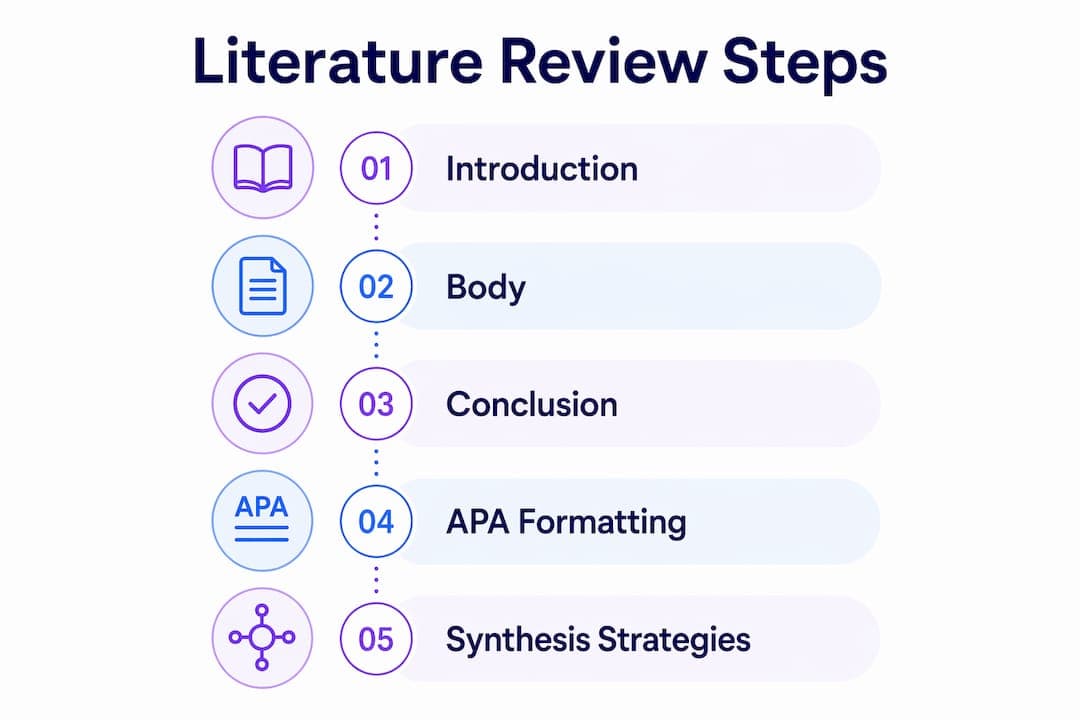
Standard literature reviews use a three-part structure: introduction, body, and conclusion. Each section carries a distinct purpose, and skipping or collapsing any one of them weakens the review's scholarly credibility.
The introduction of a literature review defines the topic, explains its significance, and outlines the scope and limitations of the review. Think of it as a contract with your reader. You tell them what you will cover, why it matters, and where you drew the line. A strong introduction also states the research question your review supports, so readers understand the purpose before they encounter a single source.
The body is where most of the intellectual work happens. Researchers typically organize it in one of three ways:
A thematic or chronological approach guides readers through a hierarchy of ideas that justifies the research need. The choice of organization is not cosmetic. It shapes how readers understand the logic of your study.

The conclusion summarizes the major themes from the body and, critically, identifies the gap your research will fill. Without a clear gap statement, the review reads as background reading rather than a scholarly argument. Keep the conclusion focused. One to two paragraphs is standard for most research papers.
Pro Tip: If your literature review is a standalone document, APA 7th edition recommends including an abstract of 150–250 words placed before the introduction.
APA 7th edition mandates 1-inch margins on all sides, double spacing throughout, and either Times New Roman 12pt or Calibri 11pt font. These are not suggestions. Journals and universities treat formatting deviations as signs of careless scholarship.
The table below summarizes the core APA formatting requirements for a literature review:
| Element | APA 7th Edition Standard |
|---|---|
| Margins | 1 inch on all sides |
| Font | Times New Roman 12pt or Calibri 11pt |
| Spacing | Double-spaced throughout |
| Headings | Up to three levels for standalone reviews |
| In-text citations | Author-date format: (Smith, 2021) |
| Reference list | Hanging indent, alphabetical order |
| Abstract | 150–250 words if required |
Heading levels deserve special attention. A standalone APA lit review typically uses three heading levels: a centered bold Level 1 for the main title, a flush-left bold Level 2 for major sections, and a flush-left bold italic Level 3 for subsections. Using all three consistently signals to readers and reviewers that you understand academic structure.
In-text citations follow the author-date format. Parenthetical citations appear at the end of a sentence: (Jones, 2022). Narrative citations integrate the author's name into the sentence: Jones (2022) argues that... The reference list at the end uses hanging indents, where the first line of each entry is flush left and subsequent lines are indented by 0.5 inches.
Pro Tip: Use Zotero's APA 7th edition citation style to auto-generate your reference list. Then manually check hanging indents and italics, since automated tools occasionally miss formatting details.
Three literature review types exist in academic research: the summary review, the research background review, and the research study review. Each serves a different purpose and calls for a different depth of analysis.
Matching the review type to your research question is not optional. A summary review attached to an empirical study signals to reviewers that the author does not understand the genre. A research study review attempted without methodological training produces unreliable conclusions. Identify your type before you write a single sentence.
Effective literature reviews synthesize sources into a coherent narrative rather than summarizing one source at a time. Narrative synthesis improves logical flow and scholarly legitimacy. The difference between a mediocre review and a good one is almost always synthesis.
Follow these steps to build a synthesized review:
"Mapping your topic's intellectual geography highlights consensus areas and research gaps, justifying your study as the next logical step." — Cal Poly Library
Treating a literature review as a bibliography is the most common mistake researchers make. A synthesized narrative that builds a theoretical framework is what reviewers and committees actually expect. The bibliography is a byproduct. The argument is the product.
A well-executed literature review legitimizes your research by proving it is grounded in existing knowledge and by identifying the gap your study fills. That gap statement is the payoff of every organizational decision you made in the body.
A strong literature review combines a clear three-part structure, APA 7th edition formatting, and a synthesized narrative that builds toward an explicit research gap.
| Point | Details |
|---|---|
| Three-part structure | Every review needs an introduction, an organized body, and a conclusion with a gap statement. |
| APA 7th edition formatting | Use 1-inch margins, double spacing, Times New Roman 12pt or Calibri 11pt, and hanging indents in the reference list. |
| Match type to purpose | Choose summary, research background, or research study review based on your research question. |
| Synthesize, do not summarize | Group sources by theme or method and write paragraphs around ideas, not individual papers. |
| Manage scope with tools | Use Zotero or EndNote to track references and control scope by starting with seminal studies. |
Most students treat formatting as the last step, something to fix after the writing is done. That instinct gets the process backwards. The format of a literature review is not decoration. It is the scaffolding that holds the argument together.
I have reviewed hundreds of student literature reviews over the years, and the ones that fail almost always share the same flaw. They read as annotated bibliographies. The student summarizes Source A, then Source B, then Source C, and never once tells the reader what those three sources mean together. The format problem and the thinking problem are the same problem.
The fix is to treat your organizational structure as an argument before you write a word. If you cannot explain in one sentence why you grouped two studies together, you do not yet understand the relationship between them. That understanding is what the review is supposed to demonstrate.
APA formatting is not arbitrary either. The author-date citation system, the heading levels, the hanging indents: each convention exists to make your review scannable and verifiable. A reviewer who wants to check your source on a specific claim should be able to find it in under ten seconds. When formatting is inconsistent, that trust breaks down.
My practical advice: write your outline as a series of claims, not a list of sources. Each heading in your body should represent an argument you are making about the literature, not a category of papers you are filing. That shift in thinking changes everything about how the review reads.
— Tilen
Formatting a literature review to APA 7th edition standards while simultaneously synthesizing dozens of sources is a demanding task. Samwell is built specifically for this kind of academic writing challenge.
Samwell serves over 1,000,000 students and academic professionals from leading universities. Its tools include APA format templates, real-time AI detection checks, and a Power Editor that helps researchers expand and refine specific sections of their reviews. The Guided Essays feature generates structured outlines, which is particularly useful when you are deciding how to organize a thematic or chronological body. Samwell's Semihuman.ai technology minimizes plagiarism risk while keeping your writing original. If you need to write a literature review that meets scholarly standards without spending weeks on formatting alone, Samwell is worth exploring at samwell.ai.
A literature review follows a three-part structure: an introduction that defines the topic and scope, a body organized thematically or chronologically, and a conclusion that identifies research gaps. APA 7th edition is the most widely required formatting standard, specifying 1-inch margins, double spacing, and author-date citations.
Length depends on the type of paper and institutional requirements. For a journal article, the review of related literature typically runs 1–3 pages. For a thesis or dissertation, it can extend to 20–40 pages or more.
A summary review surveys ideas broadly without tying the content to a specific research question. A research background review justifies a new study by showing what is already known and naming the gap the new research will fill.
APA 7th edition uses the author-date format. Parenthetical citations appear as (Author, Year) at the end of a sentence. Narrative citations integrate the author's name: Author (Year) argues that... All cited sources appear in a reference list with hanging indents at the end of the document.
Zotero and EndNote both manage references and generate APA-formatted bibliographies. Grammarly supports grammar and clarity checks. Samwell provides APA templates, structured outlines, and AI-assisted writing that helps researchers move from source collection to synthesized draft efficiently.