Loading...

TL;DR:
- A literature review essay critically evaluates scholarly works to map major theories and identify research gaps. It follows a three-part structure: an introduction, a thematic body, and a conclusion that highlights unresolved issues. Effective reviews synthesize sources thematically and critically, focusing on relevant recent and foundational texts.
A literature review essay is a critical, synthesized evaluation of scholarly works on a specific topic, designed to map major theories, identify trends, and expose gaps in existing knowledge. Unlike an annotated bibliography, which lists and summarizes sources one by one, a literature review builds a coherent argument about the state of a field. Every graduate student, researcher, and advanced undergraduate will write one at some point. The difference between a weak review and a strong one comes down to structure, source selection, and synthesis. This guide covers all three in depth.
A literature review essay follows a three-part structure: an introduction that defines the scope and research question, a body that synthesizes sources thematically or chronologically, and a conclusion that identifies research gaps and suggests future directions. That structure is not arbitrary. Each part serves a distinct function, and skipping any one of them produces a review that feels incomplete to academic readers.
The introduction does more than set the scene. It tells readers exactly what question you are investigating and why the existing literature matters to that question. A weak introduction lists topics. A strong introduction states a clear research question and explains how the review will address it.
The body is where most students struggle. Organizing sources thematically, meaning grouping studies by shared ideas or methods rather than by author, creates a narrative that shows how the field has evolved. Grouping authors in conversation reveals debates, agreements, and turning points that a source-by-source summary never could. Think of the body as a map of the field, not a reading list.
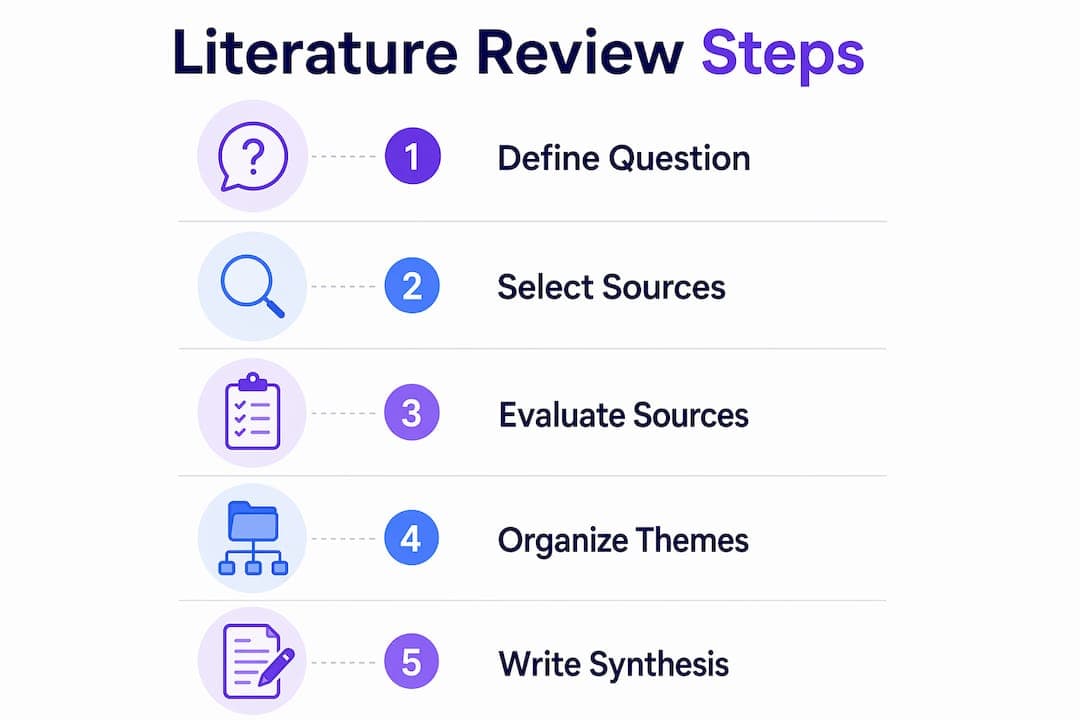
The conclusion does not simply restate what you covered. It highlights what the field still does not know, which is the justification for your own research. Effective literature reviews now require a significantly greater focus on identifying research gaps to justify new projects and improve academic impact.
Pro Tip: Use subheadings in longer reviews to signal thematic shifts. Readers, including committee members and journal reviewers, scan before they read. Clear subheadings show you have organized your thinking.
Source selection is the foundation of a credible review. The goal is not to find every paper ever written on your topic. The goal is to find the right papers. Students should be selective, not exhaustive, focusing on sources that directly support their thesis or research question.

Start with seminal works. Every field has foundational texts that shaped its vocabulary and methods. Identifying those early gives you a baseline for understanding how later research built on or challenged them.
From there, use citation mapping. Citation mapping begins with a seminal paper and tracks citations forward and backward to locate standard texts and recent studies efficiently. Forward tracking finds papers that cited your seminal source, showing how ideas developed. Backward tracking finds what that seminal source cited, revealing earlier foundations. This method builds comprehensive coverage faster than keyword searches alone.
Pro Tip: Consult annual review journals and dissertations in your field. They model the scope, source types, and organizational style that your discipline expects. Reading three strong examples in your field teaches you more than any generic guide.
Avoid the trap of collecting sources without reading them critically. Every source you include should earn its place by contributing a specific idea, data point, or perspective to your argument.
Synthesis is the skill that separates a strong review from a weak one. Synthesis means integrating sources by theme or method, not summarizing them one after another. A summary says "Smith found X. Jones found Y." A synthesis says "Both Smith and Jones found X, though Jones extended this to Y under different conditions, which challenges the assumption that Z."
That distinction matters because your reader already has access to the original papers. What they need from your review is your analysis of how those papers relate to each other and to your research question.
Libraries at CUNY and Trinity College Dublin describe the literature review as a dialogue, not a list. That framing is the most useful mental model for writing synthesis. Ask yourself: what are these scholars arguing with each other about, and where does my research enter that argument?
Citation in a literature review is not just about avoiding plagiarism. It is about demonstrating that you know the field. Recommended citations integrate sources from the last 3–5 years alongside one or two foundational texts to remain current and academically credible. That balance signals to reviewers that you understand both the history and the current state of your topic.
The most common citation mistake is treating references as a checklist. Every citation should serve your argument. If you cannot explain in one sentence why a source is in your review, it probably should not be there.
A literature review written for a standalone essay looks different from one written for a dissertation chapter, a grant proposal, or a journal article submission. Literature reviews vary by academic purpose, and each context demands a different scope, depth, and organizational style.
Knowing your purpose before you start writing shapes every decision you make, from how many sources to include to how deeply you analyze each one. A literature review for a research proposal has a different job than a dissertation chapter, and conflating the two wastes time and weakens both.
A literature review essay synthesizes scholarly sources into a coherent argument about the state of a field, organized by theme or method, and grounded in a clear research question.
| Point | Details |
|---|---|
| Structure drives clarity | Use a three-part format: introduction, thematic body, and conclusion identifying research gaps. |
| Synthesis over summary | Integrate sources in conversation with each other rather than summarizing them one by one. |
| Select sources strategically | Prioritize recent peer-reviewed work and foundational texts; use citation mapping to build coverage efficiently. |
| Citation serves the argument | Every citation should support your synthesis, not just appear as a reference at the end of a sentence. |
| Purpose shapes format | Tailor scope, depth, and source selection to whether you are writing a course essay, dissertation chapter, or proposal. |
The most common mistake I see is treating the literature review as a reading report. Students collect 20 sources, write a paragraph on each one, and call it done. The result reads like a catalog, not an argument.
The fix is deceptively simple: build your review around themes, not sources. Before you write a single sentence, cluster your notes by shared ideas. Which papers agree? Which contradict each other? Where does the field seem to be heading? Those clusters become your body paragraphs, and the tensions between them become your analytical contribution.
The second mistake is starting without a clear research question. I have watched students spend weeks reading broadly, only to realize they have no thread connecting their sources. Refining your research question early is not a preliminary step you rush through. It is the most important work you do before writing begins. A narrow, specific question makes every source selection decision easier and every paragraph more focused.
The third mistake is overquoting. A literature review full of block quotes signals that the writer does not trust their own analysis. Paraphrase aggressively. Your voice should dominate the review, with sources appearing as evidence for your claims, not as the claims themselves.
The skill of writing a strong literature review is learnable. The students who master it fastest are the ones who read three or four strong examples in their field before they start writing. Pattern recognition is faster than abstract instruction.
— Tilen
Writing a literature review is one of the most demanding tasks in academic research. Samwell is built for exactly this kind of work, with AI tools that help you plan your structure, organize sources by theme, and draft synthesis paragraphs that hold together analytically.
Over 1,000,000 students and academic professionals use Samwell to write research papers that meet citation standards including APA and MLA. The platform's Guided Essays feature generates structured outlines so you start with a clear framework, not a blank page. Real-time AI detection checks keep your work original. If you are ready to write a stronger, faster literature review essay, Samwell gives you the tools to do it without cutting corners on academic integrity.
A literature review essay is a critical synthesis of scholarly sources on a specific topic, organized to highlight major theories, trends, and research gaps. It is not a summary of individual sources but an integrated argument about the state of a field.
An annotated bibliography lists and briefly describes individual sources. A literature review synthesizes those sources into a coherent narrative that shows how they relate to each other and to a central research question.
The number depends on your academic purpose. A standalone course essay may require 10–20 sources, while a dissertation chapter may require 50 or more. Prioritize relevance and quality over quantity.
Your citation style depends on your discipline. APA is standard in social sciences, MLA in humanities, and Chicago in history. Always confirm the required style with your instructor or target journal before you begin.
Paraphrase sources rather than quoting them directly, and cite every idea that is not your own. Using reference management tools like Zotero or Mendeley reduces accidental citation errors and keeps your bibliography organized.