Loading...

Over 60 percent of undergraduate students admit that repeating overused essay topics limits their originality. Modern academic writing calls for fresh ideas that reflect today’s shifting realities for American, Canadian, British, and international students alike. Discovering innovative essay themes is not just about standing out but about making your academic work more relevant, intellectually stimulating, and genuinely impactful in a global classroom.
| Takeaway | Explanation |
|---|---|
| 1. Explore Current Events for Essays | Use current events to find relevant and engaging topics for essays by connecting real-world dynamics to academic concepts. |
| 2. Analyze Controversial Issues Thoughtfully | Choose complex social topics to develop nuanced arguments that reflect intellectual courage and critical reasoning. |
| 3. Integrate Personal Experience Wisely | Use personal stories as analytical tools to complement academic research without overshadowing scholarly evidence. |
| 4. Investigate Local Community Challenges | Focus on community issues to connect academic understanding with real-life experiences for impactful research. |
| 5. Examine Ethical Dilemmas with Empathy | Address moral complexities by analyzing multiple perspectives while demonstrating intellectual curiosity and understanding. |
Writing an essay doesn't mean being stuck in a textbook bubble. Current events provide a goldmine of original essay topics that connect academic learning with real world dynamics. By tapping into ongoing global conversations and recent developments, you can craft essays that are timely, relevant, and intellectually engaging.
Paying attention to news sources like global media platforms offers students an opportunity to discover essay topics that transcend traditional academic boundaries. Whether it's technological innovations, social movements, political shifts, environmental challenges, or cultural transformations, contemporary events offer rich analytical terrain for academic exploration.
To effectively leverage current events for essay topics, start by reading diverse news sources. Look for stories that spark curiosity or challenge existing perspectives. Consider how these events intersect with your academic discipline's core concepts. For instance, a sociology student might explore the social implications of emerging technologies, while a political science major could analyze international policy responses to global challenges.
When selecting a current event topic, prioritize credible sources and seek multiple perspectives. Avoid sensationalist reporting and focus on well researched, nuanced coverage that allows for critical analysis. Your goal is to transform a current event into an academic argument that demonstrates intellectual depth and critical thinking.
Pro tip: Set up news alerts for topics related to your academic interests and review them weekly to stay updated on potential essay subject matter.
College essays become powerful platforms for intellectual exploration when students dare to examine complex and contentious social topics. Controversial issues challenge students to move beyond surface level understanding and develop nuanced, critically reasoned arguments that demonstrate academic sophistication.
Controversial research topics offer students an opportunity to showcase intellectual courage and analytical thinking. By selecting challenging subjects like euthanasia, animal testing, or capital punishment, you can craft essays that reveal deeper societal complexities and demonstrate your ability to engage with difficult conversations.
Successful analysis of controversial topics requires several key strategies. First, approach the subject with intellectual objectivity. Research multiple perspectives systematically. Understand the historical context, ethical dimensions, and various stakeholder viewpoints. Your goal is not to argue for a specific stance but to demonstrate comprehensive understanding and critical reasoning.
When selecting a controversial topic, choose one that genuinely interests you and offers meaningful societal insights. Avoid sensationalism. Focus on topics where you can provide balanced, evidence based analysis. Academic credibility comes from showing respect for different perspectives while maintaining a clear analytical framework.
Pro tip: Always include counterarguments in your essay to demonstrate intellectual maturity and comprehensive understanding of complex social issues.
Transforming personal stories into compelling academic writing requires skill and strategic thinking. Personal experiences are more than just anecdotes they are powerful narrative tools that can illuminate complex academic concepts and create profound intellectual connections.
Academic writing traditionally emphasizes objectivity, but personal writing examples demonstrate how individual perspectives can enrich scholarly analysis. Your unique background provides a lens through which abstract theories become tangible and meaningful.
To effectively integrate personal experience into academic writing, start by identifying meaningful moments that directly relate to your research topic. Reflect on how your individual encounters with specific ideas, challenges, or observations can provide deeper insight into broader scholarly discussions. These personal narratives should not replace academic evidence but instead complement scholarly research with authentic human context.
When connecting personal experiences to academic themes, maintain a balance between storytelling and critical analysis. Use your personal narrative as an entry point to explore larger theoretical frameworks. Demonstrate how your individual perspective offers unique insights that contribute to academic understanding. Avoid oversharing or becoming too emotional analyze your experiences with the same rigor you would apply to any scholarly source.
Pro tip: Choose personal experiences that illuminate academic concepts rather than simply describing events focus on moments of reflection and intellectual growth.
Technology is transforming every aspect of modern society, offering students unprecedented opportunities for compelling academic writing. Technology trends provide rich analytical terrain for essays that demonstrate critical thinking and contemporary relevance.
Exploring AI writing trends in academia reveals fascinating research opportunities. Emerging technological developments like artificial intelligence, blockchain, cybersecurity, and social media ethics represent dynamic areas where academic inquiry meets real world innovation.
When selecting a technology trend for your essay, focus on topics with profound societal implications. Consider exploring how technological advancements intersect with human experience. For instance, examine the ethical dimensions of gene editing, the social consequences of automation, the privacy challenges posed by emerging technologies, or the transformative potential of virtual reality in education and healthcare.
Successful essays on technology trends require more than surface level description. Develop a nuanced argument that analyzes potential impacts, explores ethical considerations, and demonstrates scholarly rigor. Use credible academic sources to support your analysis and avoid sensationalism. Your goal is to provide thoughtful insight into how technological innovations are reshaping human experience.
Pro tip: Select technology topics that balance technical understanding with broader philosophical and social implications to create a truly engaging academic essay.
Essays that explore cultural perspectives offer powerful insights into global understanding and nuanced social analysis. Cross cultural comparison transforms academic writing from monolithic perspectives to rich dialogues that reveal complex human experiences.
Cross-cultural academic differences illuminate how intellectual traditions shape our understanding of key societal issues. Different cultures approach academic discourse with unique communication styles, research methodologies, and interpretive frameworks.
To develop a compelling comparative essay, select topics that reveal meaningful cultural variations. Consider exploring themes like family structures, educational philosophies, gender roles, environmental attitudes, or economic systems. Your goal is not to judge which cultural perspective is superior but to demonstrate deep understanding of diverse human experiences.
Effective cross cultural analysis requires extensive research and genuine intellectual empathy. Read scholarly sources from multiple cultural perspectives. Interview individuals from different backgrounds if possible. Seek out primary sources that represent authentic cultural voices. Avoid stereotyping or making sweeping generalizations that oversimplify complex cultural realities.
Pro tip: Always approach cultural comparisons with intellectual humility and genuine curiosity recognize that your own cultural lens influences your interpretation of different perspectives.
Ethical dilemmas represent the complex moral landscapes where academic writing becomes truly transformative. Moral reasoning challenges students to move beyond simplistic judgments and engage with the nuanced realities of contemporary ethical challenges.
Everyday moral dilemmas reveal the intricate ways personal values intersect with social responsibilities. Modern life presents increasingly complex scenarios that demand sophisticated ethical analysis involving competing principles, relational obligations, and contextual considerations.
When exploring ethical dilemmas for academic essays, select topics that reveal genuine moral complexity. Consider emerging challenges like data privacy, genetic engineering, artificial intelligence ethics, environmental sustainability, or medical decision making. Your goal is to demonstrate critical thinking by analyzing multiple perspectives and revealing the underlying moral tensions.
Effective ethical analysis requires intellectual humility and a commitment to understanding different viewpoints. Research diverse philosophical frameworks. Examine how cultural background, personal experience, and social context shape moral reasoning. Avoid presenting simplistic binary arguments. Instead, reveal the nuanced considerations that make ethical decisions challenging and meaningful.
Pro tip: Always approach ethical dilemmas with empathy and intellectual curiosity recognize that genuine moral reasoning requires understanding the complexity of human experience.
Academic writing becomes truly powerful when it connects scholarly analysis to real world experiences. Community challenges transform academic research from abstract theory into meaningful social understanding.
Research on community problems reveals how local issues intersect with broader social dynamics. Investigating challenges in your immediate environment provides an opportunity to conduct original research that has tangible relevance and potential impact.
Select community challenges that demonstrate complexity and invite deep analytical exploration. Consider topics like healthcare access, environmental sustainability, educational inequity, economic development, or social service gaps. Your goal is to move beyond surface level descriptions and provide nuanced insights that reveal underlying systemic factors.
Effective community research requires direct engagement. Conduct interviews with local stakeholders. Attend community meetings. Review local government documents. Analyze demographic data. Seek multiple perspectives that capture the lived experiences of community members. Academic rigor emerges from understanding local contexts with empathy and intellectual depth.
Pro tip: Always approach community research with respect and humility listen more than you speak and recognize that local residents are the true experts of their own experiences.
Below is a comprehensive table summarizing the strategies and key insights for essay writing discussed throughout the article.
| Topic | Main Concept | Key Considerations |
|---|---|---|
| Using Current Events | Utilize real-world topics to craft timely and engaging essays. | Focus on well-researched sources and connect themes with academic disciplines. |
| Analyzing Controversial Issues | Explore complex societal topics to foster critical analysis. | Approach topics objectively, consider various perspectives, and integrate balanced arguments. |
| Connecting Personal Experience | Incorporate personal narratives to enhance academic themes. | Align experiences with research topics and maintain balance between storytelling and analysis. |
| Exploring Technology Trends | Analyze emerging trends affecting society to highlight innovation and ethics. | Examine broader implications and societal impacts while supporting arguments with credible research. |
| Investigating Cultural Perspectives | Compare global viewpoints on key issues to reveal diverse human experiences. | Conduct thorough research across cultures, avoiding stereotypes, and focus on empathetic analysis. |
| Addressing Ethical Dilemmas | Evaluate complex moral scenarios found in modern issues. | Utilize diverse philosophical frameworks and explore multiple perspectives to reflect moral complexity. |
| Researching Local Community Challenges | Study immediate environment issues for relatable academic exploration. | Engage with stakeholders and analyze data to reveal systemic factors impacting local contexts. |
Struggling to find fresh, compelling essay topics that truly reflect your academic goals and personal insights? This article highlights the challenge of connecting innovative ideas—from current events and ethical dilemmas to personal experiences and cultural comparisons—with polished, well researched writing. It can be overwhelming to balance critical thinking with originality and citation accuracy while exploring complex subjects like technology trends or community challenges.
Samwell.ai is designed to solve these exact hurdles. With its advanced AI powered by Semihuman.ai technology, you get a seamless way to generate original essays tailored to your chosen topic, whether it’s analyzing controversial issues or connecting personal narrative with academic theory. Features like the Power Editor and Guided Essays help you develop nuanced arguments while maintaining academic integrity through real time plagiarism checks and citation compliance.
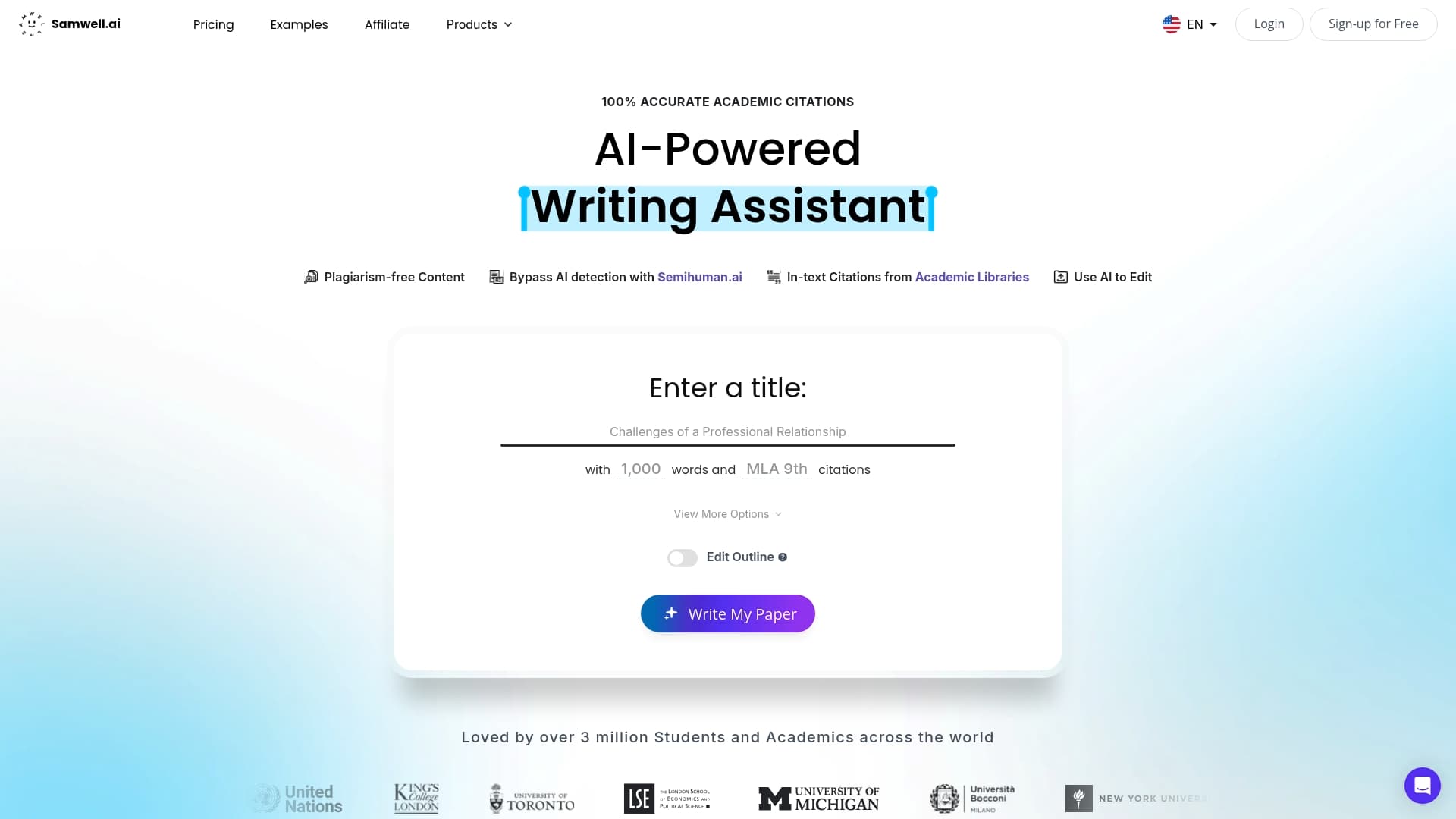
Ready to transform your essay writing process and confidently tackle any innovative topic? Visit Samwell.ai now to start crafting high quality, credible papers that stand out academically. Don’t wait—enhance your college success today with our powerful AI tools built for students and academics who want the perfect blend of efficiency and scholarly rigor.
Explore reputable news sources, blogs, and social media platforms to discover trending topics. Set up news alerts for subjects that align with your academic interests to receive regular updates.
Focus on topics that challenge societal norms, such as euthanasia, animal testing, or immigration policies. Choose an issue that resonates with you and allows for balanced analysis to demonstrate critical reasoning.
Identify key moments from your life that connect with your research topic and reflect on their significance. Use these experiences as a lens to enhance your arguments while maintaining academic rigor and balance.
Examine innovations like artificial intelligence, blockchain, or virtual reality that impact society. Select a trend with broader implications to offer a thoughtful analysis of its ethical and social consequences.
Choose topics that reveal significant cultural differences, such as educational systems or family structures. Provide nuanced insights by thoroughly researching multiple cultural perspectives to enrich your analysis.
Select contemporary moral challenges, such as data privacy or environmental ethics, to explore in your writing. Develop a nuanced argument that considers various viewpoints and reflects the complexities of ethical decision-making.