Loading...

TL;DR:
- In-text citations credit sources and help readers find references. Correct formatting and placement are essential across APA, MLA, and Chicago styles.
In text citations are short references placed inside your writing that attribute ideas, quotations, or data to their original sources. Every major academic style guide, including APA, MLA, and Chicago, requires them. They serve a dual purpose: crediting the original author and allowing readers to trace claims independently through a linked reference list. Correct use of in text citations is the single most reliable way to protect your academic integrity and demonstrate that your arguments rest on real evidence.
An in text citation is defined as a brief reference embedded directly in your prose, pointing readers to a full bibliographic entry in your reference list or bibliography. The citation appears immediately after the borrowed idea, quote, or paraphrase. It is intentionally short so it does not interrupt reading flow, yet specific enough to link to one exact source.

Three style systems dominate academic writing. APA (American Psychological Association) uses an author-date format: (Smith, 2023). MLA (Modern Language Association) uses an author-page format: (Smith 45). Chicago Notes-Bibliography uses a superscript number that corresponds to a footnote or endnote. Each system reflects the priorities of its discipline. APA is standard in psychology, education, and the social sciences. MLA governs literature and the humanities. Chicago is common in history and some professional fields.
The two-part system works like a pointer. The in text citation is the pointer; the reference list entry is the destination. Every pointer must have a destination, and every destination must have a pointer. That rule is non-negotiable across all major styles.
The formatting differences between styles are specific and consequential. Getting them wrong signals carelessness to instructors and reviewers.
APA 7 places the author's last name, publication year, and, for direct quotes, a page number inside parentheses: (Garcia, 2022, p. 34). The comma between each element is required. For paraphrases, the page number is optional but recommended. APA is the standard citation format for psychology, nursing, and education research papers.
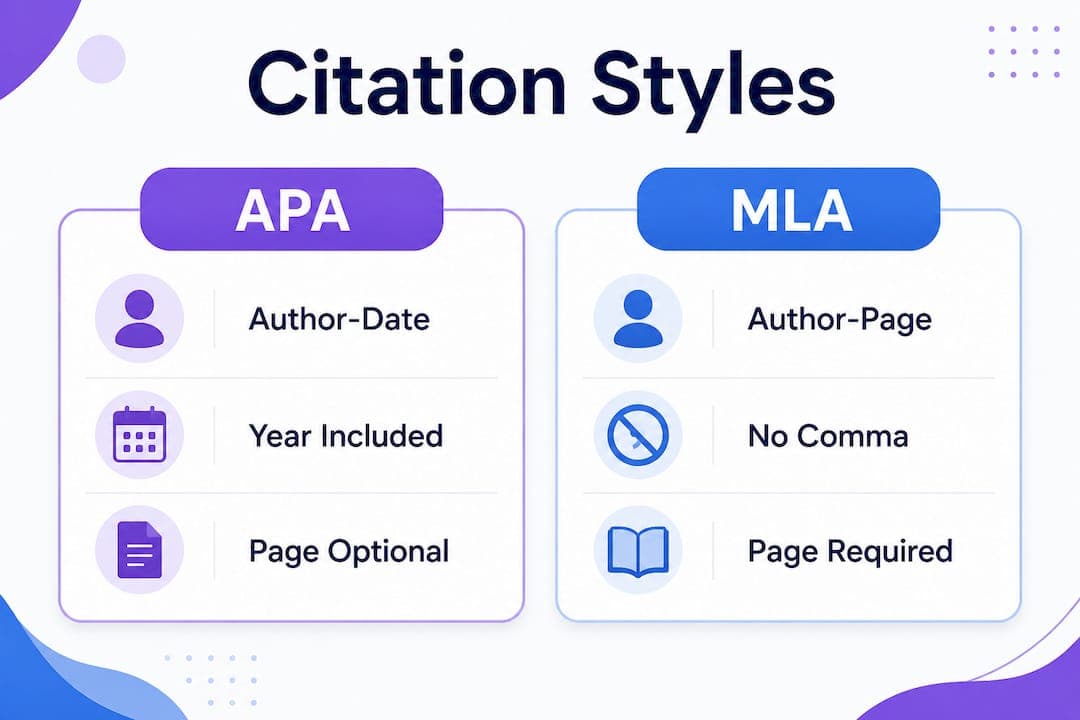
MLA 9 uses the author's last name and the page number with no comma between them: (Smith 45). That missing comma is one of the most common errors students make when switching between styles. When directly quoting in MLA, the page number is always required. For paraphrases, MLA still expects a page number whenever one is available.
Chicago uses a superscript number in the text, like this.¹ The number corresponds to a full footnote at the bottom of the page or an endnote at the end of the document. This system keeps the prose clean and is especially useful for papers with many sources, since footnotes can include commentary alongside the citation.
IEEE and Vancouver styles, common in engineering and medicine, use bracketed numbers in the text: [1], [2]. Sources are numbered in the order they first appear. These systems prioritize brevity and are not interchangeable with APA or MLA.
| Style | Format | Example | Disciplines |
|---|---|---|---|
| APA 7 | Author, Year, Page | (Garcia, 2022, p. 34) | Psychology, Education |
| MLA 9 | Author Page | (Smith 45) | Literature, Humanities |
| Chicago | Superscript footnote | ¹ | History, Arts |
| IEEE/Vancouver | Bracketed number | [1] | Engineering, Medicine |
Pro Tip: When your instructor does not specify a style, check your discipline first. Science courses almost always use APA or a numeric system. Humanities courses default to MLA.
Real papers rarely involve only simple, single-author sources. Knowing how to handle edge cases keeps your citations accurate under pressure.
Pro Tip: When citing a website or online PDF with no page numbers, APA permits paragraph numbers or section headings as locators. Write (Garcia, 2022, para. 4) or (Garcia, 2022, Discussion section). APA guidance on unpaginated sources confirms this approach maintains citation accuracy.
Citation errors are the fastest way to lose points on a paper. Most mistakes fall into a short list of predictable categories.
Each of these errors is avoidable with one habit: check every citation against the style guide before submitting.
Accuracy matters, but so does how citations fit into your prose. A paper full of clunky parenthetical interruptions is harder to read and harder to grade.
Pro Tip: Build your reference list as you write, not after. Every time you add a citation to your draft, immediately add the full entry to your reference list. This prevents the frantic last-minute search for source details and eliminates most one-to-one rule errors.
For a deeper look at current standards, the 2026 in text citation guide on Samwell covers updated rules across all major styles.
Accurate in text citations require matching the right format to your style guide, citing every source you use, and verifying every citation against the reference list before submission.
| Point | Details |
|---|---|
| Match format to style guide | APA uses author-date, MLA uses author-page, Chicago uses footnotes. |
| Always include page numbers for quotes | Omitting locators for direct quotes causes point deductions in every major style. |
| Apply "et al." correctly | Use "et al." for three or more authors from the first citation in APA 7 and MLA 9. |
| Enforce the one-to-one rule | Every in text citation needs a reference list entry, and every entry needs a citation. |
| Verify citation generators | Automated tools produce errors; check every output against the official style manual. |
I have reviewed hundreds of student papers over the years, and citation errors are almost never about laziness. They come from genuine confusion about which rule applies when. The APA versus MLA comma question trips up even careful writers. The "et al." threshold catches students who learned an older version of the rules. The one-to-one rule gets violated most often by students who do their reference list last, when they can no longer remember which sources they actually used in the text.
The deeper problem is that most students treat citations as a finishing step. They write the whole paper, then go back and add citations. That approach guarantees errors. Citations are part of the argument. When you decide to use a source, that is the moment to record the full bibliographic details and drop the in text citation into your draft. Waiting until the end means reconstructing decisions you made hours or days ago.
I also want to push back on the idea that citation generators solve this problem. They help with speed, and that matters when you are managing a heavy course load. But they are not reliable enough to use without checking. I have seen generators produce APA citations with MLA formatting, invent page numbers, and drop author names entirely. The APA in text citation guide on Samwell is a faster and more reliable reference than most automated tools for standard source types.
Mastering citations is not just about avoiding penalties. It is about building the habit of tracing ideas to their origins. That habit is the foundation of good research, and it stays useful long after the paper is submitted.
— Tilen
Getting citations right takes practice and reliable reference material. Samwell has built a library of citation guides covering APA, MLA, and Chicago formats, written specifically for students who need clear, current answers without wading through dense style manuals.
Samwell's MLA citation guide and Chicago format guide walk through formatting rules with real examples. The platform also offers AI-assisted writing tools that generate properly cited academic papers while checking for originality. Over 1,000,000 students and academics from leading universities use Samwell to write with confidence. Visit samwell.ai to access citation guides and writing tools built for academic work.
An in text citation is a brief reference placed inside your writing that credits the original source of a quote, paraphrase, or idea. It links directly to a full entry in your reference list or bibliography.
APA uses author-date format (Garcia, 2022), while MLA uses author-page format (Garcia 45) with no comma between author and page number. APA is standard in social sciences; MLA governs humanities writing.
Page numbers are required for direct quotes in all major styles. In APA, page numbers are optional for paraphrases but recommended. In MLA, include a page number whenever one is available.
"Et al." is Latin for "and others." Both APA 7 and MLA 9 require it when a source has three or more authors, replacing all names after the first to keep citations concise.
Citation generators are useful for speed but frequently produce errors with complex sources. Always verify the output manually against the official style guide before submitting your paper.