Loading...

TL;DR:
- In-text citation involves embedding source references within your writing to credit authors and help readers find full sources. Proper placement, signal phrases, and style-specific wording are essential to maintain credibility and avoid plagiarism.
In-text citation is the practice of embedding brief source references within your writing to credit original authors and enable readers to locate the full source details. The specific words and phrases you choose inside those references, what academics call citation language, determine whether your paper reads as credible scholarship or sloppy guesswork. Style guides like APA, MLA, Chicago, and Harvard each prescribe distinct in text citation words, signal phrases, and formatting rules. Getting them right protects you from plagiarism penalties and gives your argument the authority it deserves. Resources like Purdue OWL and Penn State Libraries offer free guidance, but this article puts the core rules in one place.
In-text citations rely on two types of language: signal phrases and parenthetical elements. Signal phrases introduce a source before you quote or paraphrase it. Parenthetical elements appear in brackets or parentheses after the cited material and contain the minimum information a reader needs to find the full reference.
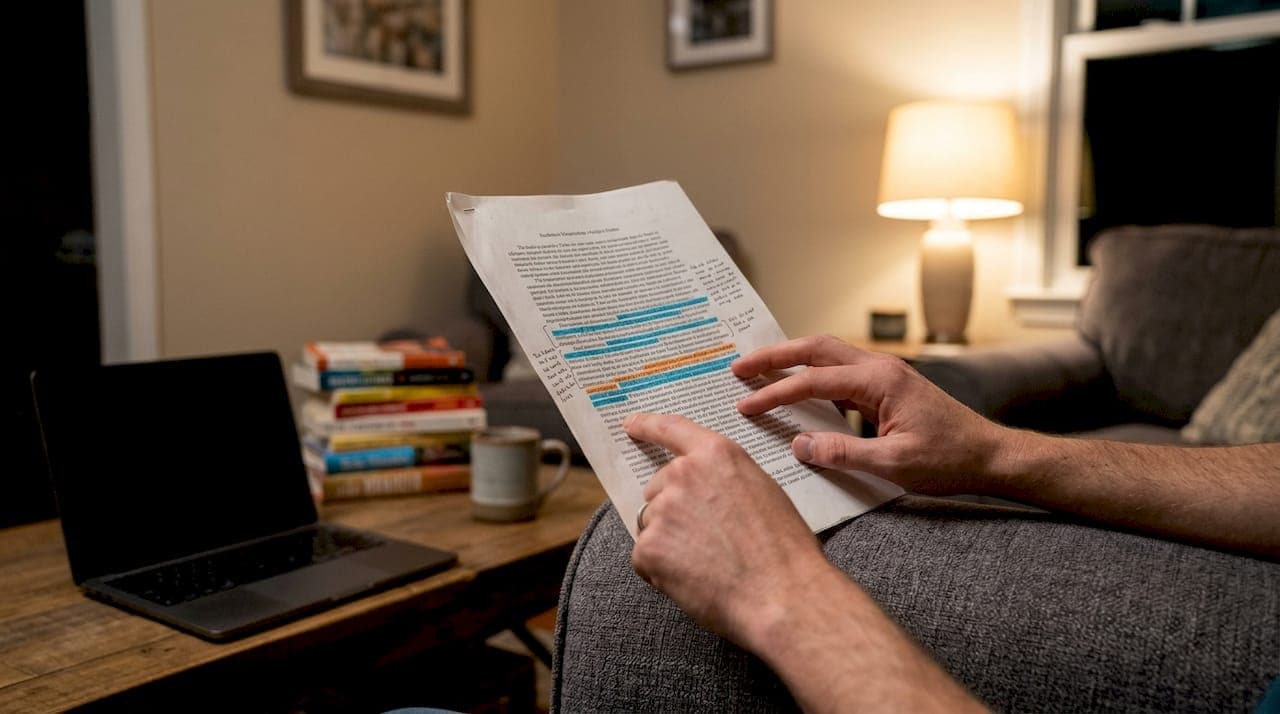
Signal phrases use reporting verbs to characterize what a source does. Common verbs include argues, contends, emphasizes, indicates, notes, observes, reports, and suggests. The verb you pick signals your relationship to the source. "Smith argues" implies you may disagree. "Smith demonstrates" implies the evidence is strong. Choosing the right verb is not a stylistic flourish. It is a claim about the source's credibility and your stance toward it.
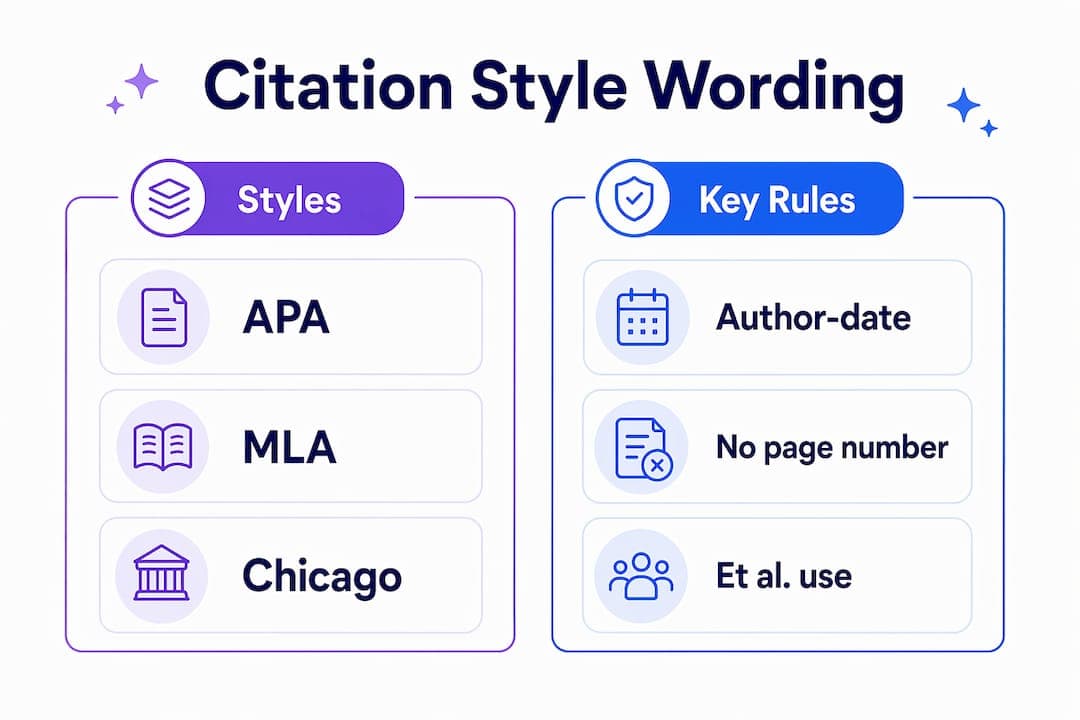
Parenthetical elements carry specific shorthand terms that vary by style:
Pro Tip: When you name the author in your sentence, drop the author name from the parenthetical. Writing "Garcia (2023) argues" and then adding "(Garcia, 2023)" at the end is redundant. Narrative citations/14%3A_The_Research_Process/14.17%3A_MLA_In-Text_Citations) require only the year or page number in parentheses.
Placement is the most misunderstood part of writing citations. Citations should directly follow the specific text they support, not float to the end of a paragraph that covers multiple ideas. Dropping a single citation at the end of a five-sentence paragraph implies that one source supports every sentence. That is rarely true and often misleading.
The correct approach follows this sequence:
One practical test: cover the citation and ask whether a reader could tell which source supports which claim. If the answer is no, move the citation closer to the specific claim it backs.
Pro Tip: Precise citation placement enhances readability and source tracing. Integrate citations naturally by treating them as part of the sentence rhythm, not as an afterthought stapled to the end.
Block quotations follow a different rule. In APA, quotations of 40 or more words must be indented as a block without quotation marks, and the parenthetical citation follows the final period rather than preceding it. That is the one case where the citation comes after the punctuation, not before.
Each major style uses a distinct formula for in-text references. The table below shows how the same source appears across five styles, using a 2021 book by Johnson and Lee on page 45.
| Style | In-text format | Key wording rule |
|---|---|---|
| APA 7th | (Johnson & Lee, 2021, p. 45) | Author, year, page; ampersand inside parentheses |
| MLA 9th | (Johnson and Lee 45) | Author and page; no year; "and" spelled out |
| Chicago (notes) | ¹Johnson and Lee, Title, 45. | Footnote or endnote; full name at first use |
| Harvard | (Johnson and Lee, 2021, p. 45) | Similar to APA; "and" spelled out |
| IEEE | [1] | Numbered bracket; no author or date in text |
APA uses the author-date system. The year appears in every citation because APA prioritizes currency of research. MLA uses the author-page system because humanities scholarship focuses on the text itself, not when it was published. Chicago offers two systems: notes-bibliography for humanities and author-date for sciences. IEEE, common in engineering, strips all prose from the citation and replaces it with a bracketed number tied to a reference list.
Direct quotations require a page or locator number in every style except IEEE. Omitting the page number on a direct quote is one of the most common errors that draws academic penalties. APA and MLA both require "p." before a single page number. Chicago uses just the number in footnotes.
The term "et al." works differently across styles. APA and MLA both use "et al." for three or more authors, but APA applies it from the first citation onward, while older MLA editions listed all authors on first mention. MLA 9th edition now uses "et al." from the first citation as well, matching APA practice. For a full walkthrough of APA in-text citation rules, the differences become clear quickly with examples.
Missing information is common, especially with online sources. The right citation words depend on what is absent.
Pro Tip: Always try to locate the original source before citing it secondhand. Secondary source citations signal to readers that you did not read the primary material, which weakens your argument's authority.
The phrase "Anonymous" is a legitimate author name in APA when a source explicitly credits itself that way. Do not confuse it with sources that simply lack an author. Those use the title instead.
Correct in-text citation words require matching the right signal phrase, parenthetical shorthand, and locator to the style your paper follows.
| Point | Details |
|---|---|
| Signal phrases set your stance | Choose reporting verbs like "argues" or "demonstrates" to show your relationship to the source. |
| Placement follows the claim | Place citations immediately after the specific idea or quote they support, not at paragraph end. |
| Style dictates the formula | APA uses author-date, MLA uses author-page, and Chicago uses footnotes with full names. |
| Missing info has standard fixes | Use "n.d." for no date, "para." for no page, and the title when no author is listed. |
| Direct quotes always need locators | Every direct quotation requires a page or paragraph number regardless of citation style. |
Students consistently underestimate how much citation language affects the quality of a paper. The mechanics look simple on the surface. Author, year, page. Done. But the real skill is in the signal phrases and the placement, and that is where most papers fall apart.
I have reviewed hundreds of student papers where every parenthetical was technically correct but the signal phrases were all the same verb: "says." Smith says. Jones says. Garcia says. That repetition flattens every source into the same level of authority. A study that demonstrates something carries more weight than one that merely suggests it. Choosing the right verb is an argument in itself.
The other mistake I see constantly is the end-of-paragraph citation dump. A student writes four sentences drawing on three different sources, then drops one citation at the end. That is not just a formatting error. It is a credibility problem. Readers cannot tell which claim belongs to which source, and that ambiguity is exactly what ethical citation practices exist to prevent.
Citation standards also evolve. APA released its 7th edition in 2019 with significant changes to et al. rules and electronic source formatting. MLA 9th edition followed with updates of its own. Relying on a style guide from five years ago is a real risk. Check the edition your institution requires, and verify against a current source like Penn State Libraries or Purdue OWL before submitting.
My honest advice: treat citation wording as part of your argument, not a bureaucratic chore. When your citations are precise and well-placed, your writing reads as confident and credible. When they are sloppy, even a strong argument looks weak.
— Tilen
Citation errors cost students grades they earned on the substance of their writing. Samwell is an AI-powered academic writing platform used by over 1,000,000 students and academics from leading universities, built to catch exactly those errors before they reach a professor's desk.
Samwell checks citation formatting across APA, MLA, and Chicago styles in real time, flags missing locators on direct quotes, and helps you write properly cited essays from the first draft. Its Power Editor lets you target specific paragraphs for citation review, and its plagiarism detection runs alongside your writing session. For students who want structured support from outline to reference list, Samwell's Guided Essays feature builds the citation framework into the writing process itself. Visit Samwell.ai to start writing with citation confidence.
In-text citation words are the specific terms, abbreviations, and signal phrases embedded in academic writing to credit a source. They include elements like author names, publication years, page numbers, and shorthand like "et al." or "n.d."
Use "et al." when a source has three or more authors. Both APA and MLA apply it from the first citation onward to keep parentheticals short and readable.
In APA, use "para." followed by the paragraph number, for example (Lee, 2022, para. 3). When no paragraph numbers exist, cite the section heading or the first few words of the title in quotation marks.
A narrative citation names the author in the sentence itself, for example "Garcia (2023) argues." A parenthetical citation places all information inside brackets at the end of the sentence, for example (Garcia, 2023). Narrative citations/14%3A_The_Research_Process/14.17%3A_MLA_In-Text_Citations) omit the author name from the parenthetical to avoid redundancy.
Every major style except IEEE requires a page or locator number for direct quotations. Omitting page numbers on direct quotes is a frequent error that results in academic penalties.