Loading...

TL;DR:
- In-text citations credit sources within research papers and guide readers to full references.
- Using the correct citation style depends on discipline, with APA, MLA, Chicago, and Harvard each having distinct formats.
An in-text citation is a brief reference placed inside the body of a research paper that directs readers to the full source entry in your bibliography or reference list. Every time you quote, paraphrase, or summarize another person's idea, an in-text citation for research paper writing is required. The four major citation styles used in academic writing are APA (American Psychological Association), MLA (Modern Language Association), Chicago, and Harvard. Each style has its own format, and choosing the wrong one, or applying it inconsistently, can cost you points and credibility.
Major citation styles each use a distinct in-text format, and mixing them up is one of the most common student errors. Knowing which format belongs to which style is the first step toward consistent, accurate citations.
APA uses the author-date format: (Smith, 2023). For direct quotes, you add a page number: (Smith, 2023, p. 45). APA is the standard in psychology, education, and the social sciences.
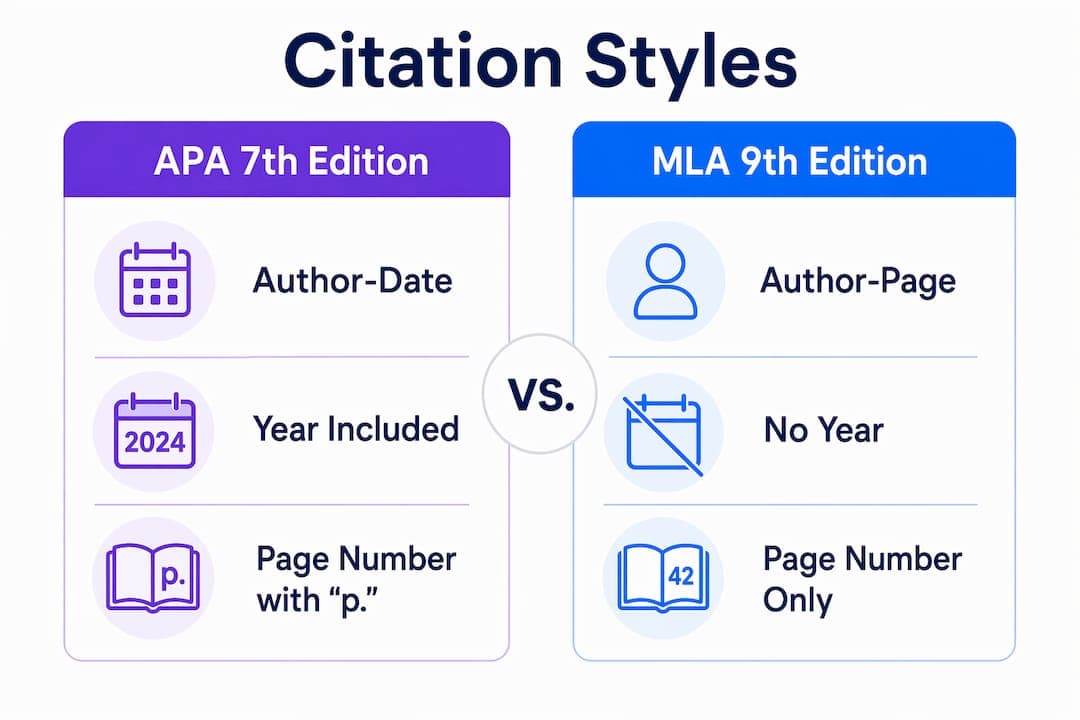
MLA uses author and page number only, with no year: (Smith 45). MLA 9 requires page numbers for direct quotes and usually for paraphrases as well. If page numbers are unavailable, omit them but note the style's specific guidance. MLA is most common in the humanities and literature.
Chicago uses superscript footnotes or endnotes rather than parenthetical citations in the text. A number appears after the relevant sentence, and the full source details appear at the bottom of the page or end of the document. For Chicago in-text citation formatting, the bibliography entry still mirrors the footnote source. Chicago is standard in history and some humanities disciplines.
Harvard follows the same (Author, Year) pattern as APA but with slight formatting differences depending on the institution. It is widely used in the UK, Australia, and many international universities.
The table below compares how each style handles a single-author source with a direct quote.
| Style | In-text format | Example |
|---|---|---|
| APA 7 | (Author, Year, p. #) | (Smith, 2023, p. 45) |
| MLA 9 | (Author Page #) | (Smith 45) |
| Chicago | Superscript footnote | Smith, Title, 45. |
| Harvard | (Author, Year, p. #) | (Smith, 2023, p. 45) |
Key rules that apply across all styles:
You must provide an in-text citation whenever you paraphrase, summarize, or quote another person's ideas. Failure to cite is treated as plagiarism at most universities, regardless of intent. The only exception is common knowledge, such as "the Earth orbits the Sun," which requires no citation.

Two formats exist for placing citations within a sentence. A parenthetical citation places the author and year inside brackets at the end of the sentence: Smith (2023) found that stress affects memory. A narrative citation weaves the author's name into the sentence itself: "Smith (2023) found that stress affects memory." Both are correct in APA. MLA and Chicago follow similar logic but with their own punctuation rules.
The in-paragraph citation sits inside the sentence, before the final period. For a block quote, the citation comes after the closing punctuation. Direct quotes always require a locator, such as a page number, paragraph number, or section heading, so readers can find the exact passage.
Best practices for citation placement:
Pro Tip: Treat each citation as a mini-essay: introduce the source in your own words, deliver the quote or paraphrase, then tie it back to your argument. This keeps citations from feeling like dropped-in evidence with no context.
APA 7 has a specific rule here. After the first narrative citation in a paragraph, you do not need to repeat the year in subsequent narrative citations within the same paragraph. When you start a new paragraph, reset and include the year again. This rule applies only to narrative citations, not parenthetical ones.
Some citation scenarios go beyond the basics, and getting them wrong is easy. These situations come up regularly in longer research papers.
Direct quotations longer than 40 words require block quote format in APA 7. Indent the entire passage half an inch from the left margin, remove quotation marks, and place the citation after the closing punctuation. For a detailed walkthrough of APA block quote formatting, the rules around indentation and citation placement are covered in full.
Digital sources, websites, and ebooks often lack page numbers. APA handles this by using paragraph numbers (para. 3) or section headings ("Results section, para. 2"). MLA allows you to omit page numbers entirely when they are unavailable.
A secondary source is one you read about in another source, rather than reading the original directly. Avoid secondary source citations whenever possible. Track down the original work and cite it directly. When that is not possible, MLA uses "qtd. in" and APA uses "as cited in" to signal the secondary source. Only the secondary source appears in your reference list.
Additional special situations to know:
Pro Tip: When citing a source with no page numbers, use the section heading and paragraph count together. For example: (Smith, 2023, Discussion section, para. 4). This gives readers a precise location without a page number.
Most citation errors fall into a small number of repeating patterns. Recognizing them before you submit saves you from avoidable grade penalties.
The most frequent mistakes students make:
Sources should appear multiple times throughout a paper when they are central to your argument. Using a source only once suggests it is not truly supporting your thesis. A practical guideline is roughly one source per page of assigned length, balanced to support arguments without crowding out your own analysis.
Citation generators handle complex punctuation and formatting rules automatically, reducing errors and saving time. They are especially useful for styles like Chicago, where footnote formatting differs from the bibliography entry. That said, always verify generated citations manually. Generators occasionally misread source types or miss edition-specific rules.
Pro Tip: After drafting your paper, run a cross-check: every source in your reference list should appear at least once in the text, and every in-text citation should have a matching reference list entry. Mismatches are a red flag for reviewers and instructors alike.
Consistency matters as much as accuracy. Pick one citation style and apply it throughout the entire paper. Switching between APA and MLA mid-paper, even accidentally, signals careless proofreading to any reader familiar with academic standards.
Accurate in-text citation requires matching the right style format to every source, placing citations at the correct position in the sentence, and cross-checking every in-text reference against your full bibliography.
| Point | Details |
|---|---|
| Match style to discipline | APA suits social sciences; MLA suits humanities; Chicago suits history; Harvard is common internationally. |
| Cite paraphrases too | Every paraphrase, summary, and quote needs a citation, not just direct quotes. |
| Handle special cases correctly | Use "as cited in" for secondary sources and paragraph numbers when page numbers are absent. |
| Avoid over-citing and under-citing | Integrate key sources multiple times; do not crowd out your own analytical voice. |
| Verify against the reference list | Every in-text citation must match a full entry in your bibliography, with no exceptions. |
Students often treat citation as a compliance task, something to finish before submitting. That framing misses the point entirely. A well-cited paper signals that you have read widely, thought critically, and positioned your argument within an existing conversation. Reviewers notice the difference immediately.
The APA and MLA differences that trip up students most often are not the obscure edge cases. They are the basics: page numbers in MLA, year placement in APA, and footnote structure in Chicago. I have reviewed hundreds of student papers, and the same three or four errors appear repeatedly. Getting those right puts you ahead of most of your peers without any extra research effort.
The harder skill is integration. Dropping a citation at the end of a paragraph is not the same as using a source well. The strongest academic writers introduce a source, quote or paraphrase it precisely, and then explain what it means for their argument. That three-step habit turns citations from a formality into a genuine tool for persuasion.
Digital sources have added a new layer of complexity. Websites change, URLs break, and page numbers disappear. Learning to use paragraph references, section headings, and access dates now will protect you as more academic publishing moves online. Citation norms will keep evolving, but the underlying logic, credit the source, locate the passage, match the reference list, will not.
— Tilen
Writing a research paper with accurate citations across APA, MLA, or Chicago is time-consuming. Samwell handles citation formatting automatically, so you spend your time on analysis rather than punctuation rules.
Samwell's research paper generator produces fully cited academic papers with reference lists that match your chosen style. The platform supports over 1,000,000 students from leading universities and applies real-time checks to keep citations consistent from the first paragraph to the last. If you need to refine an existing draft, the enhanced essay creator targets citation gaps and formatting inconsistencies directly. Accurate citations are built into the writing process, not added as an afterthought.
An in-text citation is a brief reference placed within the body of a research paper that credits the source of a quote, paraphrase, or summary. It directs readers to the full source entry in the bibliography or reference list.
APA uses (Author, Year) and adds a page number for direct quotes, while MLA uses (Author Page Number) with no year. The key differences between APA and MLA affect punctuation, author format, and locator requirements.
Yes. University guidelines require citations for paraphrased and summarized material, not just direct quotes. The only exception is common knowledge that any general reader would already know.
Use a paragraph number (para. 3) or a section heading followed by a paragraph count. APA and MLA both provide guidance for sources without standard page numbers, including websites and ebooks.
Use "as cited in" for APA or "qtd. in" for MLA to signal a secondary source. Avoid this whenever possible by locating and citing the original work directly, since secondary citations reduce academic credibility.