Loading...

TL;DR:
- Effective editing improves clarity, structure, and argumentation beyond fixing typos and surface errors.
- Using a combination of AI tools and human editors enhances revision quality and argument strength.
Editing your paper is defined as the process of improving clarity, structure, and argumentation in a written draft, going well beyond fixing typos or surface errors. Most students treat editing as a final grammar check, but effective editing is a formal, multi-stage process covering content, structure, style, and citation compliance. Tools like Grammarly and PaperCheck AI deliver instant feedback on language, while professional human editors on platforms like Editor World refine argument strength and disciplinary tone. The difference between a good paper and a great one almost always comes down to how thoroughly you revise.
The right resources make the difference between a surface polish and a genuine revision. You need at least one AI editing tool, a clear draft with accurate citations, and ideally access to a human editor for high-stakes work.
AI-based editing platforms process standard academic documents in under one minute, providing instant corrections for grammar, spelling, and clarity. That speed matters when you are working against a deadline. PaperCheck AI offers customizable settings for American, British, or Australian English and lets you accept or reject edits individually or in bulk with before/after comparisons. Grammarly covers grammar, tone, and readability in real time. Both tools typically allow free checking up to 3,000 words per session, with flat monthly fees for unlimited use.
Professional human editors offer manual review focused on structure, argument strength, and discipline-specific tone, marking all changes in Track Changes for your acceptance. Editor World lets you filter editors by subject expertise and client ratings, and you can communicate directly via messages or calls. Human editors catch what AI misses: logical gaps, weak evidence, and arguments that do not hold up under scrutiny.
Before sending your paper to any editor, clean up your formatting and verify your citations. A messy draft wastes an editor's time and inflates your cost. Run a basic spell check, confirm your reference list matches your in-text citations, and remove any tracked changes from previous drafts.
| Feature | AI editors | Human editors |
|---|---|---|
| Speed | Under 1 minute | Hours to days |
| Grammar and spelling | Excellent | Good |
| Argument refinement | Limited | Excellent |
| Discipline-specific tone | Moderate | Excellent |
| Cost | Low monthly fee | Per-page or hourly |
| Best for | First-pass polish | Final academic review |
Editing in stages means addressing macro issues before micro ones. Polishing sentences you later delete is wasted effort. Follow this sequence every time.
Pro Tip: Do not run your grammar checker until step six. Running it earlier locks your attention on sentence-level fixes while bigger structural problems go unresolved.
When you receive feedback from a human editor, work through their comments in the same order: argument first, structure second, sentence-level last. Track Changes makes this systematic. Accept or reject each suggestion deliberately rather than accepting all changes in bulk.

Most editing errors fall into a predictable pattern. Recognizing them before you start saves hours of rework.
Pro Tip: After accepting edits, read your paper aloud from start to finish. If a sentence sounds like someone else wrote it, rewrite it in your own words.
AI tools and human editors are not competing options. They serve different functions, and the best results come from using both in sequence.
AI tools handle the mechanical layer fast. Effective AI feedback explains why suggested changes improve writing, which helps you learn rather than just correct errors. Platforms like IELTSPodcast's essay checker score writing and explain scoring decisions, giving you a model for self-improvement. PaperCheck AI can make substantial edits per document to improve readability, and it flags issues you might read past after staring at your own draft for hours.
Human editors handle the interpretive layer. They understand disciplinary conventions, assess whether your argument will persuade a specialist reader, and catch logical inconsistencies that no algorithm currently detects. AI tools provide surface-level polishing but cannot replace the critical thinking needed for high-level argument refinement. That distinction is the core reason serious academic writers use both.
| Stage | Tool | Purpose |
|---|---|---|
| First draft complete | PaperCheck AI or Grammarly | Fix grammar, spelling, and basic clarity |
| Post-AI revision | Self-review | Accept or reject suggestions; restore voice |
| Structural review | Human editor | Strengthen argument, flow, and discipline tone |
| Final polish | AI tool (second pass) | Catch any new errors introduced during revision |

This workflow is not just efficient. It protects your voice at every stage. The AI handles what it does well. The human editor handles what requires judgment. You stay in control of both.
For students who want to improve academic writing at a structural level, combining these two layers consistently produces better outcomes than relying on either alone.
Selecting the wrong editor wastes money and can damage your paper. The right editor improves it without erasing your voice.
Professional paper editing is a collaboration, not a correction service. The editor's job is to make your ideas clearer, not to rewrite your paper. If an editor's suggestions consistently change your meaning rather than clarify it, that is a signal to find someone else.
Editing your paper requires a staged, multi-pass approach that addresses argument and structure before grammar, combining AI tools for speed with human editors for depth.
| Point | Details |
|---|---|
| Editing vs. proofreading | Editing improves argument, structure, and voice; proofreading only fixes surface errors. |
| Stage your revisions | Fix macro issues like argument and structure before running grammar checks. |
| Use AI for the first pass | Tools like PaperCheck AI and Grammarly catch mechanical errors fast and cheaply. |
| Human editors add depth | Select editors by subject expertise and use Track Changes to review every suggestion. |
| Protect your voice | Accept only changes that clarify your meaning; reject edits that replace your logic. |
After working with academic writing for years, the single most common mistake I see is students running Grammarly on a draft that has not been structurally reviewed yet. They spend an hour fixing comma placement in paragraphs that should be cut entirely. The grammar looks clean. The argument still does not hold.
The staged approach feels slower at first. It is not. Fixing a weak argument after you have polished every sentence costs three times as long as fixing it before. I have seen students submit papers with near-perfect grammar and a thesis that contradicts itself by page four. No AI tool catches that.
My honest recommendation: treat your first editing pass as a thinking exercise, not a writing exercise. Ask whether your argument actually works before you touch a single sentence. Use writing assistance tools to handle the mechanical layer, but never let them substitute for your own critical judgment. The papers that get the best marks are the ones where the student clearly understood what they were arguing, not just the ones with the fewest grammar errors.
— Tilen
Samwell is built specifically for students and academics who need more than a grammar checker. Its Power Editor targets specific sections for revision and expansion, while real-time AI detection checks keep your paper compliant with academic integrity standards. Samwell supports MLA, APA, and other major citation formats, so your references stay accurate throughout the editing process.
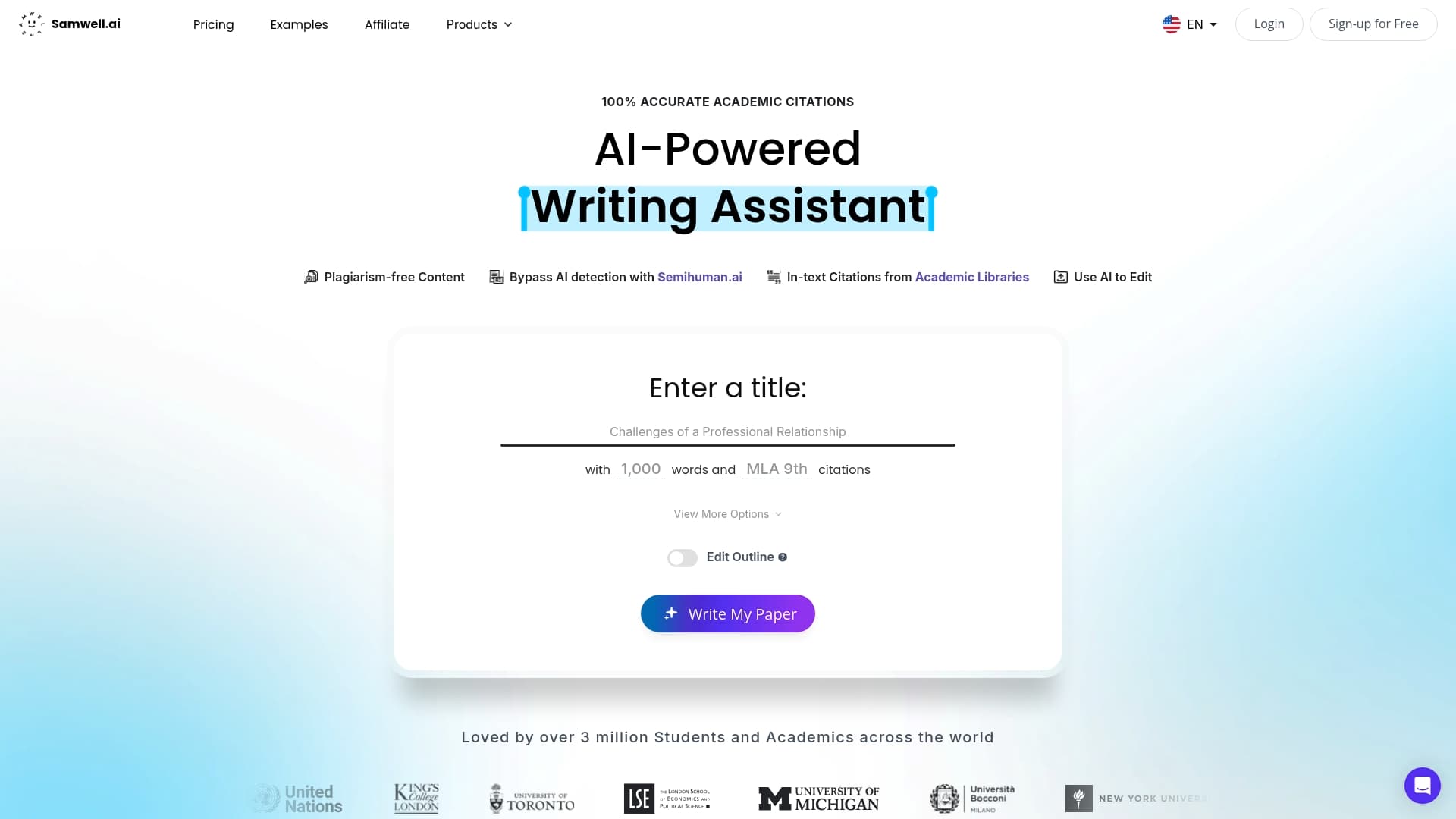
Over 1,000,000 students and academic professionals use Samwell to produce plagiarism-free academic papers that meet university standards. If you want AI-assisted editing that preserves your voice and checks your citations in one place, Samwell is the place to start.
Editing improves argument, structure, clarity, and voice across the full document. Proofreading only corrects surface errors like typos and punctuation after the content is finalized.
Review every AI or human editor suggestion critically and reject any change that alters your intended meaning. Reading your paper aloud after edits helps you catch sentences that no longer sound like you.
Yes. Tools like Grammarly and PaperCheck AI offer free tiers that check up to 3,000 words per session, covering grammar, spelling, and basic clarity at no cost.
Use a professional editor for high-stakes submissions like dissertations, journal articles, or graduate school applications where argument strength and disciplinary tone are as important as grammar.
A strong paper typically needs at least three passes: one for argument and structure, one for paragraph clarity and evidence, and one final pass for grammar and citations.