Loading...

The best expository essay examples share one quality: they explain a topic clearly and objectively, without pushing an opinion. That sounds simple, but it rules out a lot of writing students think qualifies. An expository essay does not argue, persuade, or reflect. It informs. According to Purdue OWL, the genre requires a student to investigate an idea, evaluate evidence, and set forth a clear explanation through methods like comparison and contrast, cause and effect, or definition.
Here are three short sample excerpts that show the style in action across different topics.
Technology topic excerpt: "Social media platforms have fundamentally changed how people consume news. Algorithms curate content based on past behavior, which means users often see stories that confirm existing beliefs rather than challenge them. Research on filter bubbles shows this pattern is consistent across major platforms."

Environment topic excerpt: "Deforestation in the Amazon basin accelerates at a measurable rate each year. The primary drivers are agricultural expansion, illegal logging, and infrastructure development. Scientists track these changes using satellite imagery, which provides reliable annual data on forest cover loss."

Education topic excerpt: "The shift from traditional classrooms to hybrid learning models began well before 2020 but accelerated sharply during the pandemic. Schools that had already invested in digital infrastructure adapted faster. Those without it faced significant gaps in student access and continuity."
Notice what each excerpt does: it opens with a factual claim, supports it with evidence or context, and stays neutral throughout. No "I believe," no emotional appeals, no hedging with personal opinion.
Key structural features visible in these samples:
Pro Tip: Read your draft aloud and flag every sentence where you could replace "research shows" with "I think." If the swap works grammatically, the sentence is too subjective for expository writing.
Format is not just about citation style. It shapes how your essay looks on the page, how you credit sources, and what your instructor expects structurally. Expository essays commonly appear in two citation formats: APA and MLA, each with distinct rules.
APA format is standard in social sciences, psychology, and education courses. Key features:
MLA format is typical in humanities, literature, and composition courses. Key features:
Outline-based structure is the third variation you will encounter, especially in high school and introductory college courses. The classic five-paragraph structure breaks down as:
Choosing the right format depends on your course and discipline. When an assignment does not specify, APA is the safer default for science and social science classes; MLA fits English and history. If you are writing a personal academic exercise, the outline structure alone is enough to organize your thinking before drafting.
Academic level determines how much complexity, research depth, and analytical sophistication a reader expects. A middle school essay on climate change looks very different from a college-level treatment of the same topic, and both are valid expository writing for their context. Structured example-based learning helps students calibrate their own work against appropriate models.
Topics at this level are concrete and familiar. The structure is straightforward: one clear idea per paragraph, simple transitions, and evidence drawn from textbooks or basic research.
High school expository writing introduces more nuanced topics and expects students to cite sources. The thesis becomes more specific, and body paragraphs need to do more analytical work.
College essays demand research, critical analysis, and a thesis that takes a specific, defensible position on a complex topic. The writing is denser, the evidence more varied, and the structure often extends well beyond five paragraphs.
The progression from middle school to college is not just about length. It is about how much intellectual work the writer does between stating a claim and supporting it.
Strong expository writing is not just grammatically correct. It does something specific: it guides a reader through a topic so clearly that no questions are left unanswered. Effective examples share four qualities that are worth studying before you write your own.
Clarity and focus. Every sentence serves the thesis. If a paragraph could be removed without weakening the essay, it probably should be. Effective expository essays do not wander into related topics or include background that does not directly support the central explanation.
Logical flow. Transitions are not decorative. They signal to the reader why one paragraph follows another. Phrases like "as a result," "by contrast," and "this pattern also appears in" do structural work, not just stylistic work.
Evidence quality. Expository essays rely on factual, statistical, or anecdotal support, as Purdue OWL outlines. The strongest essays use a mix: a statistic to establish scale, a specific example to make it concrete, and a source to establish credibility.
Objectivity. The essay explains; it does not advocate. This is the quality most students struggle with, especially on topics they care about. The moment a writer slips into "I believe" or "clearly, everyone should," the essay stops being expository.
Key features to look for in any effective sample:
Pro Tip: After drafting, highlight every sentence that contains a fact or statistic. If more than half your paragraphs have no highlighted sentences, your essay is relying too heavily on assertion rather than evidence.
The single most common mistake in expository writing is treating it like a lighter version of an argumentative essay. It is not. Argumentative essays defend a specific position and try to persuade the reader. Expository essays clarify a topic and let the evidence speak. The goal is understanding, not agreement.
A second misunderstanding involves the five-paragraph structure. It is a useful starting point, not a ceiling. Purdue OWL notes that completeness is the real standard: an essay must cover its topic thoroughly enough that no reasonable question goes unanswered. For a complex topic like the causes of the 2008 financial crisis, three body paragraphs will not be enough.
Objectivity is also more complicated than it appears. Research on expository texts points out that authors inevitably bring perspectives and potential biases to their writing, even when the intent is neutral. A skilled reader analyzes not just what an expository text says but how the author has framed the evidence. As a writer, this means choosing sources deliberately and acknowledging when data is contested rather than presenting one study as definitive.
Tilen, a writing expert who contributes guides and sample essays to Samwell.ai, emphasizes that students often underestimate the importance of the introduction. A weak thesis in the first paragraph forces every subsequent paragraph to work harder to stay coherent. Getting the thesis right before drafting the body is not just good advice; it is the difference between an essay that holds together and one that drifts.
Key insight: Expository writing aims for neutrality, but author bias is always present to some degree. Readers and writers alike benefit from analyzing how evidence is selected and framed, not just what it says.
The most effective expository writers treat their topic the way a good documentary filmmaker treats a subject: they show the evidence, provide context, and trust the audience to draw conclusions. Advocacy belongs in a different genre.
Writing a well-structured expository essay from scratch takes time, especially when you are still learning what "objective tone" actually feels like in practice. Samwell is built for exactly this situation: students who understand the assignment but need structured support to execute it well.
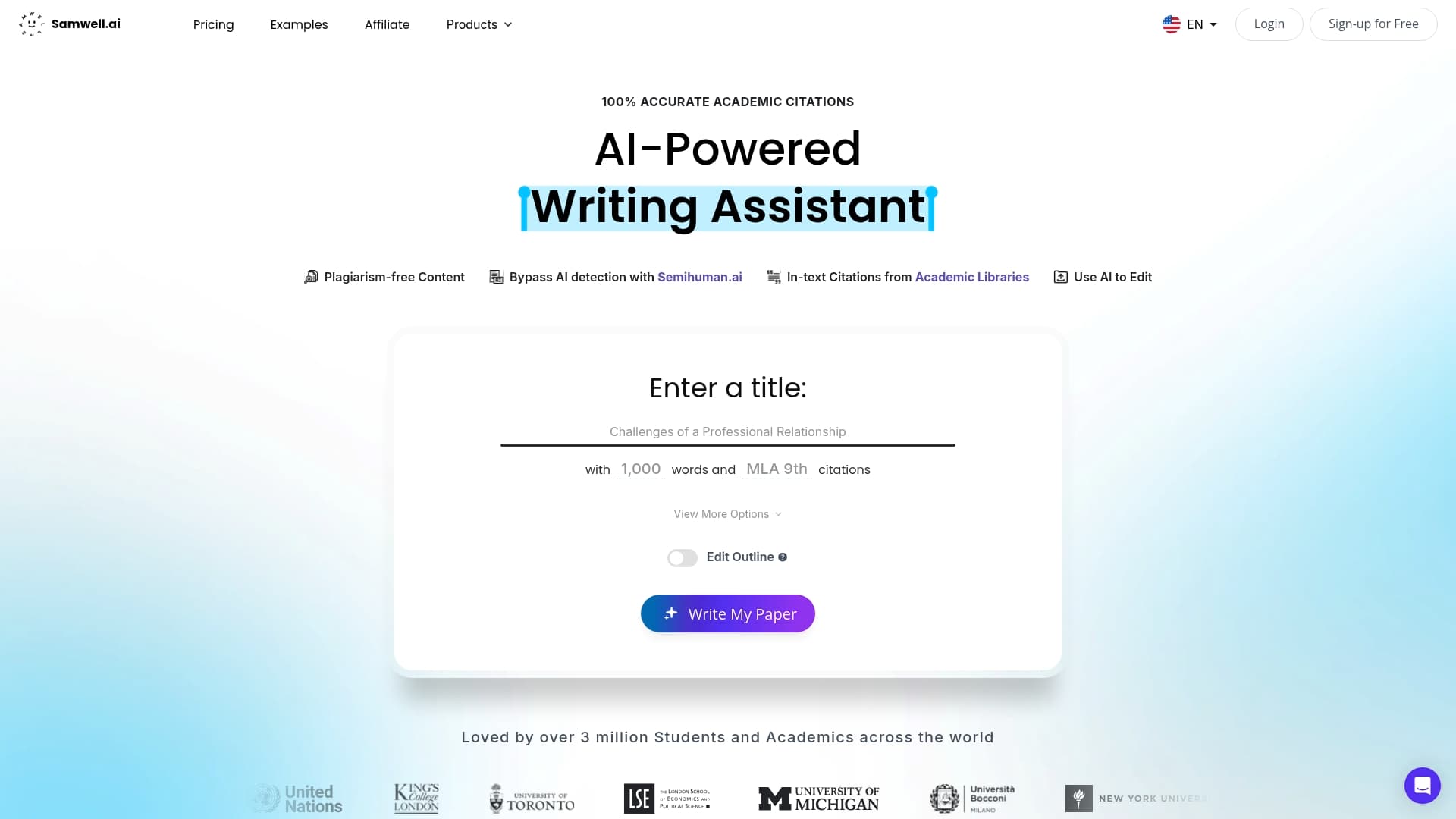
Samwell's Guided Essays feature generates structured outlines tailored to your topic, so you start with a thesis and organized body sections rather than a blank page. The Power Editor lets you expand specific paragraphs, tighten transitions, and adjust tone without rewriting the whole draft. Real-time AI detection checks flag language that reads as too subjective or too close to existing sources, which is the exact pitfall that trips up most expository writers. Samwell also handles APA and MLA citation formatting automatically, so you spend your time on the argument, not the reference page.
Over 1,000,000 students and academic professionals use Samwell for essay writing and research papers. If you are working on an expository essay and want a model that already meets academic standards, the AI essay writing tool at Samwell gives you a plagiarism-checked draft built around your specific topic and sources. For research-heavy assignments, the research paper generator handles source integration and citation compliance from the start.
Effective expository essays explain a topic objectively, using a clear thesis, logical structure, and evidence-based body paragraphs without personal opinion or persuasive language.
| Point | Details |
|---|---|
| Objectivity is non-optional | Avoid "I believe" or "I feel" to maintain the neutral, evidence-based tone expository writing requires. |
| Five paragraphs is a floor, not a ceiling | The standard structure works for simple topics; complex subjects need more paragraphs for complete coverage. |
| Format shapes the whole essay | APA uses author-date citations; MLA uses author-page; choose based on your course discipline. |
| Level determines complexity | Middle school essays use simple claims; college essays require multiple academic sources and critical analysis. |
| Samwell supports every stage | Samwell's Guided Essays, Power Editor, and citation tools help students build accurate, well-structured expository drafts. |