Loading...

TL;DR:
- Creating an essay outline helps organize ideas, supporting evidence, and argument flow before drafting begins. A clear outline leads to more coherent essays, saves revision time, and reduces structural mistakes. Starting with a strong thesis and building a flexible outline ensures better argument development and overall essay quality.
An essay outline is a structured planning tool that organizes your main ideas, supporting evidence, and argument flow before you write a single draft sentence. Students who build a clear outline before writing produce more coherent arguments, waste less time on revisions, and avoid the most common structural mistakes. Tools like Grammarly and techniques like reverse outlining have made the outlining process more accessible, but the core skill remains the same: deciding what you want to say and in what order before you say it. Samwell's Guided Essays feature takes this further by generating structured outlines tailored to your topic and citation style.
A standard essay outline follows a five-part structure: introduction, three body paragraphs, and conclusion. Each section has specific elements that work together to build a logical, persuasive argument.
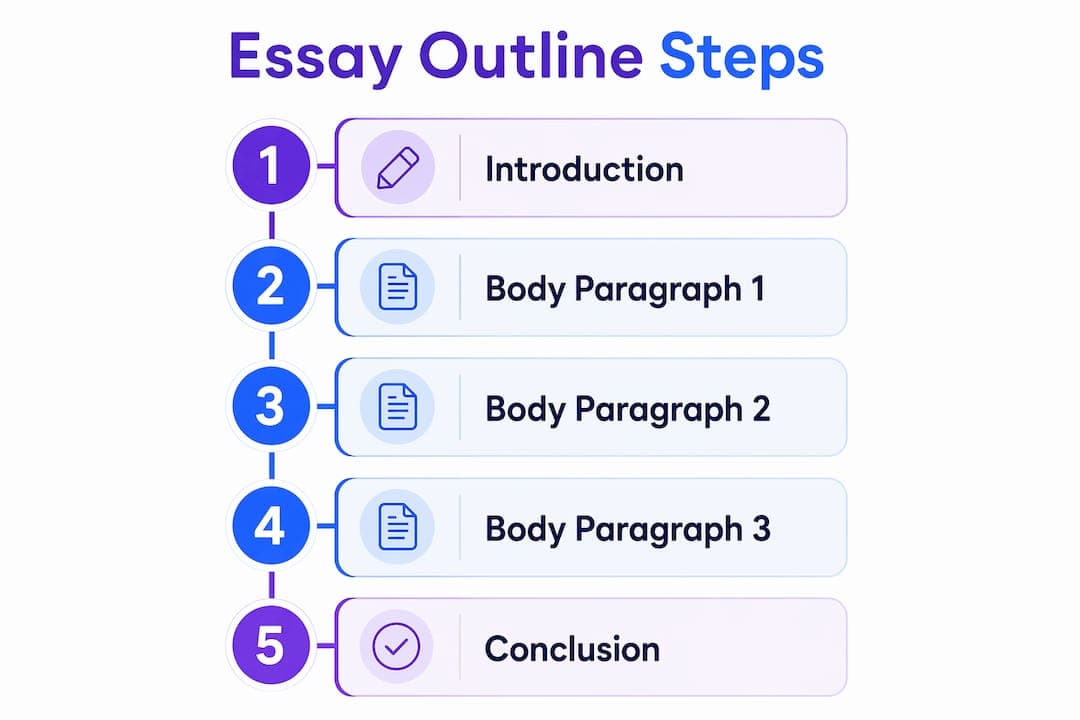
The introduction contains three elements: a hook, context, and a thesis statement. The hook grabs attention with a surprising fact, a bold claim, or a direct question. Context gives the reader enough background to understand why the topic matters. The thesis statement is the single most important sentence in your essay. It states your central argument and tells the reader exactly what you will prove.
Each body paragraph follows the same internal structure:
Essays modeled with balanced word distribution allocate roughly 10–15% of total words to the introduction and conclusion each, and 70–80% to the body paragraphs. Each of the three body paragraphs typically carries 25–30% of the total word count. That distribution tells you where your intellectual effort should go: the body is where your argument lives.
The conclusion restates the thesis in new words, briefly recaps the main points, and ends with a broader implication or call to reflection. It does not introduce new evidence. A strong conclusion answers the reader's unspoken question: "So what?"
Formal outlines use Roman numerals for main points, capital letters for sub-points, and Arabic numerals for individual pieces of evidence. The rule is that whenever you subdivide a point, you need at least two items at that level. You cannot have an "A" without a "B." This convention forces you to think in pairs and groups, which naturally strengthens your argument structure.
Building a solid outline takes about 20–30 minutes for a standard five-paragraph essay. The time you invest here saves hours during drafting and revision.
Identify your thesis. Write one sentence that states your argument and the main reason it is true. If you cannot write this sentence clearly, you are not ready to outline yet. Go back to your notes and reading first.
Gather your supporting ideas. List every point, fact, or example you want to include. Do not filter yet. Write everything down in a loose brainstorm. Tools like a simple Word document or Google Docs work fine for this stage.
Group and rank your points. Cluster related ideas together. Identify the three strongest clusters. These become your three body paragraphs. Rank them from weakest to strongest, placing your most compelling argument last for maximum impact.
Choose your outline format. Decide between an informal outline (bulleted list of paragraph jobs) and a formal outline (Roman numeral hierarchy with complete sentences). Simple assignments benefit from informal outlines. Research papers and argumentative essays need the formal structure.
Fill in the structure. Write your thesis at the top. Under each body paragraph slot, add the topic sentence, one or two pieces of evidence, and a brief note on your explanation. Add transition notes between paragraphs.
Check for logical flow. Read the outline from top to bottom. Ask: does each paragraph build on the last? Does every piece of evidence connect to its topic sentence? Does the conclusion follow naturally from the body?
Update as you research. An essay outline is a living document that should evolve during research and drafting. New sources may shift your argument. A stronger piece of evidence may replace a weaker one. Treat the outline as a working draft, not a locked contract.
Pro Tip: Write your thesis statement before you touch the outline structure. Every decision you make about what to include or exclude should be tested against one question: does this support my thesis?
For a deeper look at outline sample templates, Samwell's blog offers step-by-step formats you can adapt directly to your assignment.

Not every essay needs the same type of outline. Matching the outline format to the essay's complexity is the single biggest factor in whether outlining helps or slows you down.
| Outline type | Best used for | Key characteristic |
|---|---|---|
| Formal outline | Research papers, argumentative essays | Roman numeral hierarchy, complete sentences |
| Informal outline | Short essays, in-class writing | Bulleted list of paragraph jobs |
| Mind map | Early brainstorming, creative essays | Visual clusters, no fixed hierarchy |
| Reverse outline | Revising existing drafts | Written from the draft, not before it |
Formal outlines give you the most control over complex arguments. They force you to write complete sentences for each point, which reveals vague thinking early. If you cannot write a clear topic sentence for a body paragraph, the paragraph does not belong in the essay.
Informal outlines work well for shorter or lower-stakes assignments. A loose outline, such as a bulleted list of paragraph jobs, is often better for simple assignments than a strict formal outline that can slow your creative momentum.
Reverse outlining is the most underused technique in academic writing. After you finish a draft, go paragraph by paragraph and write one sentence summarizing what each paragraph actually does. Then compare that summary to what you intended each paragraph to do. The gaps between intention and execution reveal exactly where your argument breaks down. Reverse outlining is valuable for troubleshooting drafts by exposing structural and flow issues that are invisible during initial writing.
Pro Tip: Use a mind map for your first brainstorm, convert it to an informal outline to identify your three main points, then build a formal outline only if the essay is longer than 1,500 words or requires a complex argument.
The most damaging mistake students make is treating the outline as a formatting exercise rather than a thinking tool. Students often treat outlining as formatting, but its real purpose is to reveal and fix logical flaws before drafting begins. Catching a weak argument in the outline stage takes two minutes. Catching it after you have written 1,000 words costs you an hour.
"An outline is not a cage. It is a map. Maps change when the terrain changes." This is the mindset that separates students who outline well from those who treat it as a bureaucratic chore.
The fix for most outlining problems is the same: step back and ask whether each section of the outline serves the thesis. If a point does not directly support your central argument, cut it or rework it until it does. For more on the role of outlines in building coherent essays, Samwell's guide covers the connection between structure and argument quality in detail.
A strong essay outline is the single most reliable way to produce a well-structured, coherent essay without wasting time on major revisions.
| Point | Details |
|---|---|
| Start with the thesis | Write your central argument first; every outline decision flows from it. |
| Use the right outline type | Match formal or informal formats to essay complexity for best results. |
| Keep the outline flexible | Update your outline as research progresses; treat it as a living document. |
| Avoid outline paralysis | Focus on structural markers, not exhaustive detail, to stay efficient. |
| Use reverse outlining | Summarize each paragraph post-draft to catch logical gaps and weak arguments. |
Most students I have worked with start their outline by filling in the structure: introduction, body, conclusion. They label the boxes and then try to pour ideas into them. That approach almost always produces a generic, forgettable essay.
The better method is to start with your argument, not your structure. Write the thesis first. Then ask: what are the three strongest reasons this thesis is true? Those reasons become your body paragraphs. The structure follows the argument, not the other way around.
Reverse outlining changed how I think about revision entirely. I used to read drafts looking for weak sentences. Now I read drafts looking for weak paragraph logic. One sentence summarizing what each paragraph actually does will tell you more about your essay's problems than any line-by-line edit. The outlining process is iterative by nature. The writers who treat it that way produce noticeably better work.
The other thing most guides miss: outlining is the best cure for writer's block. When you are stuck staring at a blank page, you are usually stuck on structure, not on ideas. A ten-minute outlining session almost always breaks the block because it separates the thinking problem from the writing problem. Solve the thinking first. The writing follows.
— Tilen
Samwell is built for exactly the moment when your outline is ready and you need to turn it into a polished, properly cited essay. Over 1,000,000 students and academics from leading universities use Samwell to generate plagiarism-free essays that meet MLA, APA, and other citation standards. The Guided Essays feature generates structured outlines based on your topic and instructions, so you can start with a solid framework rather than a blank page. The Power Editor lets you expand specific sections, fix weak paragraphs, and refine your argument without rewriting the whole draft. Real-time AI detection checks keep your work compliant with evolving academic integrity standards.
An essay outline is a planning document that organizes your thesis, main points, and supporting evidence before you begin drafting. It typically follows a five-part structure: introduction, three body paragraphs, and conclusion.
For a standard five-paragraph essay, the outline should fit on one page. Over-detailing leads to outline paralysis, which wastes time without improving the final essay.
A formal outline uses Roman numerals, capital letters, and Arabic numerals in a strict hierarchy with complete sentences. An informal outline uses a simple bulleted list of paragraph jobs and works best for shorter or lower-stakes assignments.
Reverse outlining means writing a one-sentence summary of what each paragraph in a finished draft actually does, then comparing those summaries to your original plan. It reveals logical gaps and disorganized sections that are hard to spot during regular editing.
Update your outline whenever new research shifts your argument or a stronger piece of evidence replaces a weaker one. Treat the outline as a living document through the entire research and drafting process, with a final coherence check before you write the conclusion.