Loading...

The correct essay format for university assignments in the US follows a consistent set of rules that most professors expect without explanation. Get these right from the start, and you spend your energy on the argument, not on reformatting at midnight before a deadline.
Here are the core requirements at a glance:
These basics hold across virtually every US university unless your professor hands you a custom style sheet that says otherwise.
Academic essays across US universities share a standard page setup regardless of citation style. The rules below apply whether you are writing for an English class in MLA or a psychology course in APA.
Page layout and fonts
Spacing and indentation
Headers and page numbers
Pro Tip: Set your margins, font, and spacing before you type anything. Reformatting a completed draft is tedious and introduces errors, especially in your citations.
The three major citation styles used in US universities are not interchangeable. Each one shapes your document differently from the first page to the last line of your bibliography. Many university departments also issue custom style sheets that override the standard handbooks, so always check your course syllabus first.
MLA is the default style for humanities courses: literature, writing, film, and related fields.
APA dominates social sciences, education, nursing, and business courses.
Chicago style splits into two systems. The Notes-Bibliography system is standard in history and the arts; the Author-Date system appears in some social sciences.
Pro Tip: If your professor has not specified a style, ask. Choosing the wrong one and reformatting 20 footnotes into parenthetical citations is a painful lesson in asking early.
For a side-by-side comparison of how APA and MLA handle the same source, the APA vs. MLA breakdown is worth bookmarking.
Formatting rules govern how a page looks. Structure governs whether your argument actually lands. The two work together, and getting both right is what separates a B paper from an A.
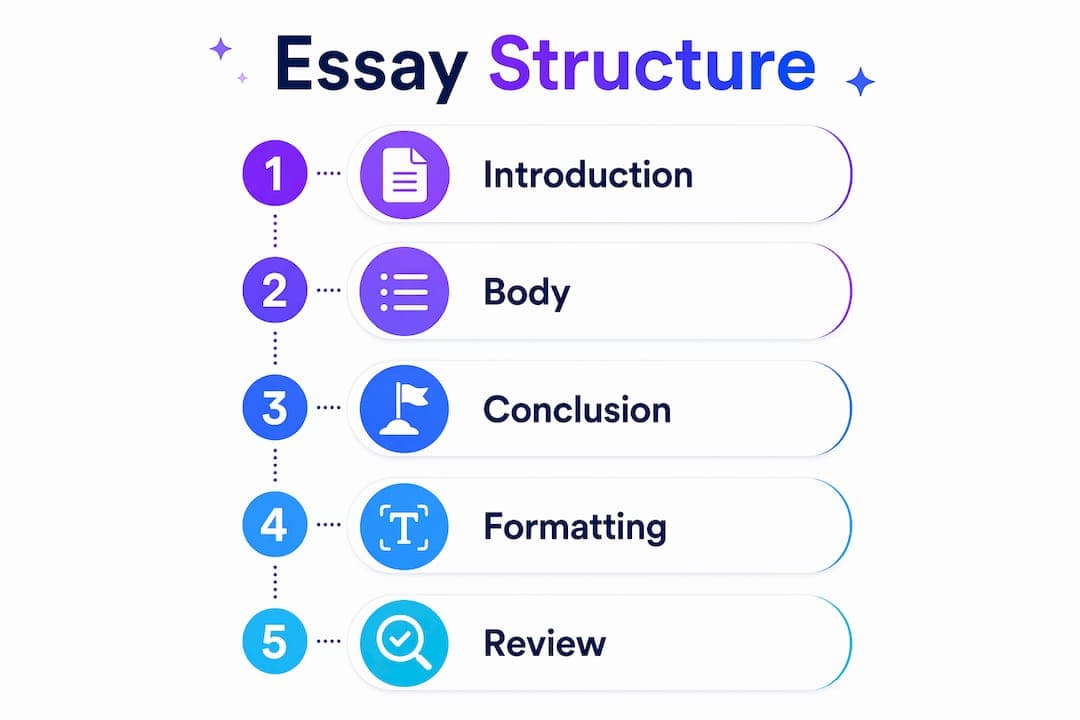
Most academic essays follow a three-part structure: introduction, body, and conclusion. The University of Sheffield describes this as an hourglass model: start broad, narrow to your specific argument, then widen back out to implications at the end.
Introduction
Your introduction does three things: it hooks the reader with a relevant context or observation, it narrows to the specific question you are answering, and it ends with a thesis statement. The thesis is a single sentence that states your argument and signals the structure of what follows. Write it last, after you know what your essay actually argues.

Body paragraphs
Each body paragraph covers one idea. Open with a topic sentence that states the paragraph's claim directly. Follow with evidence (a quote, a statistic, a close reading), then your analysis of what that evidence means for your argument. Close with a sentence that either summarizes the point or transitions to the next paragraph.
Conclusion
The conclusion is not a summary. It revisits your thesis in light of the evidence you have presented, then pushes outward: what do your findings mean beyond this paper? What questions remain open? A strong conclusion leaves the reader with something to think about, not just a recap of what they just read.
Most formatting errors fall into a few predictable categories, and nearly all of them are avoidable.
Common mistakes
Tables, figures, and appendices
Tables and figures need labels. In APA, a table gets a number (Table 1) and a title in italics above it; the source goes in a note below. In MLA, label figures as "Fig. 1" with a caption below. Appendices go after the reference list, each labeled "Appendix A," "Appendix B," and so on, and referenced in the body text.
Page numbering
Page numbers belong in the header, not the footer, for MLA and APA. MLA starts numbering on page one. APA student papers typically start with the title page as page one. Chicago style often omits the number on the title page. For a detailed walkthrough of header and pagination rules per style, that guide covers the edge cases most students get wrong.
Pro Tip: Run a formatting check as a separate pass after your final draft. Read only for layout: margins, font, spacing, header, and citation format. Trying to catch content and formatting errors at the same time means you will miss both.
Getting the argument right is hard enough without spending an hour debugging your hanging indents.
Samwell is built for exactly this situation. Over 1,000,000 students and academic professionals use it to generate, edit, and format essays that comply with MLA, APA, and Chicago standards from the start. The Power Editor lets you expand or tighten specific sections without disrupting your citation formatting. Guided Essays walks you through a structured outline before you write a word, so your introduction, body, and conclusion are already mapped. Real-time AI detection checks run as you write, and the platform's Semihuman.ai technology keeps your work original and credible. If you have been staring at a blank page or a half-finished draft that still needs a Works Cited page, start with Samwell and skip the reformatting entirely.
Correct essay format for university requires consistent page setup, the right citation style, and a clear three-part structure working together from the first line to the last bibliography entry.
| Point | Details |
|---|---|
| Standard page setup | Use 1-inch margins, 12-point Times New Roman, and double-spacing throughout every document. |
| Citation style differences | MLA uses a first-page header and Works Cited; APA requires a title page and References; Chicago uses footnotes and a Bibliography. |
| Structure matters | Every essay needs a thesis-driven introduction, focused body paragraphs, and a conclusion that extends beyond summary. |
| Format after drafting | Finalize margins, fonts, and citation formatting after completing your first draft to avoid repeated adjustments. |
| Samwell for formatting | Samwell generates and formats essays in MLA, APA, and Chicago with built-in plagiarism detection and citation compliance. |