Loading...

TL;DR:
- Citation accuracy involves ensuring every element of a reference is correct, supporting research credibility and reproducibility. Proper management and verification of sources, especially DOIs, prevent errors like hallucinated or misattributed citations that can undermine scholarly trust. Using verified metadata, manual source checking, and tools like the SIFT method help researchers maintain integrity and avoid systemic citation issues.
Citation accuracy is defined as the correctness and completeness of every element in a reference, including author names, publication dates, titles, source identifiers, and persistent links like DOIs. Accurate citations validate your research claims, allow other scholars to locate and verify your sources, and protect you from plagiarism accusations. For students and researchers alike, the importance of citation accuracy extends beyond formatting rules. It determines whether your work is trusted, reproducible, and taken seriously in peer review. With AI-generated content now introducing a new category of fabricated references called "reference hallucination," getting citations right has never been more consequential.
Citations are not administrative paperwork. They are, as the University of Washington explains, a map of the scholarly conversation, showing readers exactly where your ideas come from and how your work connects to existing research. Every citation you include positions your argument within a larger body of knowledge and signals that you have engaged seriously with the literature.
When citations are inaccurate, that map breaks down. Peer reviewers who cannot locate a source you cited will question the validity of the claim it supports. Instructors who find wrong publication years or misattributed authorship will doubt the thoroughness of your research. Over time, a pattern of citation errors damages your scholarly reputation in ways that are difficult to recover from.
The role of citations in research also extends to plagiarism prevention. Proper attribution distinguishes your original analysis from borrowed ideas. Citing sources correctly demonstrates intellectual honesty and shows you understand the difference between synthesis and copying. This is not a technicality. Academic institutions treat citation negligence as a form of misconduct, even when the intent was not deceptive.
There is also a systemic problem worth understanding. Citation noise, which occurs when researchers cite sources they have not actually read, distorts scientific evaluations and meta-analyses. When enough researchers cite a flawed or misrepresented study, that error propagates through the literature. Entire research fields can build on shaky foundations because no one stopped to verify the original source.
"Citing without reading is not a minor shortcut. It is a structural threat to how science evaluates itself." — Adapted from meta-science research on citation noise
Citation errors in biomedical literature range between 10% and 25%, a figure that represents a staggering volume of broken knowledge chains across published research. These are not rare exceptions. They are a systemic pattern with real consequences for reproducibility and trust.
The most frequent mistakes fall into predictable categories:
Each of these errors carries a specific consequence. Wrong authorship misrepresents who produced the knowledge. Broken DOIs make verification impossible years later. Misattributed sources spread misinformation by crediting claims to studies that never made them.
The newest and most alarming category is AI-generated hallucinated citations. Reference hallucination occurs when AI content generators produce citations that look structurally correct but refer to non-existent or irrelevant works. A 2026 empirical analysis confirmed that these hallucinations are common without verification processes in place. This means a student who pastes AI-generated references directly into a paper may be submitting citations to studies that do not exist.
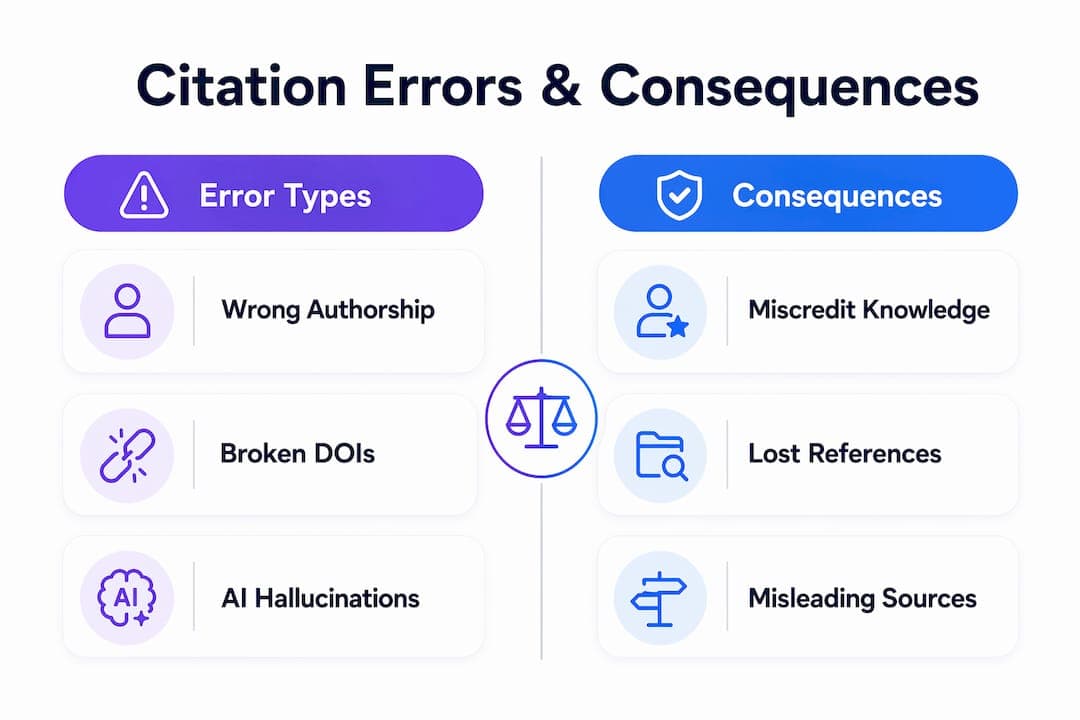
| Error type | Consequence |
|---|---|
| Wrong authorship | Misrepresents intellectual credit and distorts citation counts |
| Incorrect date | Undermines chronological accuracy and research priority claims |
| Broken or missing DOI | Prevents long-term verification and reduces research credibility |
| Source misattribution | Spreads false claims by linking them to unrelated studies |
| AI hallucinated citations | Introduces fabricated references that cannot be located or verified |
Pro Tip: Before submitting any paper, paste every DOI into a resolver like doi.org and confirm the source loads correctly. This single check catches broken links and hallucinated references simultaneously.
The most effective strategy for citation accuracy is to manage references during source discovery, not after writing. Recording full bibliographic details at the moment you first encounter a source prevents the scramble of reconstructing metadata from memory or incomplete notes. Post-writing citation fixes are where most errors enter a paper.
Here is a practical workflow that combines manual verification with tool-based formatting:
Understanding citation management for academic success is not just about software. It is about building habits that make accuracy the default rather than the exception.
Pro Tip: Set up a citation folder in your reference manager for each paper you write. Tag sources as "verified" only after you have confirmed the metadata matches the original document and the source actually supports the claim you are making.

AI content generators and dedicated citation tools are not the same thing, and treating them as interchangeable is one of the most common mistakes students make today. Understanding the difference protects your academic credibility.
Traditional citation management tools like Zotero, Mendeley, and RefWorks generate citations by pulling metadata directly from verified databases. They do not invent sources. When you import a DOI or a database record, the tool formats what already exists. The risk of error comes from metadata quality in the source database, not from the tool fabricating information.
AI content generators, including large language models used for essay writing, operate differently. They predict plausible-sounding text based on training data. When asked to generate citations, they produce references that follow the correct structural pattern but may refer to studies that were never published, authors who never wrote on that topic, or journals that do not exist. Non-AI citation tools lower hallucination risk precisely because they generate citations from verified source metadata rather than language prediction.
The comparison breaks down like this:
| Feature | Dedicated citation tools | AI content generators |
|---|---|---|
| Source of citation data | Verified database metadata | Language model prediction |
| Risk of fabricated references | Low | High without verification |
| Formatting accuracy | High for supported styles | Variable |
| Requires manual verification | For metadata quality | For every citation |
To mitigate AI citation risks, researchers and students should apply the SIFT method: Stop, Investigate the source, Find better coverage, and Trace claims to their origin. This four-step approach, developed for media literacy, applies directly to verifying AI-generated references before including them in academic work.
The role of AI in academic writing is real and growing, but citation generation is one task where human oversight cannot be delegated. Every AI-produced reference needs independent verification against a live source.
Citation accuracy requires verified metadata, persistent identifiers, and manual source confirmation at every stage of the research process.
| Point | Details |
|---|---|
| Define accuracy from the start | Citation accuracy means correct author, date, title, source, and DOI, not just consistent formatting. |
| Manage citations during research | Record full bibliographic details when you find a source, not after writing, to prevent errors. |
| Verify AI-generated references | AI content generators hallucinate citations; every AI-produced reference needs independent source confirmation. |
| Use DOIs for permanence | Persistent identifiers prevent link rot and allow long-term verification by editors and future researchers. |
| Citation noise has systemic costs | Citing without reading distorts meta-analyses and weakens institutional credibility across entire research fields. |
I have reviewed enough student papers and research drafts to say this plainly: the researchers who treat citations as an afterthought are the same ones who get caught in peer review with unsupported claims or, worse, fabricated sources they did not realize were fabricated.
What changed my own approach was recognizing that every citation is a commitment. You are telling your reader, "This claim is real, this source exists, and it says what I claim it says." That is not a formatting obligation. It is an intellectual promise. When you break it, even accidentally, you are asking your reader to trust a map with missing roads.
The AI hallucination problem has made this more urgent, not less. I have seen papers where every citation looked structurally perfect in APA format, and nearly a third of the DOIs led nowhere. The student had no idea. They trusted the AI output without running a single verification check. That is not a technology failure. It is a workflow failure.
My practical advice: build verification into your writing schedule as a discrete step, not something you do while proofreading. Allocate time specifically to open every source, confirm the metadata, and check that the content actually supports your argument. It takes longer upfront. It saves you from retractions, failed submissions, and academic misconduct investigations later.
Treat citation standards in academic writing as a professional skill, not a bureaucratic hurdle. The scholars whose work endures are the ones whose references hold up under scrutiny years after publication.
— Tilen
Accurate citations are one of the hardest parts of academic writing to get right consistently, especially when you are managing dozens of sources across a long paper.
Samwell's enhanced essay creator integrates citation management directly into the writing process, so you are not scrambling to reconstruct references after the fact. The platform supports APA, MLA, and other major citation standards, and its Semihuman.ai technology reduces plagiarism risk while helping you produce credible, well-sourced content. Over 1,000,000 students and academic professionals from leading universities use Samwell to write papers that hold up under scrutiny. If you want to spend less time fixing citation errors and more time developing your arguments, Samwell is built for exactly that workflow.
Citation accuracy means every element of a reference, including author, title, date, and DOI, is correct and complete. It matters because inaccurate citations undermine research credibility, prevent source verification, and can constitute academic misconduct.
Citation errors range from 10% to 25% in biomedical literature, with wrong authorship, incorrect dates, and broken DOIs among the most frequent mistakes. These errors break knowledge chains and reduce reproducibility across research fields.
AI content generators frequently produce hallucinated citations that look structurally correct but refer to non-existent sources. Dedicated citation tools like Zotero or Mendeley, which pull from verified database metadata, carry significantly lower fabrication risk.
SIFT stands for Stop, Investigate the source, Find better coverage, and Trace claims to their origin. It is a four-step verification framework that helps researchers confirm whether AI-generated or unfamiliar citations refer to real, relevant sources.
DOIs provide permanent identifiers that remain stable even when URLs change or expire. Using DOIs instead of direct links prevents link rot and allows editors, instructors, and future researchers to verify sources long after a paper is published.