Loading...

TL;DR:
- APA in essay writing specifies formatting and citation rules developed by the American Psychological Association; it promotes clarity and consistency in academic work. Proper setup includes specific page margins, font, spacing, and page numbering, while in-text citations require author and date, with page numbers for quotes, matching a detailed reference list. Using narrative and parenthetical citations correctly enhances readability, and tools like templates and checklists ensure formatting accuracy; automating these steps saves time and maintains control over document consistency.
APA in essay writing is the standardized system of formatting and citation developed by the American Psychological Association to promote clarity, consistency, and ethical referencing in academic work. The 7th edition, now the current standard across most universities, updated several key rules that students frequently get wrong. This guide covers every layer of APA format: page setup, in-text citations, reference lists, and practical tools to get it right the first time.
APA format guidelines set the physical structure of your paper before you write a single word of content. Getting these details right signals to your instructor that you understand academic conventions.
The 7th edition layout specifies the following requirements:
One rule that trips up many students: no running head is required for student papers in APA 7th edition. Earlier editions required it, so older templates and online guides still include it. Remove it from your header.
Your title page must include your paper title, your full name, your institution, the course name and number, your instructor's name, and the due date. Many students skip the course number, instructor name, and due date. Those omissions cost points. Always check your syllabus because some instructors add their own requirements beyond the APA baseline.
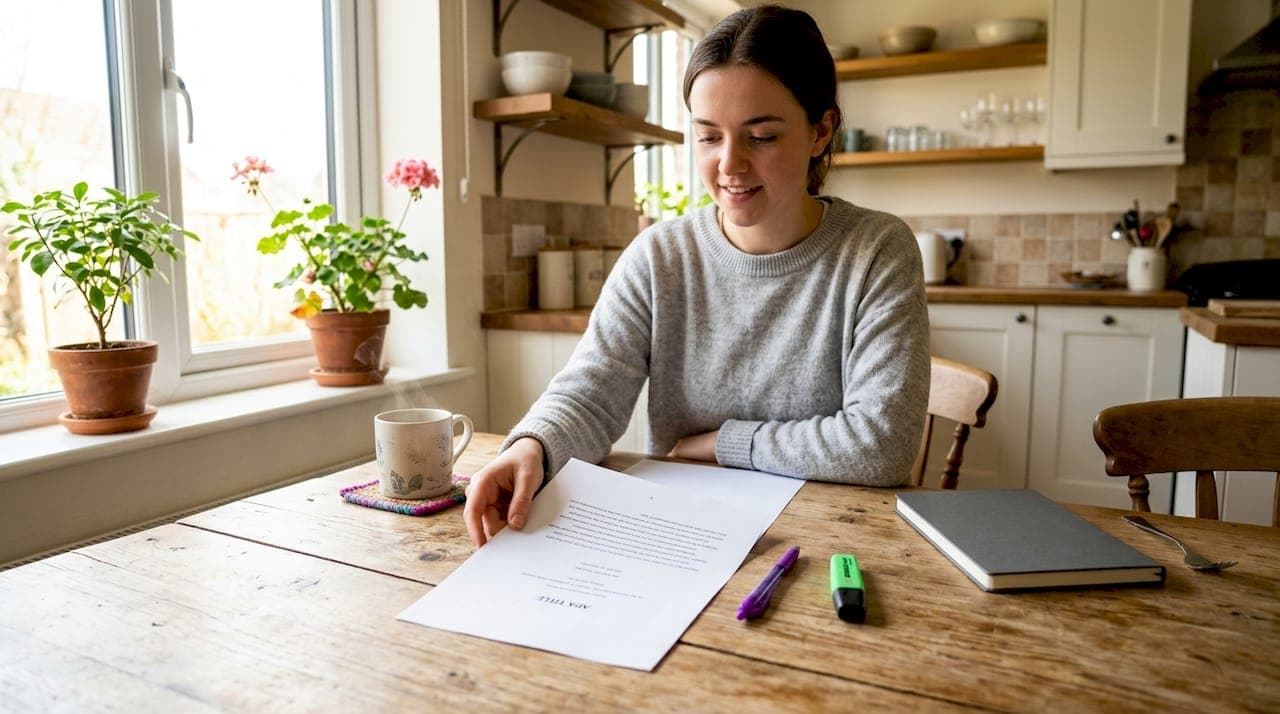
Pro Tip: Set your paragraph indent in your word processor's paragraph settings rather than pressing Tab each time. Manual tabs create inconsistent spacing that is hard to spot and harder to fix.
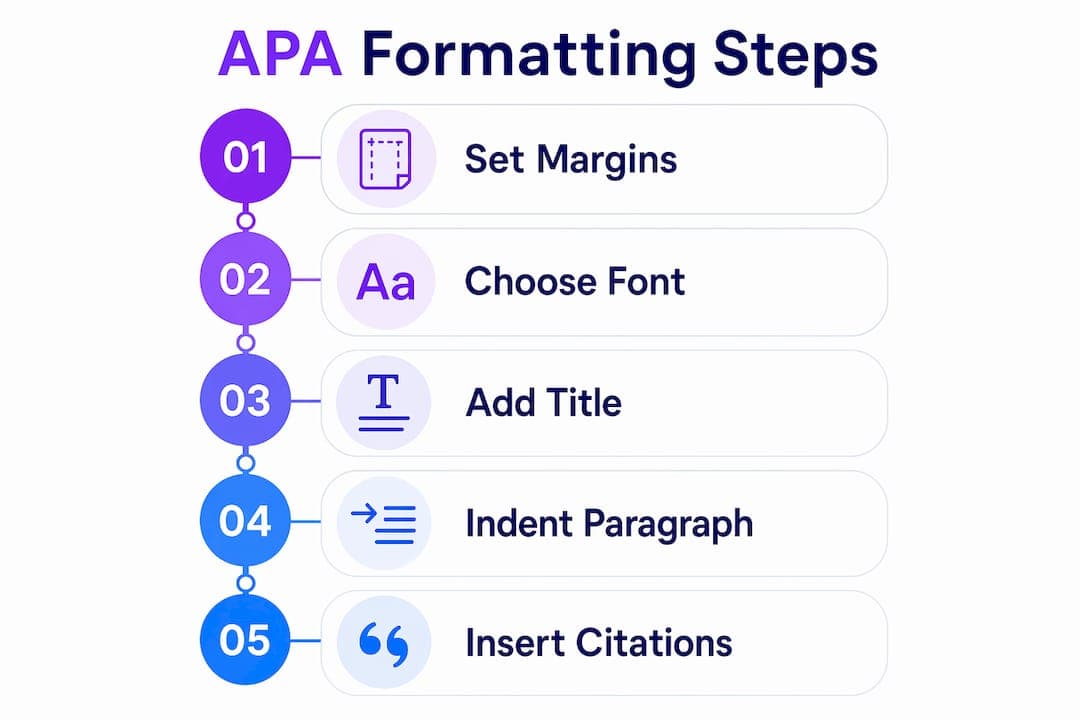
The APA citation format in a paper uses an author-date system. Every time you borrow an idea, a fact, or a direct quote, you credit the source immediately in the text. Here is how it works step by step.
The author-date citation format requires author and year for paraphrases, and author, year, and page location for direct quotes. That distinction is the most common citation error in student papers.
Punctuation placement matters more than most students realize. Parenthetical citations go before the closing period, not after. Writing "(Garcia, 2023)." is correct. Writing ".(Garcia, 2023)" is not. This single error appears in a large share of student papers and is entirely avoidable.
Narrative citations often improve prose flow compared to parenthetical citations placed at the end of every sentence. When you write about a specific researcher's argument, naming them in the sentence feels more natural and keeps your writing from reading like a list of citations. Mix both styles throughout your paper for better readability.
Pro Tip: Read each cited sentence aloud. If the citation interrupts the thought, switch to a narrative format. If the sentence stands alone as a fact, a parenthetical citation at the end works better.
The reference list is the final page of your APA style research paper. Every source you cited in the text must appear here, and every entry here must match a citation in the text. This 1:1 citation-to-reference balance is one of the most common sources of mistakes among students. A missing reference or an uncited entry both undermine your paper's credibility.
The core formatting rules for the reference list are:
The hanging indent is a formatting detail that many students set manually, which creates inconsistency. Set it through your paragraph formatting menu instead. Select all reference entries, open paragraph settings, and choose "Hanging" under the indentation special options.
| Source type | Author format | Title format | Additional info |
|---|---|---|---|
| Journal article | Last, F. M. | Sentence case, no italics | Journal name italicized, volume, issue, pages, DOI |
| Book | Last, F. M. | Sentence case, italicized | Publisher name |
| Web page | Last, F. M. (or organization) | Sentence case, no italics | Site name, URL |
| Chapter in edited book | Last, F. M. | Sentence case, no italics | In Editor name (Ed.), Book title (pp. xx-xx). Publisher |
Managing different source types is where students most often make errors. A journal article, a book chapter, and a website each follow a different reference structure. Use an APA citation list guide to verify the correct format for each source type before you submit.
Pro Tip: Build your reference list as you write, not after. Adding each source the moment you cite it takes 30 seconds and prevents the frantic last-minute scramble to reconstruct sources from memory.
Setting up an APA paper correctly from the start saves significant time during revision. The most reliable approach is to configure your word processor before you write anything.
For Microsoft Word, open a blank document and set the following before typing:
Google Docs follows the same logic. Format menu, paragraph styles, and page setup cover all the same settings. Both platforms offer APA 7 templates that pre-load these settings. Using a template is faster than configuring everything manually, and it reduces the chance of missing a setting.
Setting the paragraph indent automatically prevents the inconsistency that comes from pressing Tab. This is one of the most overlooked setup steps, and it shows up clearly when instructors check formatting.
After writing, run through a verification checklist before submitting. Check margins, font, spacing, page numbers, title page completeness, in-text citation punctuation, and reference list order. An APA formatting checklist covers each of these points systematically and takes less than ten minutes to complete.
Pro Tip: Save your correctly configured document as a personal template. Every future APA paper starts from that file, and you never have to reconfigure settings again.
Correct APA formatting requires consistent page setup, accurate author-date citations, and a reference list that matches every in-text citation one to one.
| Point | Details |
|---|---|
| Page setup comes first | Set margins, font, spacing, and indent before writing to avoid reformatting later. |
| Author-date is the core rule | Every in-text citation needs at minimum an author's last name and publication year. |
| Punctuation placement matters | Parenthetical citations go before the closing period, not after it. |
| Reference list must match citations | Every in-text citation needs a full reference entry, and every reference needs a citation. |
| Use templates and checklists | Pre-configured templates and a final checklist prevent the most common formatting errors. |
APA formatting looks mechanical on the surface. Set your margins, add your citations, build your reference list. Students often treat it as a checklist to rush through after the real writing is done. That approach is why so many papers come back with formatting deductions.
The part that actually trips people up is consistency. You can know every rule and still submit a paper where half the citations use narrative format and half use parenthetical format with no logic behind the choice. Or where the reference list has hanging indents on some entries and not others because you added sources at different times. These inconsistencies signal to a reader, and to an instructor, that the writer was not fully in control of their own document.
What I have found works is treating APA format as part of the writing process, not a separate task. When you cite a source mid-draft, format it correctly right then. When you add a reference to your list, format it immediately. Waiting until the end to "fix formatting" means you are doing the same work twice, under time pressure, and you will miss things.
The other underrated skill is knowing when to use narrative versus parenthetical citations. Most students default to parenthetical because it feels safer. But a paper that ends every sentence with "(Author, Year)" reads like a bibliography, not an argument. Narrative citations let you integrate sources into your reasoning. Garcia (2023) argues something different from "research suggests" (Garcia, 2023). The first version positions you as a writer engaging with ideas. The second version positions you as someone listing sources.
APA is not just a formatting requirement. It is a communication system. When you use it correctly, your reader can follow your reasoning, verify your sources, and trust your scholarship. That is worth getting right.
— Tilen
Writing an APA essay takes real effort. Formatting it correctly takes a different kind of attention that can pull focus away from your actual argument.
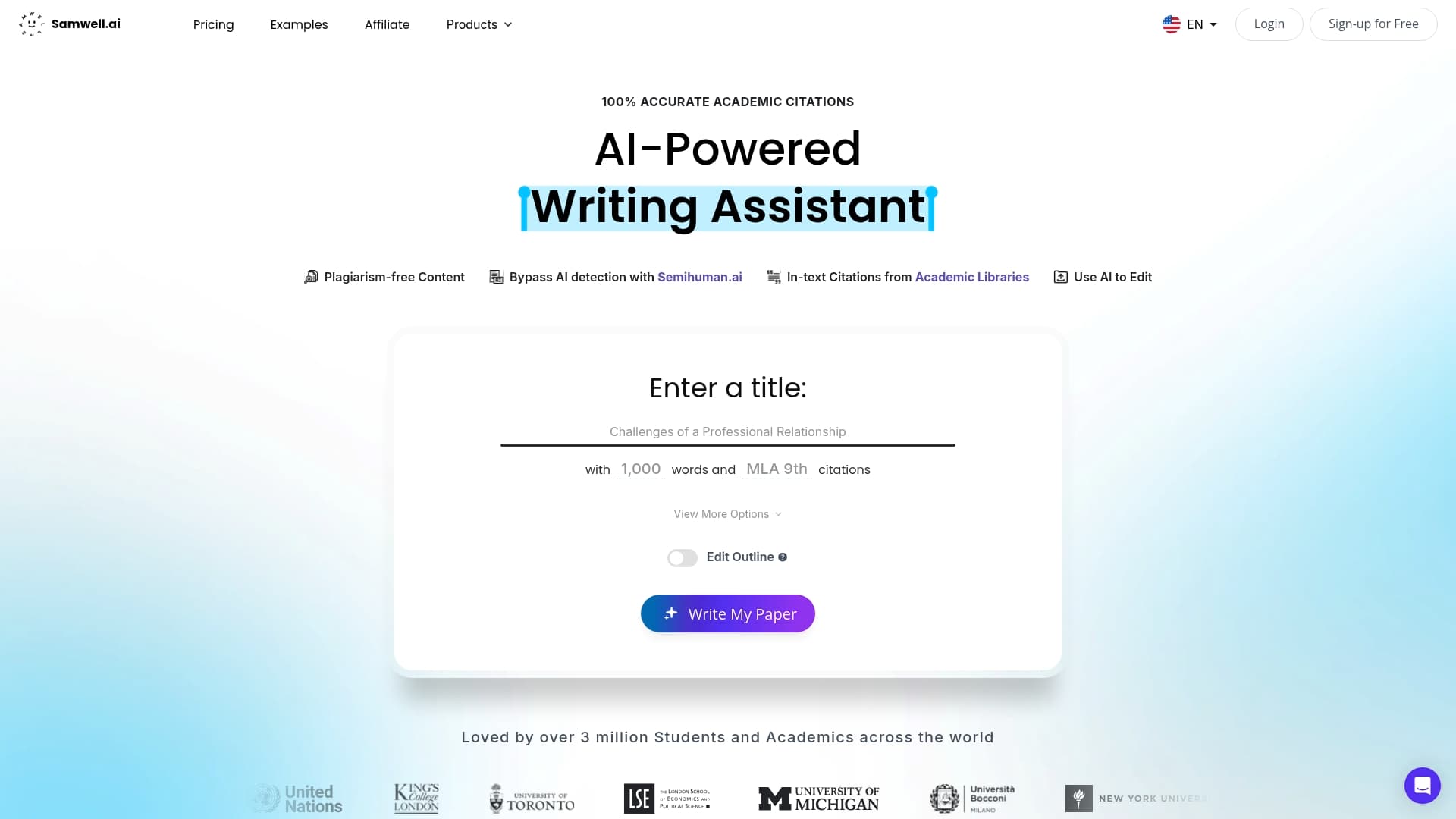
Samwell is an AI-powered writing platform used by over 1,000,000 students and academic professionals. It handles APA 7th edition formatting automatically, generates properly structured citations, and checks your paper for consistency before you submit. The Power Editor lets you expand or refine specific sections without reformatting the whole document. Guided Essays provide structured outlines so you start with a clear framework. If you want to produce APA-formatted papers without spending an hour on margin settings and citation punctuation, Samwell is built for exactly that.
APA in essay refers to applying the American Psychological Association's formatting and citation rules to academic papers. It covers page layout, in-text citations, and reference list structure.
No. APA 7th edition removed the running head requirement for student papers. Only a page number flush right in the header is required.
A direct quote requires the author's last name, publication year, and page or paragraph number, formatted as (Author, Year, p. X) for parenthetical citations.
List all sources alphabetically by the author's last name, use a hanging indent for each entry, and double-space throughout. Every entry must match an in-text citation in the paper.
A narrative citation integrates the author's name into the sentence, such as Garcia (2023) argues. A parenthetical citation places the full reference in parentheses at the end of the sentence, before the closing period.