Loading...

TL;DR:
- Following the 7th edition of the APA Publication Manual ensures correct formatting of margins, fonts, spacing, and citations.
- In-text citations use an author-date system, referencing full entries in an alphabetized reference list with hanging indents.
Formatting an APA citation paper correctly means following the 7th edition of the APA Publication Manual, which sets the standard for margins, fonts, spacing, title pages, in-text citations, and reference lists. The APA 7th edition uses an author-date citation system: every in-text citation points readers to a full entry in the reference list. Purdue OWL, maintained by Purdue University, remains one of the most trusted free resources for working through the details.
Here are the core rules at a glance:
APA student papers require 1-inch margins on all sides, double spacing throughout, and a consistent legible font. The 7th edition gives students several approved options rather than mandating a single typeface.
| Element | Specification |
|---|---|
| Margins | 1 inch on all sides |
| Font options | 11-pt Calibri, 12-pt Times New Roman, or another consistent and legible font such as Arial or Lucida Sans Unicode |
| Line spacing | Double throughout, no extra space between paragraphs |
| Paragraph indent | 0.5 inch for the first line of each paragraph |
| Alignment | Left-aligned body text; do not justify |
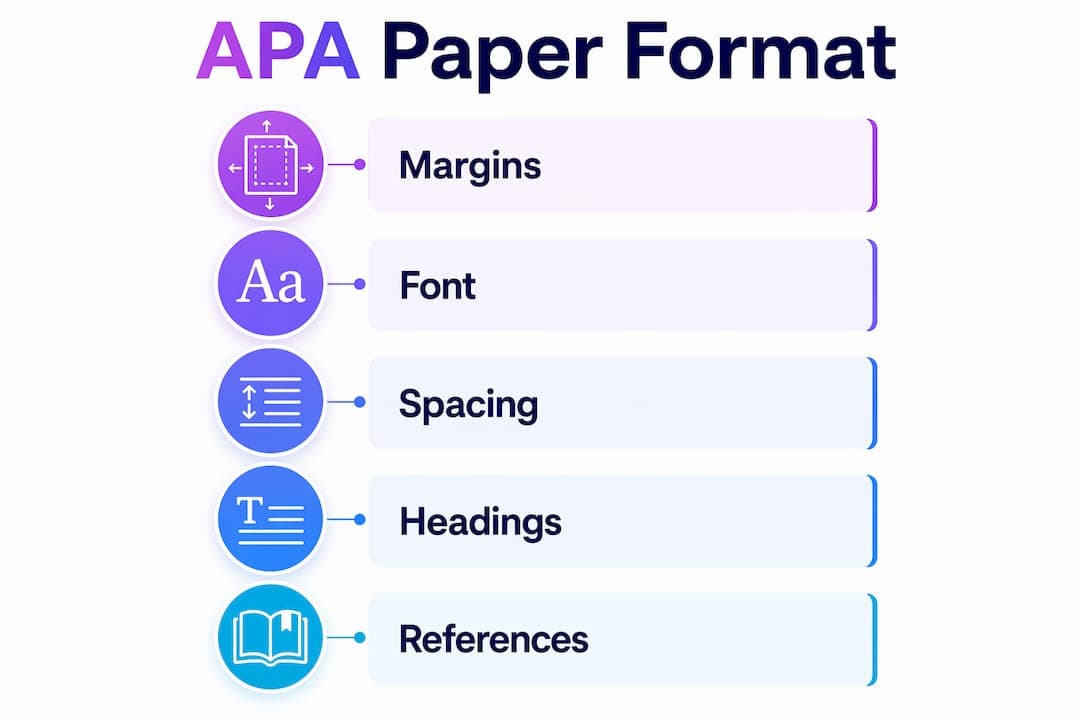
Double spacing applies to every part of the paper: the abstract, body text, block quotations, table and figure notes, and the reference list. No extra spacing before or after paragraphs. That uniformity is the rule, not a suggestion.
One change students often miss: APA 7th dropped the single mandatory font. You can use Calibri 11-pt or Times New Roman 12-pt, as long as you stay consistent throughout the document.
Student and professional papers have different title page requirements, and mixing them up is one of the most common formatting errors.
Student paper title page includes:
Professional paper title page includes:
The running head is a shortened version of the paper title, appearing in the header of every page of a professional manuscript. For student papers, no running head is required unless the instructor specifically asks for one. That distinction trips up a lot of students who learned APA formatting from older guides.
"Student papers typically will not include a running head, author note, or abstract. Professors may request these elements in papers periodically, so follow guidelines requested by the course instructor." — University of Alabama at Birmingham APA 7th Guide
Pro Tip: Set up your header in your word processor before you start writing. In Microsoft Word, double-click the header area, insert a right-aligned page number, and leave the rest blank for a student paper. This takes 30 seconds and saves you from reformatting later.
The author-date citation system is the backbone of every APA citation paper. A brief in-text citation points readers directly to the full entry in your reference list.
Paraphrase: (Thompson, 2021) or Thompson (2021) argues that...
Direct quote: (Harris, 2019, p. 45) — always include the page number for a direct quotation.
Three or more authors: Use only the first author's last name followed by "et al." in every citation, including the first one.
In-text citation rules:
For the reference list itself, follow these rules:
Personal communications such as emails and interviews appear only in-text and are excluded from the reference list, because readers cannot retrieve them. The one exception: oral communications from Indigenous Elders or Knowledge Keepers require both an in-text citation and a full reference list entry.
Seeing a correctly formatted paper is often more useful than reading a list of rules. Several authoritative sources publish annotated sample papers at no cost.
For citation generation, tools like the APA Style website's reference generator and Purdue OWL's citation resources help you build correctly formatted entries. If you want AI-assisted formatting that checks citations against APA guidelines in real time, Samwell offers an APA citation guide built specifically for students.
Pro Tip: Download the official APA student paper template from apastyle.apa.org. It has the margins, fonts, and heading styles pre-set, so you start with a compliant document instead of retrofitting one.
APA 7th edition was designed to reduce formatting complexity for students, shifting the focus toward clear scholarly communication rather than presentation details. The removal of the mandatory running head and the simplified title page are direct results of that philosophy.
The most common student errors are predictable: adding a running head when none is required, forgetting to indent the first line of every paragraph, and using a tab character instead of a proper hanging indent in the reference list. That last one causes the formatting to break when the document is exported or printed.
Word processors handle most of this well when you use the built-in tools. In Google Docs or Microsoft Word, set your hanging indent through Format > Paragraph rather than pressing Tab at the start of each line.
AI-driven platforms like Samwell assist with citation management, APA compliance checks, and plagiarism detection, which reduces the back-and-forth of manual formatting. Samwell's step-by-step APA guide walks through every formatting requirement with examples.
Abstracts are not required for most student papers under APA 7th edition guidelines. When an instructor does require one, the abstract appears on its own page immediately after the title page.
The word "Abstract" is centered and bolded at the top of the page. The abstract itself is a single paragraph with no first-line indent, double-spaced, and of an appropriate length as required. Below the abstract, you may include keywords: indent the first line, write Keywords: in italics, then list your terms separated by commas.
APA uses five levels of headings, and most student papers only need two or three. Each level has a distinct format.
| Level | Format |
|---|---|
| 1 | Centered, bold, title case |
| 2 | Left-aligned, bold, title case |
| 3 | Left-aligned, bold italic, title case |
| 4 | Indented, bold, title case, ends with a period |
| 5 | Indented, bold italic, title case, ends with a period |
Start with Level 1 for your main sections and work down as needed. Do not skip levels. Every heading at the same level should be parallel in grammatical structure.
Tables and figures each have their own numbering sequence. Tables are numbered Table 1, Table 2, and so on; figures follow the same pattern with Figure 1, Figure 2.
For tables: the number appears above the table in bold, followed by the title in italics on the next line. For figures: the number and title both appear below the figure, with the number in bold and the title in italics on the same line. Any data taken from another source requires a note below the table or figure citing that source. Double spacing applies to all table and figure notes.
APA style uses footnotes sparingly. There are two acceptable types: content footnotes, which add information that would interrupt the flow of the main text, and copyright permission footnotes, which acknowledge reproduced material.
Footnotes appear at the bottom of the page where they are referenced, numbered consecutively with superscript Arabic numerals. Endnotes, placed at the end of the document before the reference list, are an acceptable alternative when your instructor or publisher prefers them. APA discourages using footnotes as a substitute for in-text citations.
Getting every margin, indent, and citation format right takes real attention. Samwell is built for exactly this: an AI-powered writing platform that handles APA citation formatting, plagiarism detection, and paper structure so you can focus on the actual argument you're making.
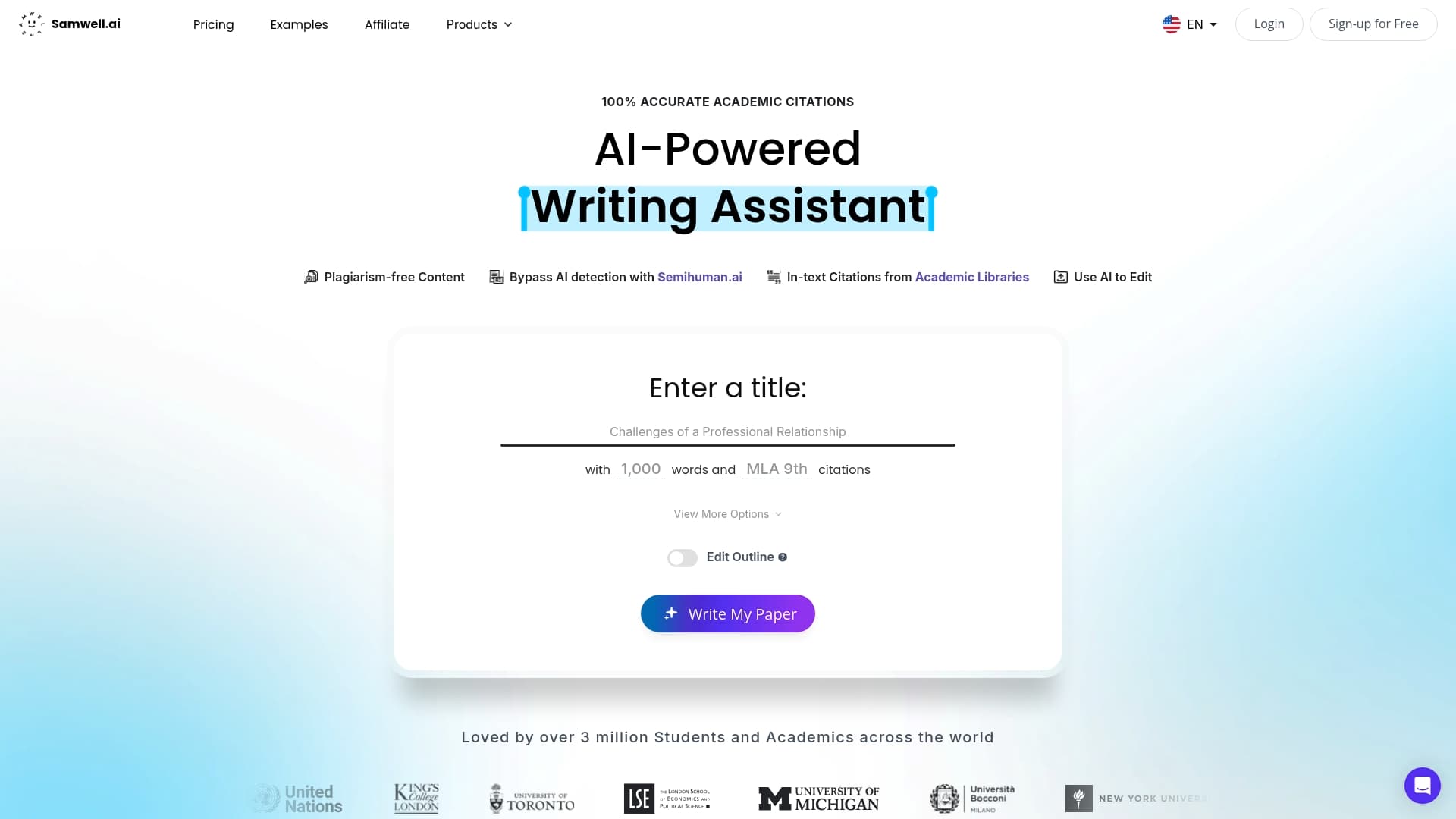
Over 1,000,000 students and academic professionals use Samwell to generate, edit, and format research papers that meet APA 7th edition standards. The platform's Power Editor lets you expand and refine specific sections, while real-time AI detection checks keep your work original. Whether you're building a reference list from scratch or checking that your in-text citations match your sources, Samwell catches the errors that cost you points. Start your paper at samwell.ai and skip the formatting guesswork.
Correct APA formatting requires consistent application of 7th edition rules across every element, from margins and fonts to in-text citations and the reference list.
| Point | Details |
|---|---|
| Core formatting rules | Use 1-inch margins, double spacing throughout, and an approved font like 11-pt Calibri or 12-pt Times New Roman. |
| Running head | Student papers do not require a running head unless the instructor specifically requests one. |
| In-text citations | Use the author-date format; include only the year in-text, even when the reference list entry has a full date. |
| Reference list | Alphabetize entries, use a hanging indent set via paragraph tools, and title the page "References" in bold centered text. |
| Samwell | Samwell assists students with APA citation formatting, plagiarism detection, and paper structure at samwell.ai. |