Loading...

TL;DR:
- APA citation is a two-part system with in-text citations and a References list used in academic writing. It helps readers locate sources and maintains academic integrity, following the 7th edition published in 2020.
APA citation is the standardized method developed by the American Psychological Association to credit sources clearly and consistently in academic writing. The system links two components: in-text citations placed within your text and a References list at the end of your paper. The 7th edition, published in 2020, is the current authoritative standard. APA style dominates social sciences, nursing, business, and select natural sciences, making it one of the most widely required formats in higher education today.
An APA citation is a two-part system. Every source you mention in your text gets a brief in-text citation, and every in-text citation connects to a full entry in your References list. The goal of APA style is clear, consistent academic communication that lets readers locate original sources without confusion. This design also protects academic integrity by making source attribution transparent and verifiable.
APA style has existed since 1929 and has gone through seven editions over more than 90 years. That long history reflects how deeply the format is embedded in academic publishing standards. Understanding the two-part structure from the start saves you from the most common errors students make.
In-text citations in APA style always include the author's last name and the publication year. For direct quotes, you also add a page number or location indicator. These three elements give readers enough information to find the full source in your References list.
APA uses two distinct formats for in-text citations:
Parenthetical and narrative formats serve different purposes in academic writing. Narrative citations improve flow when the author's identity is relevant to your argument. Parenthetical citations keep the focus on the idea rather than the source.
The rules shift depending on how many authors a source has. For 1–2 authors, list all last names every time: (Brown & Smith, 2024). For three or more authors, use only the first author's last name followed by "et al.": (Wilson et al., 2023). This keeps citations readable without sacrificing accuracy.
For indirect citations, where you reference a source quoted inside another source, use "as cited in" followed by the source you actually read. Example: (Jones, 2019, as cited in Brown, 2024). Use indirect citations sparingly. Tracking down the original source is always the better practice.
Pro Tip: When citing a direct quote, include the page number in your in-text citation: (Smith, 2025, p. 45). For sources without page numbers, such as websites, use paragraph numbers or section headings instead.
The References list is the backbone of proper APA formatting. Every source cited in your text must appear here, and every entry here must have a corresponding in-text citation. The References list starts on a new page titled "References" (centered, bold), is double-spaced throughout, and uses a hanging indent for each entry. A hanging indent means the first line is flush with the left margin, and every subsequent line is indented 0.5 inches.
Each reference entry contains four primary elements: author, date, title, and source. The specific formatting of each element varies by source type, but the four-element structure stays constant. Titles of standalone works, such as books and reports, are italicized and written in sentence case. Titles of articles and chapters are not italicized.
Missing information is common, and APA has rules for it. If no author is listed, move the title to the author position. If no date is available, write "(n.d.)" in place of the year. These substitutions keep your reference entries complete and consistent.
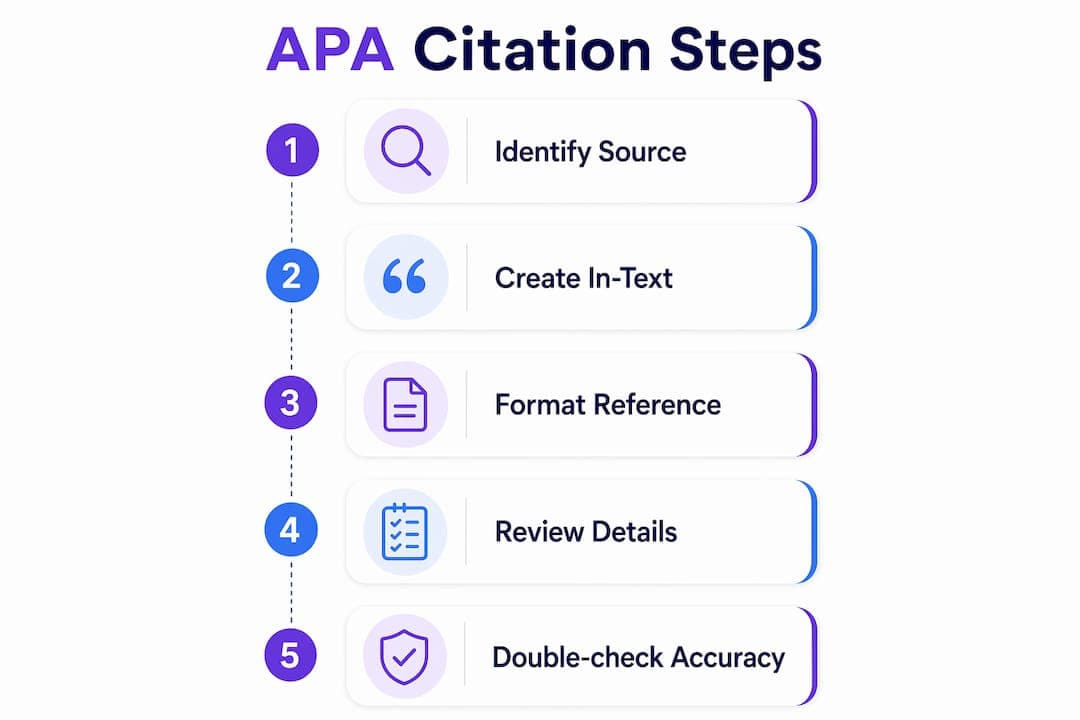
Here is a numbered process for building a clean References list:
Pro Tip: Build your References list as you write, not after. Adding each source the moment you cite it takes 30 seconds and prevents the frantic last-minute scramble before submission.
| Source type | Format example |
|---|---|
| Book | Author, A. A. (Year). Title of work: Capital letter also for subtitle. Publisher. |
| Journal article with DOI | Author, A. A. (Year). Title of article. Journal Name, Volume(Issue), pages. https://doi.org/xxxxx |
| Webpage | Author, A. A. (Year, Month Day). Title of page. Site Name. URL |
| Edited book chapter | Author, A. A. (Year). Title of chapter. In E. Editor (Ed.), Title of book (pp. xx–xx). Publisher. |
Different source types require different metadata, and the APA manual specifies exactly what each entry needs. The four most common types students encounter are books, journal articles, websites, and audiovisual media.
The APA manual organizes citation rules by source type in specific sections, which is why consulting the manual directly matters. Each source type has unique metadata requirements that generic advice cannot fully cover.
Pro Tip: For an APA citation list guide that walks through each source type with worked examples, bookmark a reliable academic library resource and return to it every time you encounter an unfamiliar source type.
Most APA errors fall into a small set of repeatable patterns. Recognizing them before you submit saves you from grade penalties and credibility problems.
Understanding citation generators for students helps you use these tools effectively while knowing exactly where to double-check the output.
Pro Tip: Cross-check every generated citation against APA manual Sections 10.1 and 10.2, which cover the most common source types. This single habit catches the majority of formatting errors before your instructor does.
Correct APA citation requires mastering two linked components: precise in-text citations and a fully formatted References list built on the APA 7th edition standard.
| Point | Details |
|---|---|
| Two-part structure | Every in-text citation must connect to a matching entry in the References list. |
| Author-date format | In-text citations always include the author's last name and publication year at minimum. |
| References list rules | Start on a new page, alphabetize by surname, double-space, and apply 0.5-inch hanging indents. |
| DOI as URL | Format every DOI as https://doi.org/... and never invent one if it does not exist. |
| Verify generator output | Citation tools produce errors; always check against the APA 7th edition manual before submitting. |
Students typically learn APA by memorizing formats before they understand the logic behind them. That approach creates fragile knowledge. The moment you encounter an unfamiliar source type, the memorized template breaks down and you are stuck guessing.
The more useful mental model is this: APA citation exists to help a reader find your source. Every element in a reference entry serves that function. The author tells you who wrote it. The date tells you when. The title tells you what it is. The source tells you where to find it. Once you internalize that logic, formatting decisions become easier because you are asking "what does my reader need?" rather than "what does the template say?"
I have also noticed that students who build their References list as they write, rather than at the end, make significantly fewer errors. The source is fresh in your mind when you cite it. You have the tab open. You can verify the DOI, the exact spelling of the author's name, and the volume number in 60 seconds. Doing that same verification three days later, across 15 sources, is where mistakes accumulate.
The other underrated habit is reading your in-text citations aloud. Narrative citations especially can sound awkward when overused. If every other sentence starts with "Smith (2025) stated," your writing loses momentum. Varying between parenthetical and narrative formats is not just a stylistic preference. It is a sign of a writer who understands the material well enough to control how sources appear in the argument.
— Tilen
Academic writing is demanding enough without spending hours second-guessing citation formats. Samwell helps students and researchers produce properly formatted papers with APA citations built in from the start.
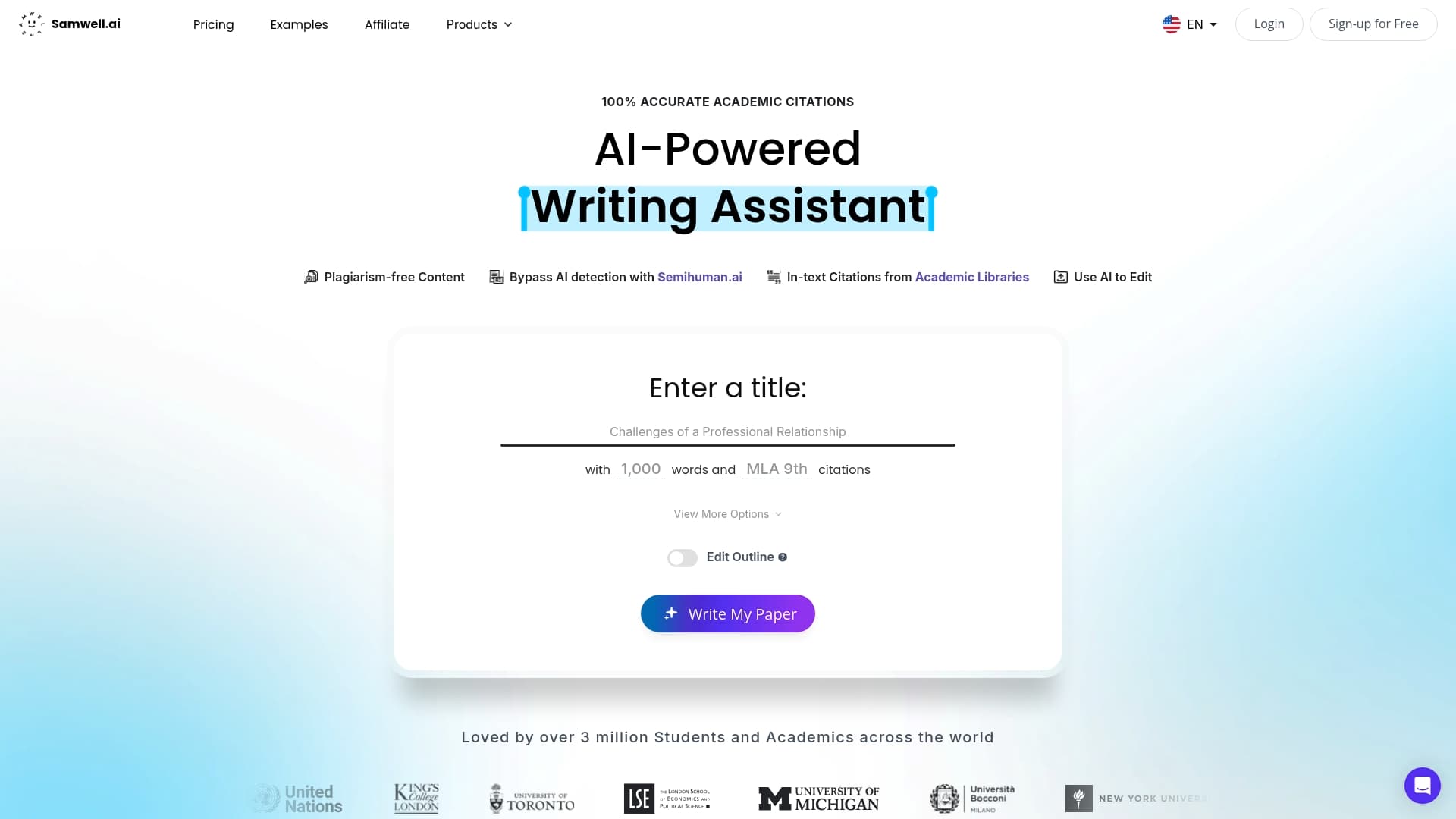
Samwell's platform supports APA 7th edition formatting across in-text citations and References lists, reducing the manual checking that trips up most students. The Power Editor feature lets you expand and refine specific sections of your paper while keeping citation formatting consistent throughout. Over 1,000,000 students and academic professionals already use Samwell to write with greater accuracy and confidence. If APA formatting is slowing you down, Samwell gives you a faster path to a correctly formatted, academically sound paper.
An APA in-text citation includes the author's last name and the publication year in parentheses: (Smith, 2025). Direct quotes also require a page number: (Smith, 2025, p. 45).
The References list starts on a new page titled "References," is double-spaced, alphabetized by author surname, and uses a 0.5-inch hanging indent for each entry.
A parenthetical citation places the author and year in parentheses at the end of a sentence. A narrative citation names the author in the sentence itself, with only the year in parentheses.
Move the title to the author position when no author is listed. Use "(n.d.)" in place of the year when no publication date is available.
Citation generators are useful starting points but frequently contain errors. Always verify generated citations against the APA 7th edition manual, particularly Sections 10.1 and 10.2, before submitting your work.