Loading...

TL;DR:
- AI writing helpers assist in drafting, editing, and refining texts through machine learning. They support structured workflows by generating drafts, improving tone, and verifying facts, enhancing productivity for academic and professional writing. Using these tools ethically involves transparent attribution, multi-pass editing, and manual revisions to preserve voice and credibility.
An AI writing helper is writing assistant software that drafts, edits, and refines text using machine learning, covering everything from grammar correction to full-document generation. Tools like Grammarly AI Writer, QuillBot, and Copy.ai represent the current standard for AI-powered writing assistants, each targeting a different slice of the writing process. The industry term for this category is "intelligent writing assistant," though "AI writing helper" captures how most students and creators actually search for these tools. Whether you need to draft a research paper at midnight or polish a professional email before a deadline, the right automated writing tool changes what you can accomplish in a single session.
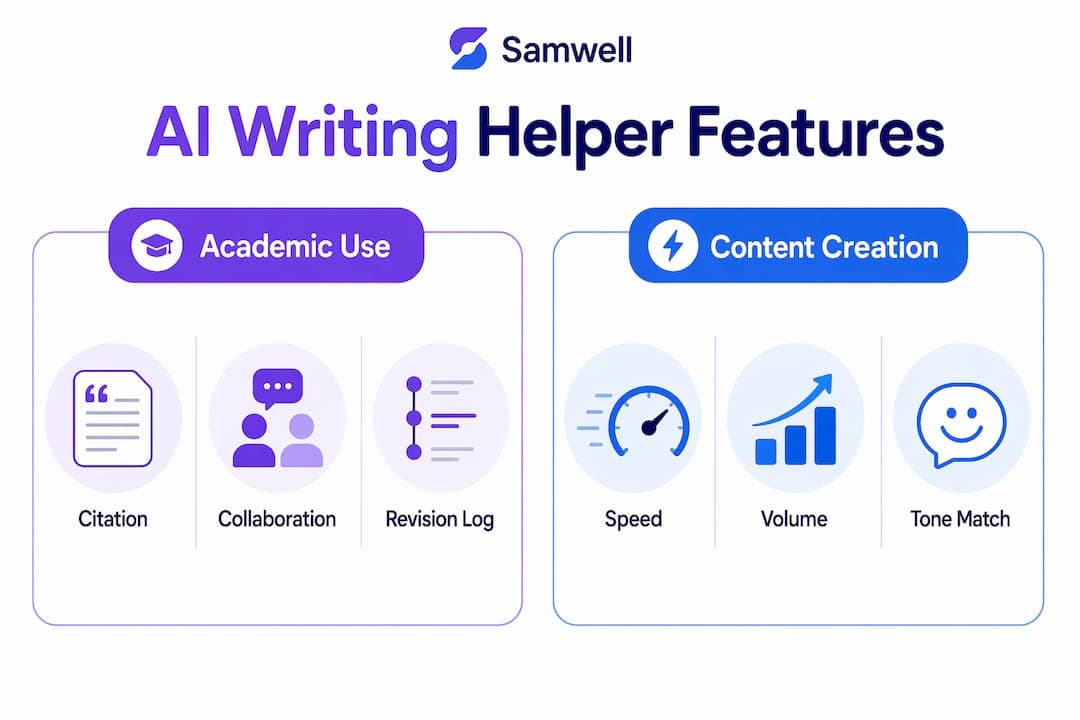
The most useful AI writing helpers do more than fix typos. They generate full drafts from a prompt, adjust tone for different audiences, and expand thin outlines into structured arguments. Grammarly AI Writer can produce a well-structured draft from a single prompt in seconds, then sharpen sentences and fix grammar automatically. That combination of generation and editing in one tool is what separates modern AI text generators from basic spell-checkers.
When evaluating any writing assistant software, look for these core capabilities:
Pro Tip: Test any AI writing tool on a real piece of your own writing before committing to a paid plan. Generic demos always look good. Your actual use case is the real benchmark.
Real-time collaboration features matter more than most buyers expect. If you share documents with professors, editors, or co-authors, a tool that works inside Google Docs or Microsoft Word saves significant time compared to copying text in and out of a separate app.
The most effective way to use an AI writing helper is not to hand it your entire assignment. The best results come from a structured, multi-pass process that keeps you in control of the argument and the evidence. Here is a three-pass workflow that reduces quality issues and keeps your writing credible:
This approach works equally well for student essays, research proposals, professional reports, and long-form content. The key is treating the AI as a drafting partner, not a ghostwriter.
Pro Tip: Keep a lightweight revision log: a simple text file noting which sections you drafted manually, which the AI generated, and what you changed. This protects you if your institution asks about your process.

Grammarly AI Chat is free with a Grammarly Free account and supports brainstorming, outlining, drafting, and revising inside a single document environment. The value is not just the features. It is that you never leave the document to get help, which means fewer interruptions and a cleaner thinking process. For academic professionals managing multiple projects, that reduction in context-switching adds up fast.
Maintaining a provenance trail matters beyond just ethics. Research notes, original outlines, and revision logs give you a defensible record of your process. Institutions are updating their AI policies quickly in 2026, and a clear revision trail is your best protection against misconduct accusations.
Ethical use of AI writing tools is not a simple yes-or-no question. A 2026 Springer Nature study of 415 participants found that moral judgments about AI-assisted writing vary sharply by scenario. Direct copying of AI-generated text is broadly condemned. Collaborative writing with AI is moderately accepted. Minimal tool use for grammar and clarity sits in an ethically ambiguous middle ground. That spectrum matters because it means context determines acceptability, not a single blanket rule.
Key distinctions every writer should understand:
"Ethical use of AI writing tools depends on the degree of human involvement and the specific scenario, not on a single universal standard." — Chatbot or cheatbot? Moral judgments of AI usage in academic writing
Institutional policies are evolving fast. The safest approach is to check your institution's current guidelines before submitting any AI-assisted work. For a deeper look at how these norms are shifting, the AI writing trends in academia piece from Samwell covers the 2025 and 2026 policy landscape in detail.
Choosing the best AI writing tools depends on your primary use case. Here is a direct comparison of four widely used platforms:
| Tool | Best For | Key Strength | Academic Features | Free Tier |
|---|---|---|---|---|
| Grammarly AI Writer | Professional and academic editing | Grammar, tone, full-draft generation | Yes, with citation suggestions | Yes |
| QuillBot | Paraphrasing and summarizing | Paraphrase modes, summarizer | Yes, plagiarism checker add-on | Yes |
| Copy.ai | Marketing and content creation | Template library, bulk content | Limited | Yes |
| Jasper | Long-form content creation | Brand voice, team collaboration | Limited | No (trial only) |
Grammarly AI Writer and QuillBot are the strongest options for students and academic professionals. Grammarly handles end-to-end writing from draft to polish. QuillBot excels when you need to restate source material in your own words without losing meaning.
Copy.ai and Jasper serve content creators better than academics. Both tools prioritize speed and volume over citation accuracy or argument structure. If you write blog posts, social media copy, or marketing materials, either tool delivers fast results. For a research paper, they fall short.
Mobile availability is a real differentiator. Grammarly has a strong iOS and Android app. QuillBot's mobile experience is more limited. If you write primarily on a phone or tablet, test the mobile version before choosing a tool.
Getting strong results from any AI writing helper requires discipline on your end. The tool handles execution. You handle strategy.
Pro Tip: When the AI output sounds generic, paste in a paragraph you wrote yourself and ask the tool to match that tone. Most AI writing helpers can mirror your style when given a clear example.
For students specifically, Samwell's tips for leveraging AI covers how to integrate these practices into coursework without crossing academic integrity lines.
The most effective use of an AI writing helper combines structured multi-pass editing, transparent attribution, and manual rewriting to preserve voice and credibility.
| Point | Details |
|---|---|
| Define your use case first | Academic writing needs different tools than content creation; match the tool to the task. |
| Use a three-pass editing workflow | Structure, style, and verification passes produce cleaner, more credible final drafts. |
| Understand plagiarism vs. AI detection | Low plagiarism scores do not confirm human authorship; run both checks separately. |
| Keep a revision log | Documenting your process protects you under evolving institutional AI policies. |
| Rewrite key passages manually | Partial manual rewriting preserves your voice and prevents generic-sounding output. |
Most writers I see treat AI writing helpers as a first draft machine. They prompt the tool, get 500 words, lightly edit, and submit. The result is technically correct and completely forgettable. The writing has no argument, no personality, and no evidence of actual thinking.
The writers who get real value from these tools use them at the end of their process, not the beginning. They write a rough draft first, then use the AI to sharpen sentences, catch logical gaps, and test whether their argument holds up under scrutiny. That order matters. When you write first, the AI improves your thinking. When the AI writes first, it replaces your thinking.
The ethical dimension reinforces this. The role of AI in academic writing is strongest when it supports human judgment, not when it substitutes for it. I have seen students lose marks not because they used AI, but because the AI-generated sections were obviously disconnected from the rest of their argument. The tell is always the same: the AI paragraphs are smooth and the student paragraphs are rough, and they do not sound like the same person wrote them.
Use the tool to get better at writing. Do not use it to avoid writing.
— Tilen
Samwell is built specifically for students and academic professionals who need AI writing help that respects citation standards and academic integrity. The platform's Power Editor lets you target specific sections for expansion or revision, while Guided Essays generate structured outlines from your topic and sources.
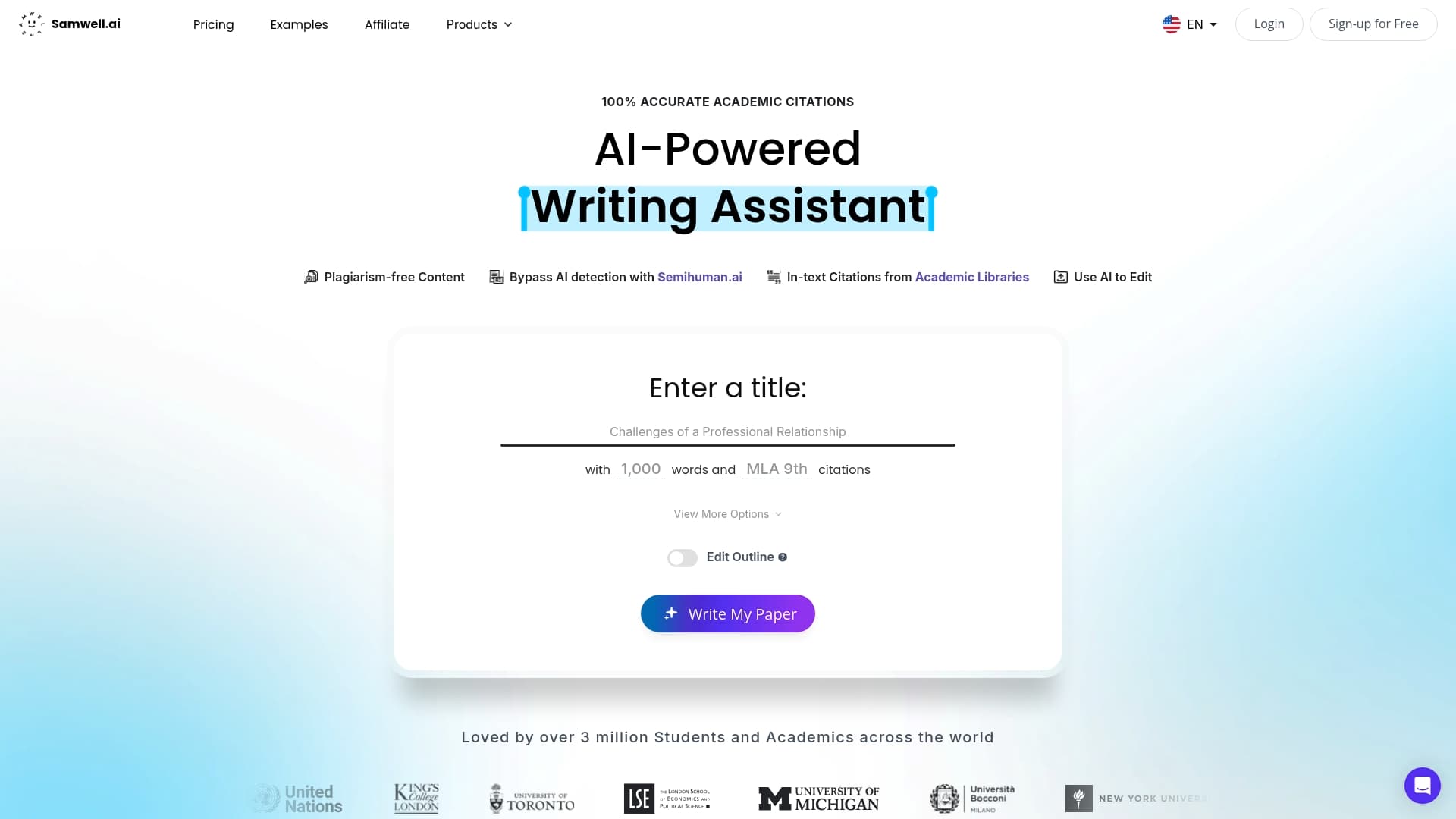
Samwell uses Semihuman.ai technology to minimize AI detection flags and supports MLA, APA, and other major citation formats out of the box. Over 1,000,000 students from leading universities use it to produce credible, original work faster. If you want an AI writing platform built for academic quality rather than marketing copy, Samwell is the place to start.
An AI writing helper is software that uses machine learning to assist with drafting, editing, and refining text. Common functions include grammar correction, tone adjustment, full-draft generation, and idea brainstorming.
It depends on the use case and your institution's policy. A 2026 Springer Nature study found that direct copying of AI text is broadly condemned, while using AI for grammar and clarity sits in an ethically ambiguous zone. Always check your institution's current guidelines.
AI writing tools and plagiarism checkers measure different things. A low plagiarism score does not confirm human authorship. Tools like Turnitin provide separate similarity and AI writing scores for this reason.
Grammarly AI Writer and QuillBot are the strongest options for academic use. Grammarly handles full-draft generation and editing, while QuillBot excels at paraphrasing source material accurately.
Manually rewrite key passages rather than accepting full AI regeneration. Giving the tool a sample of your own writing and asking it to match your tone also produces more authentic results.